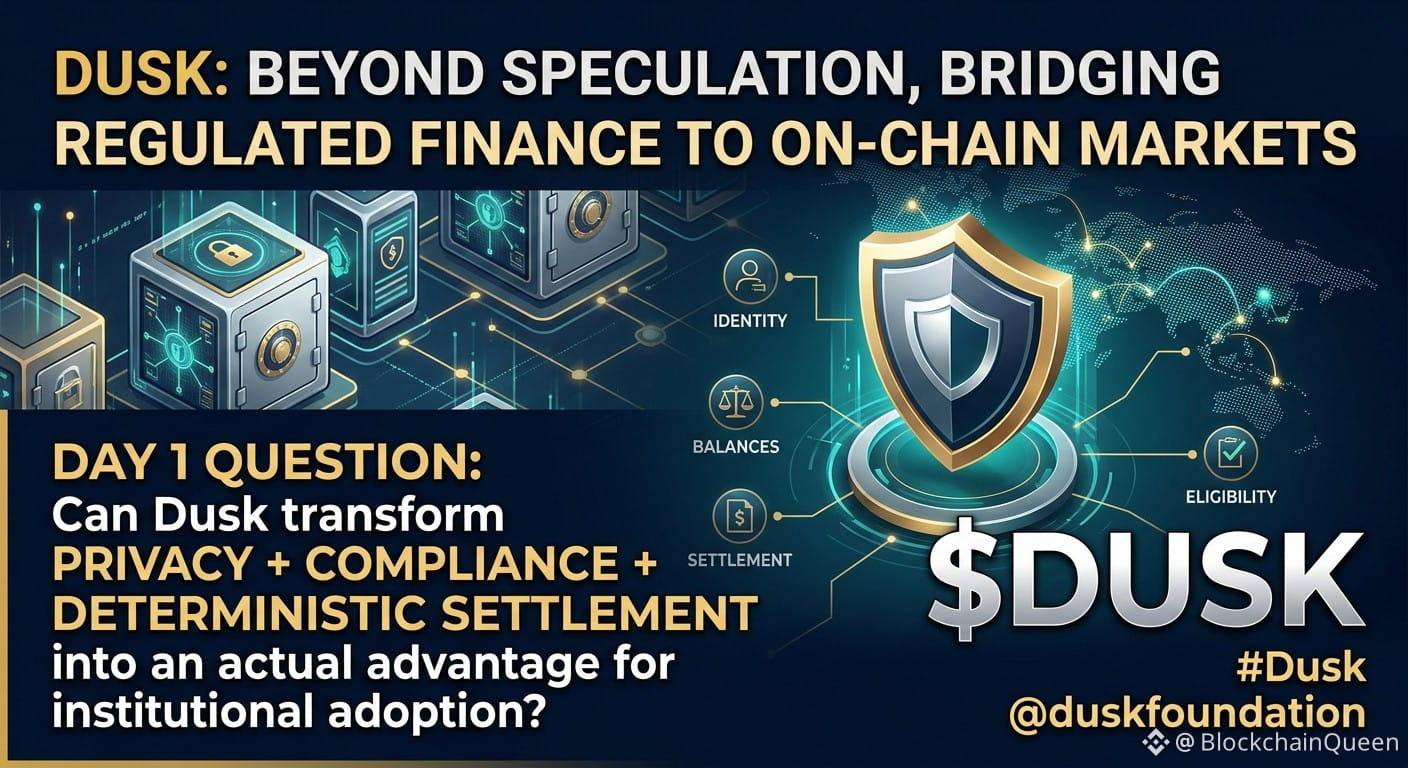
I've been looking at @Dusk from a slightly different angle: not as another blockchain trying to attract crypto users, but as infrastructure trying to solve a problem that becomes much harder when traditional finance moves on-chain.
The problem is simple to describe but difficult to engineer.
Financial markets need transparency, but institutions also deal with information that shouldn't be visible to everyone. Investor identities, balances, transaction details, eligibility and business activity can all be sensitive. A completely public ledger can make verification easy, but it can also expose information that financial institutions would rather keep controlled.
This is where Dusk becomes interesting.
The network is designed around regulated digital assets, with privacy, access control and settlement built into the architecture rather than treated as optional features added later. The important distinction is that privacy doesn't necessarily mean hiding everything. The more useful model for regulated markets is selective visibility: sensitive information stays protected while authorized participants can still verify what they are allowed to verify.
That changes the conversation around blockchain adoption.
Instead of asking, "How do we convince institutions to use a completely transparent blockchain?" the better question might be, "How do we build blockchain infrastructure that fits the way regulated financial markets already operate?"
That's a much harder problem.
And it also explains why I'm paying attention to the broader Dusk architecture. DuskDS provides the underlying settlement infrastructure, while Dusk's execution and identity components are designed to support applications involving regulated assets.
For $DUSK , I think the interesting question isn't simply whether the token can attract speculation.
It's whether actual network activity can eventually create meaningful utility around the ecosystem.
@Dusk
$DUSK #dusk
The problem is simple to describe but difficult to engineer.
Financial markets need transparency, but institutions also deal with information that shouldn't be visible to everyone. Investor identities, balances, transaction details, eligibility and business activity can all be sensitive. A completely public ledger can make verification easy, but it can also expose information that financial institutions would rather keep controlled.
This is where Dusk becomes interesting.
The network is designed around regulated digital assets, with privacy, access control and settlement built into the architecture rather than treated as optional features added later. The important distinction is that privacy doesn't necessarily mean hiding everything. The more useful model for regulated markets is selective visibility: sensitive information stays protected while authorized participants can still verify what they are allowed to verify.
That changes the conversation around blockchain adoption.
Instead of asking, "How do we convince institutions to use a completely transparent blockchain?" the better question might be, "How do we build blockchain infrastructure that fits the way regulated financial markets already operate?"
That's a much harder problem.
And it also explains why I'm paying attention to the broader Dusk architecture. DuskDS provides the underlying settlement infrastructure, while Dusk's execution and identity components are designed to support applications involving regulated assets.
For $DUSK , I think the interesting question isn't simply whether the token can attract speculation.
It's whether actual network activity can eventually create meaningful utility around the ecosystem.
@Dusk
$DUSK #dusk