#bstockscis
#bStocksCIS
@BinanceCIS
💧 Why can a good asset still be inconvenient to buy or sell?
Earlier, I perceived liquidity very simply:
“ If an asset can be bought, then everything is fine with liquidity.”
In reality, it’s not the same thing.
Imagine you want to buy bStock.
There’s a seller who is ready to sell it for $100.
But the next seller wants $101, and the next one — $103.
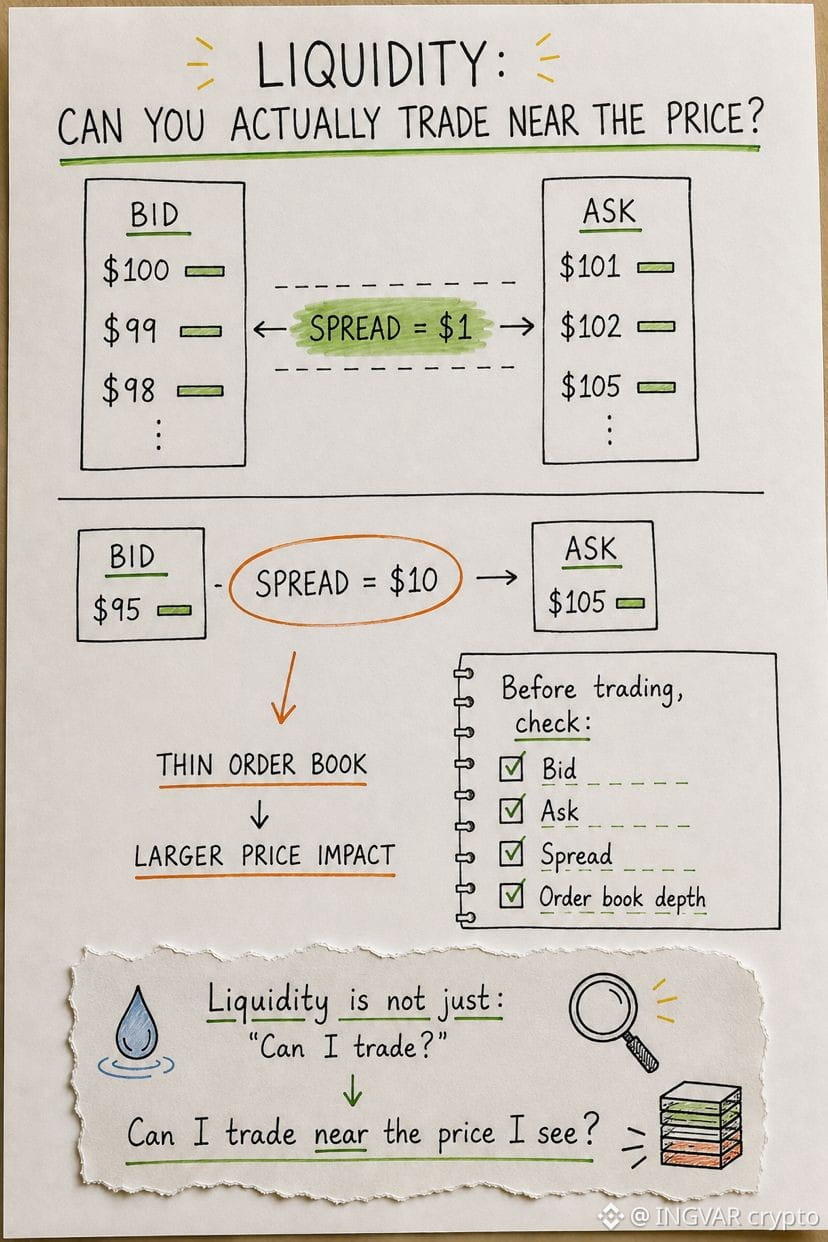
It seems like you can buy the asset, but your actual price will depend on **how many orders are available near the current price**.
That’s where the concept of liquidity comes in.
📌 High liquidity usually means there are enough buyers and sellers willing to trade close to the current price.
📌 Low liquidity can mean a larger gap between the best bid and the ask prices, and a stronger impact of the deal itself on the price.
This gap is called **spread**.
For example:
Bid: $100
Ask: $101
Spread = $1.
And if:
Bid: $95
Ask: $105
Spread is already $10.
The same price on a chart doesn’t tell us how easy it is to actually buy or sell an asset at a price close to that number.