

#Binance Binance is the world's largest digital asset trading platform, with more than 100 million users and hundreds of billions of transactions. However, such scale and influence have also brought a lot of trouble to Binance, especially pressure and challenges from US regulators.
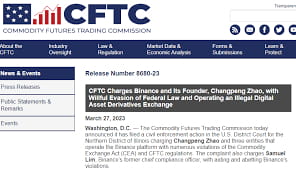
Recently, the U.S. Commodity Futures Trading Commission (CFTC) filed a lawsuit against Binance and its CEO Changpeng Zhao, accusing them of violating U.S. commodity regulations, deliberately evading regulation, providing illegal digital asset derivatives transactions to U.S. investors, and engaging in illegal financial activities such as market manipulation and money laundering. This is the second lawsuit filed by the CFTC against Binance. Previously in March 2020, the CFTC accused Binance of allowing U.S. investors to use its platform for leveraged trading.
These lawsuits are undoubtedly a huge blow to Binance, which may affect its business and reputation in the United States and around the world. If the CFTC wins the case, Binance may face high fines and compensation, or even be banned from working with US investors. In addition, the CFTC's lawsuit may also attract the attention and follow-up of regulators in other countries or regions, bringing more legal risks and compliance costs to Binance.
Faced with such a crisis, Binance did not choose to remain silent or retreat, but actively responded and refuted.
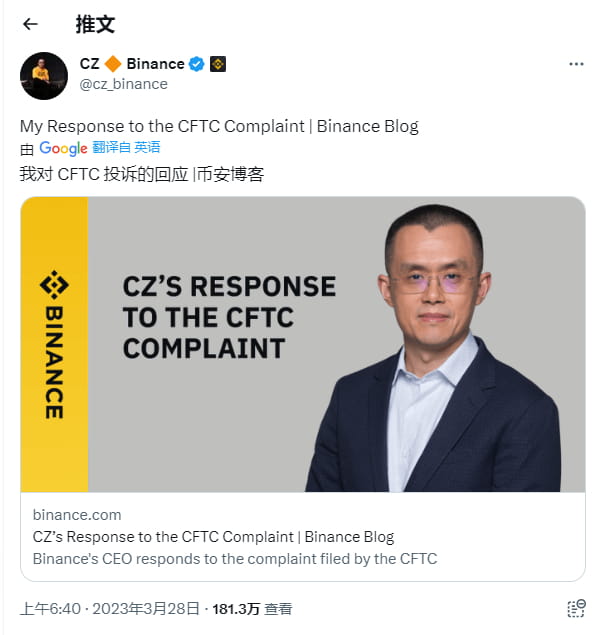
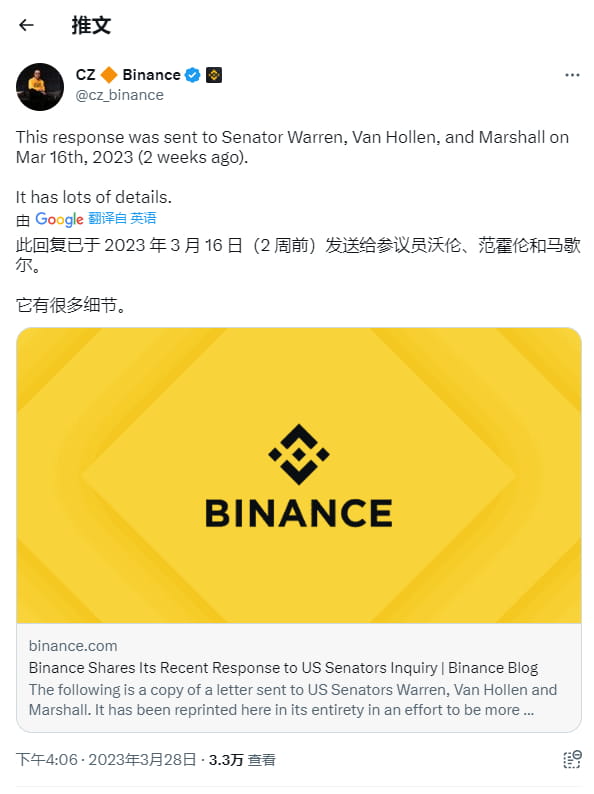
Binance has published several articles on its official blog, responding to inquiries from the CFTC and US senators about its compliance and financial situation. In the article, Binance stated that it is a "legal, transparent and responsible" enterprise that abides by the laws and regulations of various countries, maintains communication and cooperation with global regulators, and has taken various measures to prevent illegal financial activities. The article also emphasized the difference between Binance and its US partner Binance.US, saying that the two are independently operated platforms with different management teams, customer bases and business models. The article concluded that Binance welcomes the attention and suggestions of regulators and senators, is willing to continue to maintain dialogue with them, and protect Binance's users and partners. From these responses, it can be seen that Binance does not want to confront or conflict with US regulators, but wants to seek a balance and compromise. Binance is trying to win the trust and support of regulators and the public by demonstrating its compliance awareness, community values and future vision. At the same time, Binance is also trying to reduce its legal responsibilities and risks in the US market by distinguishing its relationship with Binance.US. However, can these responses alleviate Binance's crisis situation? The answers to these questions are not easy to give, because they involve the positions, motivations and strategies of US regulators, as well as Binance’s true situation, goals and capabilities. However, we can analyze and discuss them from the following aspects.
First, the US regulators' lawsuit against Binance may be due to the need for regulation of the digital asset market and the competitive threat to Binance. The United States is the world's largest financial market and the most strictly regulated market. US regulators have the responsibility to protect the interests of American investors, prevent financial fraud and crime, and maintain financial stability and order. Therefore, they have regulatory powers and obligations over any entity that provides financial services in the United States or affects the US financial market.
As the world's largest digital asset trading platform, Binance will have a significant impact on the U.S. digital asset market, whether it is directly targeting U.S. investors or not. Therefore, U.S. regulators have reason to review and investigate Binance to ensure that it complies with U.S. laws and regulations. At the same time, the U.S. regulator's lawsuit against Binance may also be due to competitive threats to Binance.
Binance is an innovative and disruptive enterprise that provides a wide variety of digital asset transactions and services, including spot, futures, options, leverage, lending, mining, etc. These transactions and services not only cover the functions of the traditional financial field, but also create new financial models and value. These transactions and services have attracted a large number of users and funds, making Binance a leader and trendsetter in the digital asset field. However, these transactions and services may also threaten local digital asset trading platforms and service providers in the United States, such as Coinbase, Kraken, Gemini, etc. These platforms and service providers are restricted and constrained by US laws and regulations and cannot compete with Binance. Therefore, US regulators have the motivation to suppress and sanction Binance in order to protect the local digital asset industry and interests in the United States.
Secondly, Binance's response to US regulators may be due to the consideration of balancing compliance requirements and market demand. As a global enterprise, Binance faces different laws, regulations and regulatory requirements in different countries or regions. Binance needs to find a balance between complying with local laws and regulations and meeting local market needs. If Binance completely obeys the laws and regulations of a certain region, it may damage its business and reputation in other regions. If Binance completely ignores the laws and regulations of a certain region, it may suffer bans and penalties from that region. Therefore, Binance needs to seek partners, establish branches, set up compliance teams, and other ways to adapt to different regulatory environments. At the same time, Binance's response to US regulators may also be due to its emphasis on and planning for its own image and future development.
As a young and dynamic enterprise, Binance has its own vision and mission, which is to "make free financial services ubiquitous". Binance hopes to meet the different needs of different users by providing diversified and innovative digital asset transactions and services, so that more people can participate in and enjoy the convenience and value brought by digital assets. In order to achieve this vision, Binance needs to establish a good and positive brand image and win the trust and support of users, partners and regulators. Therefore, when facing the lawsuit from US regulators, Binance must not only show compliance awareness and social responsibility, but also show innovative spirit and community value. In summary, Binance's lawsuit against US regulators is a complex and multi-dimensional issue involving law, finance, market, technology, society and other aspects. How Binance responds to this crisis may affect its business and development in the United States and around the world. Binance needs to find a balance between complying with laws and regulations and protecting its own interests, between responding to regulators and maintaining users, and between maintaining innovation and taking risks.
Whether Binance can successfully do this remains to be proven by time and results. But the idea I agree with and uphold is: no matter what happens in the market, there will always be someone waiting for you on the other side. Are you you or your counterparty?