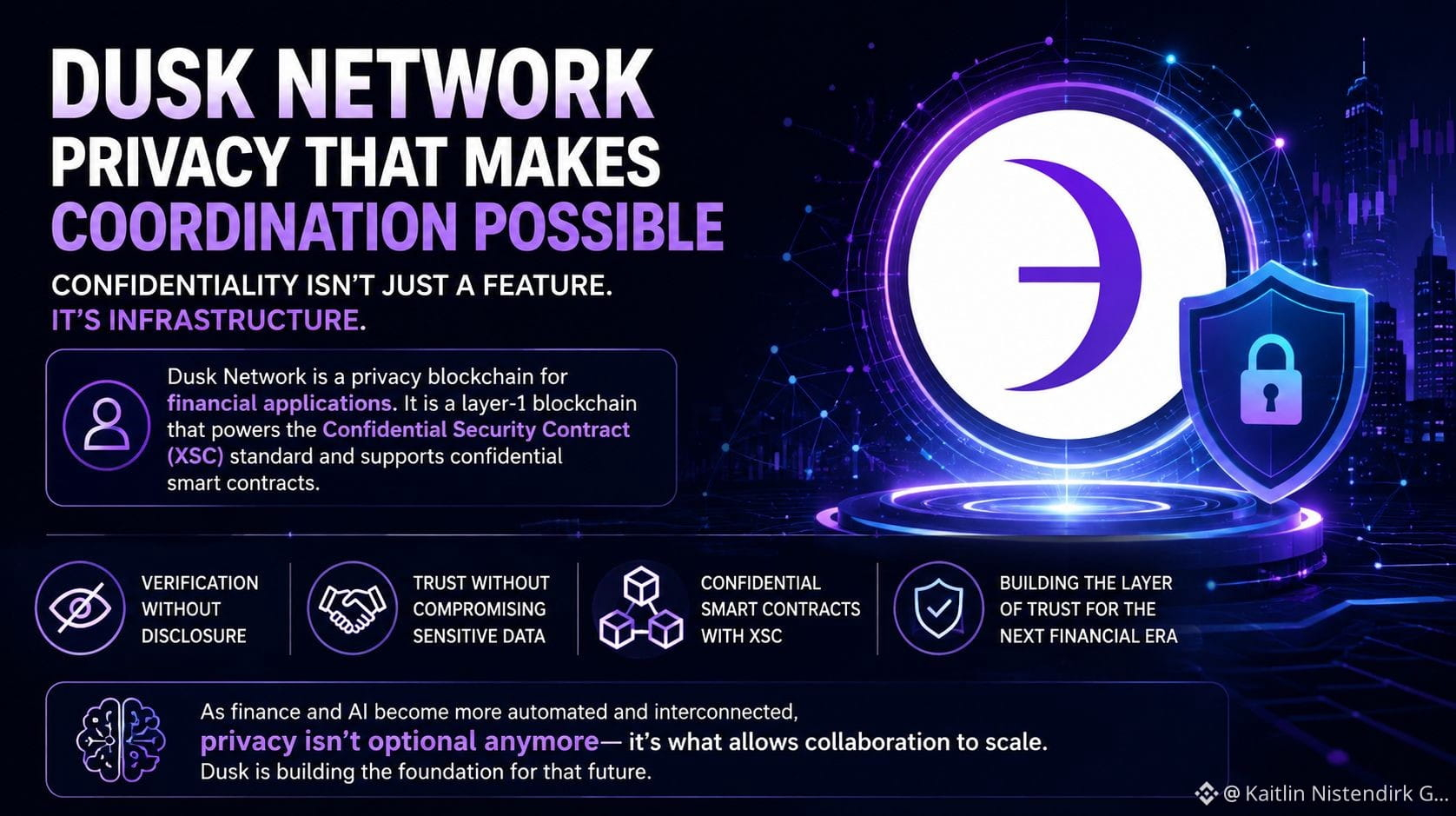
I've been watching Dusk from a different angle: privacy isn't valuable simply because information stays hidden. Its deeper value is that it can make people willing to coordinate where transparency would otherwise become a barrier.
Financial infrastructure has always lived with this contradiction. Participants need verification, shared trust, and open coordination, but they also need to protect sensitive business information. Dusk makes me think about what happens when those two needs no longer have to compete.
What interests me most is the possibility that privacy becomes invisible infrastructure. Not something users constantly talk about, but something that quietly removes the reasons they previously avoided certain on-chain activity.
As AI and automated finance become more connected, this question becomes even more important. More data and faster decisions don't necessarily mean everything should be public.
I'm watching to see whether Dusk can turn confidentiality from a feature people admire into infrastructure people simply depend on. That, to me, is where lasting adoption begins.
@Dusk $DUSK #dusk
Financial infrastructure has always lived with this contradiction. Participants need verification, shared trust, and open coordination, but they also need to protect sensitive business information. Dusk makes me think about what happens when those two needs no longer have to compete.
What interests me most is the possibility that privacy becomes invisible infrastructure. Not something users constantly talk about, but something that quietly removes the reasons they previously avoided certain on-chain activity.
As AI and automated finance become more connected, this question becomes even more important. More data and faster decisions don't necessarily mean everything should be public.
I'm watching to see whether Dusk can turn confidentiality from a feature people admire into infrastructure people simply depend on. That, to me, is where lasting adoption begins.
@Dusk $DUSK #dusk