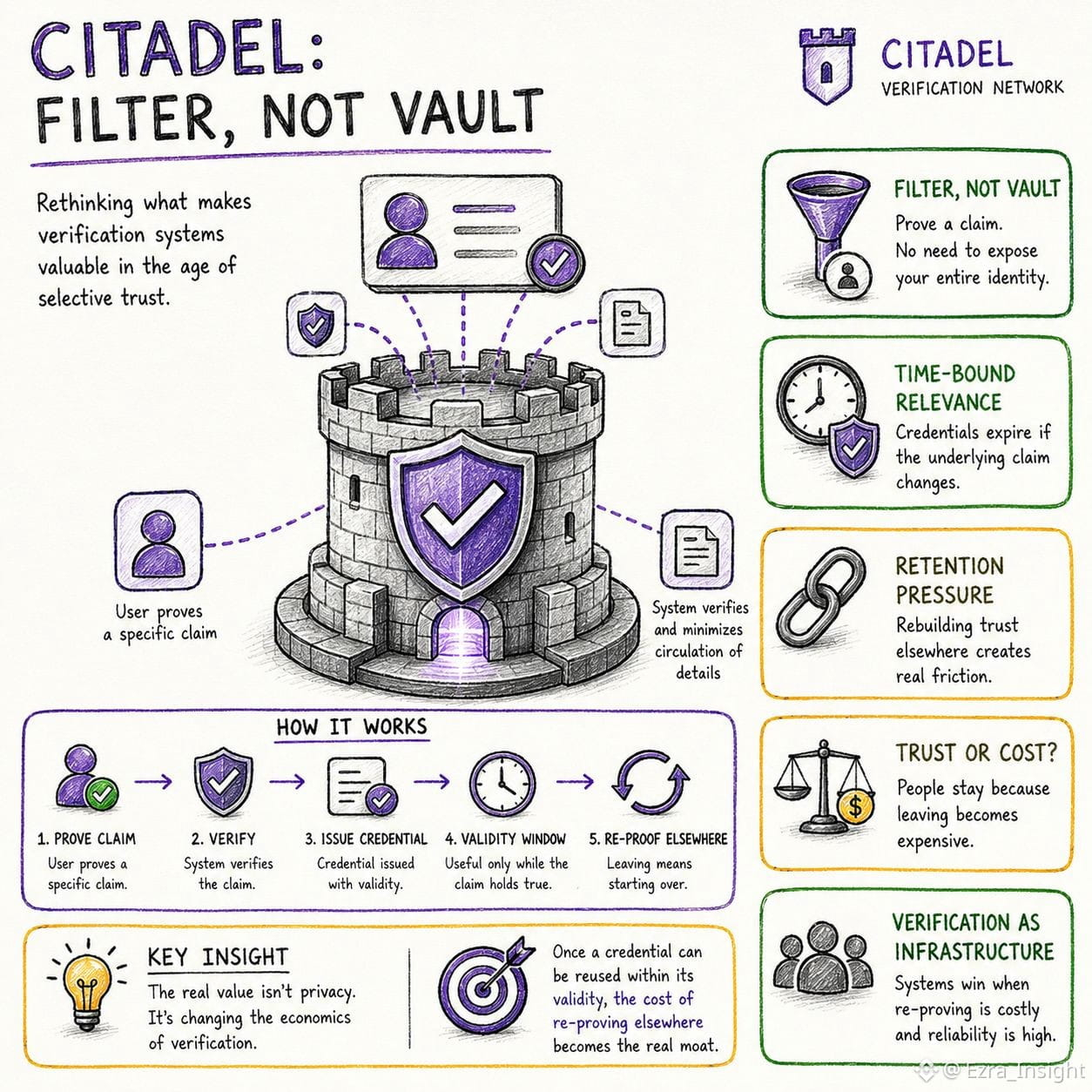
I kept thinking about what actually makes a verification system valuable. At first, Citadel looked like another identity layer bolted onto a chain, another compliance box wrapped in infrastructure. But the more I looked at how credentials move through it, the more it felt like something else: a filter, not a vault.
You don’t need to expose your entire identity. You prove a specific claim, the system verifies it, and the underlying details don’t need to keep circulating. The burden quietly shifts from disclosure to attestation. Then there’s the part I find more interesting: time. A credential verified today doesn’t automatically remain useful tomorrow. If the underlying claim changes, the proof loses its relevance. So maybe Citadel’s real value isn’t simply that it protects privacy. It changes the economics of verification. Once a credential can be reused while staying bounded by its validity, leaving means rebuilding that trust somewhere else. And that makes me wonder when verification becomes infrastructure, do people stay because they trust the system or because starting over becomes too expensive?
@Dusk $DUSK #dusk
You don’t need to expose your entire identity. You prove a specific claim, the system verifies it, and the underlying details don’t need to keep circulating. The burden quietly shifts from disclosure to attestation. Then there’s the part I find more interesting: time. A credential verified today doesn’t automatically remain useful tomorrow. If the underlying claim changes, the proof loses its relevance. So maybe Citadel’s real value isn’t simply that it protects privacy. It changes the economics of verification. Once a credential can be reused while staying bounded by its validity, leaving means rebuilding that trust somewhere else. And that makes me wonder when verification becomes infrastructure, do people stay because they trust the system or because starting over becomes too expensive?
@Dusk $DUSK #dusk