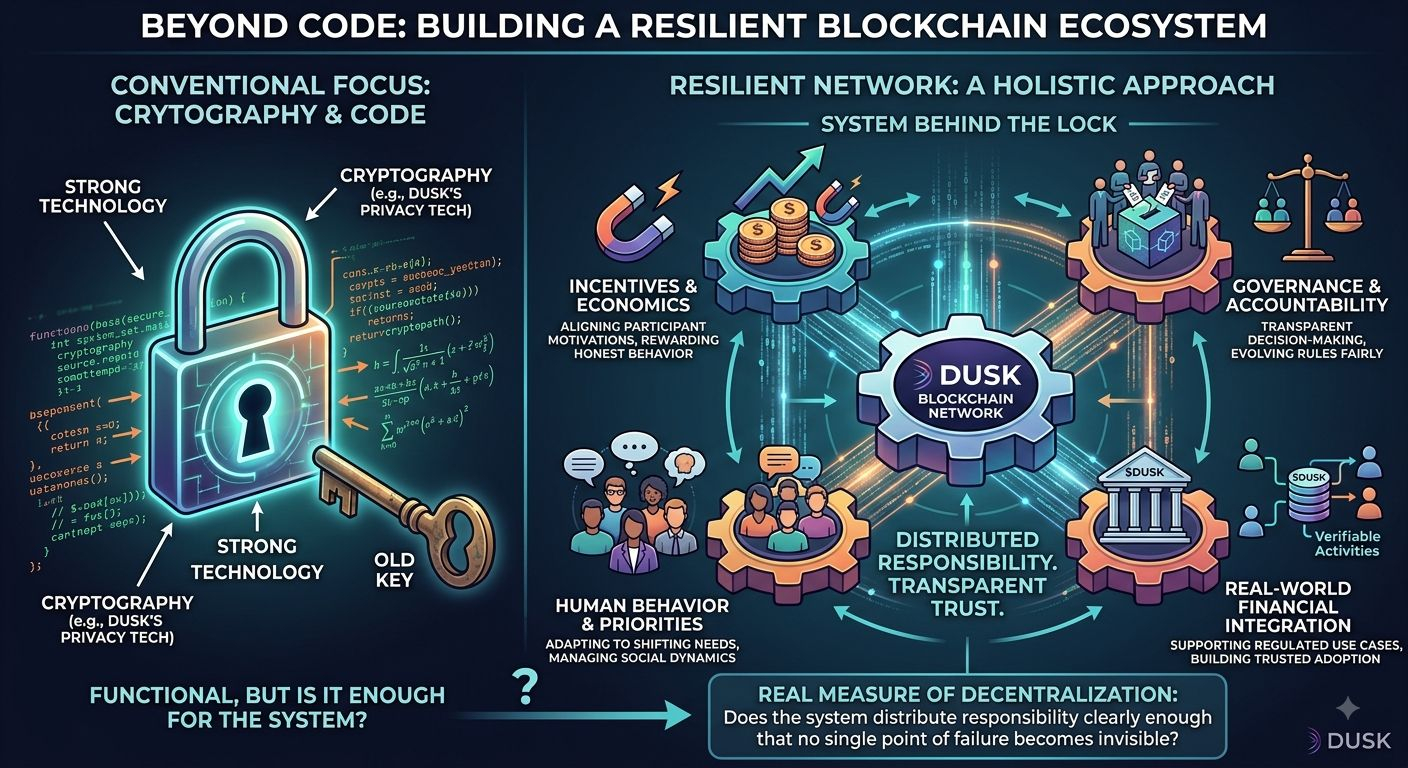
I keep thinking about an old key sitting in a drawer. It may look simple and worn, but its real value comes from the lock, the door, and the trust behind the whole system.
That same idea makes me think about Dusk. In crypto, security is often discussed through cryptography and code, but strong technology alone does not automatically create a strong network. The harder questions are about incentives, governance, accountability, and how people behave as a system grows.
Dusk is interesting to me because its infrastructure focuses on privacy while still considering the need for reliable and verifiable financial activity. DUSK and dusk fit into a br
oader conversation about how blockchain networks can support real-world financial use without simply asking users to trust a central authority.
I keep wondering: what happens when the technology works exactly as designed, but the incentives around it slowly change
That distinction matters.
A resilient blockchain is not built only from cryptography. It also depends on developers, validators, institutions, users, and the rules that connect them. Governance can evolve. Economic assumptions can change. Human priorities can shift.
Maybe the real measure of decentralization is not whether a system removes trust completely, but whether it distributes responsibility clearly enough that no single point of failure becomes invisible.
For me, that is the more interesting question behind blockchain infrastructure: not whether we can build systems without trust, but whether we can build systems where trust is supported by transparency, accountability, and sound incentives.
@Dusk #dusk $DUSK
That same idea makes me think about Dusk. In crypto, security is often discussed through cryptography and code, but strong technology alone does not automatically create a strong network. The harder questions are about incentives, governance, accountability, and how people behave as a system grows.
Dusk is interesting to me because its infrastructure focuses on privacy while still considering the need for reliable and verifiable financial activity. DUSK and dusk fit into a br
oader conversation about how blockchain networks can support real-world financial use without simply asking users to trust a central authority.
I keep wondering: what happens when the technology works exactly as designed, but the incentives around it slowly change
That distinction matters.
A resilient blockchain is not built only from cryptography. It also depends on developers, validators, institutions, users, and the rules that connect them. Governance can evolve. Economic assumptions can change. Human priorities can shift.
Maybe the real measure of decentralization is not whether a system removes trust completely, but whether it distributes responsibility clearly enough that no single point of failure becomes invisible.
For me, that is the more interesting question behind blockchain infrastructure: not whether we can build systems without trust, but whether we can build systems where trust is supported by transparency, accountability, and sound incentives.
@Dusk #dusk $DUSK