

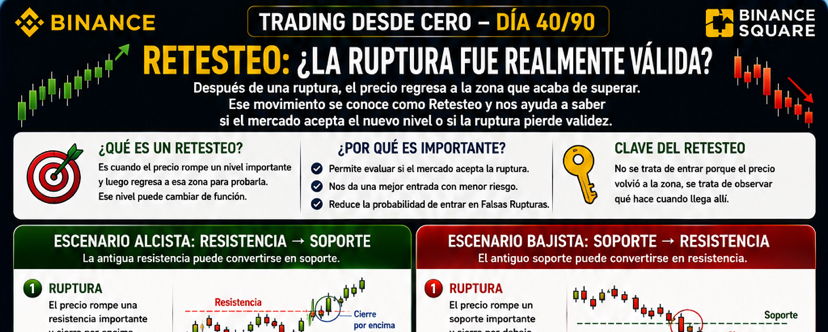

📘 Trading from Scratch – Day 40/90
🎯 Retesting: how to know if a breakout is being accepted
In the previous topics, we learned how to identify consolidations, breakouts, Fake Breakouts, and Pullbacks.
Now we’re going to study a related concept, but with a specific function: Retesting.
A retest happens when price breaks through an important zone and then later returns to check that same level.
This moment can provide interesting information because it allows us to see whether the market accepts the new level or if the breakout starts to lose strength.
Educational content. Not investment advice.
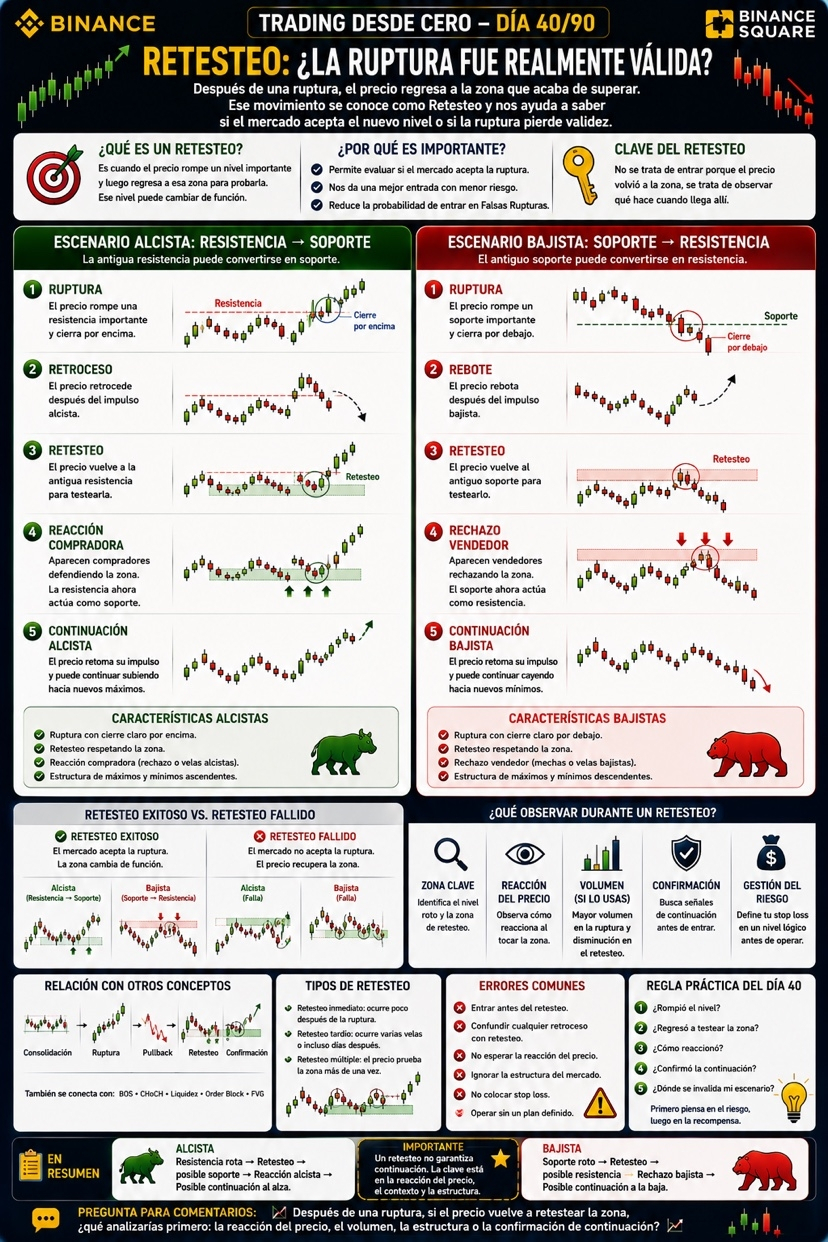
🟢 Bullish scenario: resistance → support
Imagine the price finds resistance several times.
Resistance ─────────
The market tries to push through it and finally:
📈 Breaks resistance.
📈 Closes above.
📉 Then it pulls back.
📉 It moves back toward the old resistance.
Here the retest appears.
If the old resistance manages to act as support and buyers appear, price could try to continue upward.
🔎 What to look for?
1️⃣ Breakout
Resistance must be clearly overcome.
2️⃣ Return
Price moves back toward the broken zone.
3️⃣ Price reaction
Observe whether sellers manage to regain the level or whether buyers appear.
4️⃣ Confirmation
A bullish reaction can add more confidence to the scenario.
5️⃣ Risk management
Even a breakout with a retest can fail.
🔴 Bearish scenario: support → resistance
Now we have an important support.
Support ─────────
Finally it loses it:
📉 Breaks support.
Closes below.
📈 Afterwards, it makes a bounce.
📈 It moves back toward the old support.
That return can turn into a bearish retest.
If the old support zone now acts as resistance and selling pressure appears, the price could continue moving downward.
🔎 What to look for?
1️⃣ Support break
2️⃣ Bounce back toward the zone.
3️⃣ Price reaction.
4️⃣ Possible seller rejection.
5️⃣ Confirmation and risk management.
🧠 Why is the retest important?
Because an isolated breakout only shows that price managed to surpass a level.
A retest lets you observe something additional:
What happens when price comes back to that level?
For example:
🟢 Before
Resistance
⬇️
Price tries to break
⬇️
📈 Breakout
⬇️
📉 Retest
⬇️
🟢 Support
⬇️
📈 Continuation
🔴 Before
Support
⬆️
Price tries to break
⬆️
📉 Breakout
⬆️
📈 Retest
⬆️
🔴 Resistance
⬇️
📉 Continuation
⚠️ What if the retest fails?
Here we need to connect again with the Fake Breakout.
Imagine a bullish scenario:
📈 Price breaks resistance.
📉 Comes back to retest it.
📉 But instead of finding buyers, it drops back below resistance.
The breakout could be losing validity.
The same can happen in the opposite direction.
That’s why:
Retest + favorable reaction ≠ guarantee
And:
Retest + recovery of the broken level = possible sign of weakness in the breakout.
📊 Bullish retest vs. bearish
Element
🟢 Bullish
🔴 Bearish
Initial level
Resistance
Support
Breakout
Upward
Downward
Retest
From above
From below
New feature
Support
Resistance
Sought reaction
Buyer
Seller
Possible continuation
Upward
Downward
🔗 Retest + previous topics
Now we can combine several concepts from the project:
Consolidation → Breakout → Retest → Confirmation
But it can also happen that:
Breakout → Retest → Rejection → Continuation
or:
Breakout → Retest → Zone recovery → possible Fake Breakout
This shows why we shouldn’t analyze a single signal in isolation.
❌ Common mistakes
❌ Don’t enter immediately after the breakout.
❌ Consider any return as a valid retest.
❌ Ignore the reaction in the zone.
❌ Mistaking a failed retest for confirmation.
❌ Chasing price after a highly extended candle.
❌ Don’t set the risk before placing a trade.
🧠 Day 40 practical rule
When a breakout appears, think:
Did it break?
⬇️
Did it return to the zone?
⬇️
How did it react?
⬇️
Did it confirm the continuation?
⬇️
Where would my scenario be invalidated?
This last question is especially important because it forces you to think first about risk and not only about the possible gain.
📌 Conclusion
The Retest lets you observe how price behaves after breaking an important zone.
🟢 Broken resistance → retest → possible support → bullish reaction.
🔴 Broken support → retest → possible resistance → bearish reaction.
But the retest by itself does not confirm a trade. What matters is studying the reaction, structure, and context before making a decision.
📘 On Day 41/90, we’ll study volume during breakouts and see how it can help us assess whether a move has sufficient participation or if it could be a weak breakout.
💬 Question:
📉 After a breakout, if price returns to retest the zone, what would you analyze first: the price reaction, volume, structure, or the confirmation of continuation? 📈
#Trading #BinanceSquare #Retest #PriceAction #TechnicalAnalysis