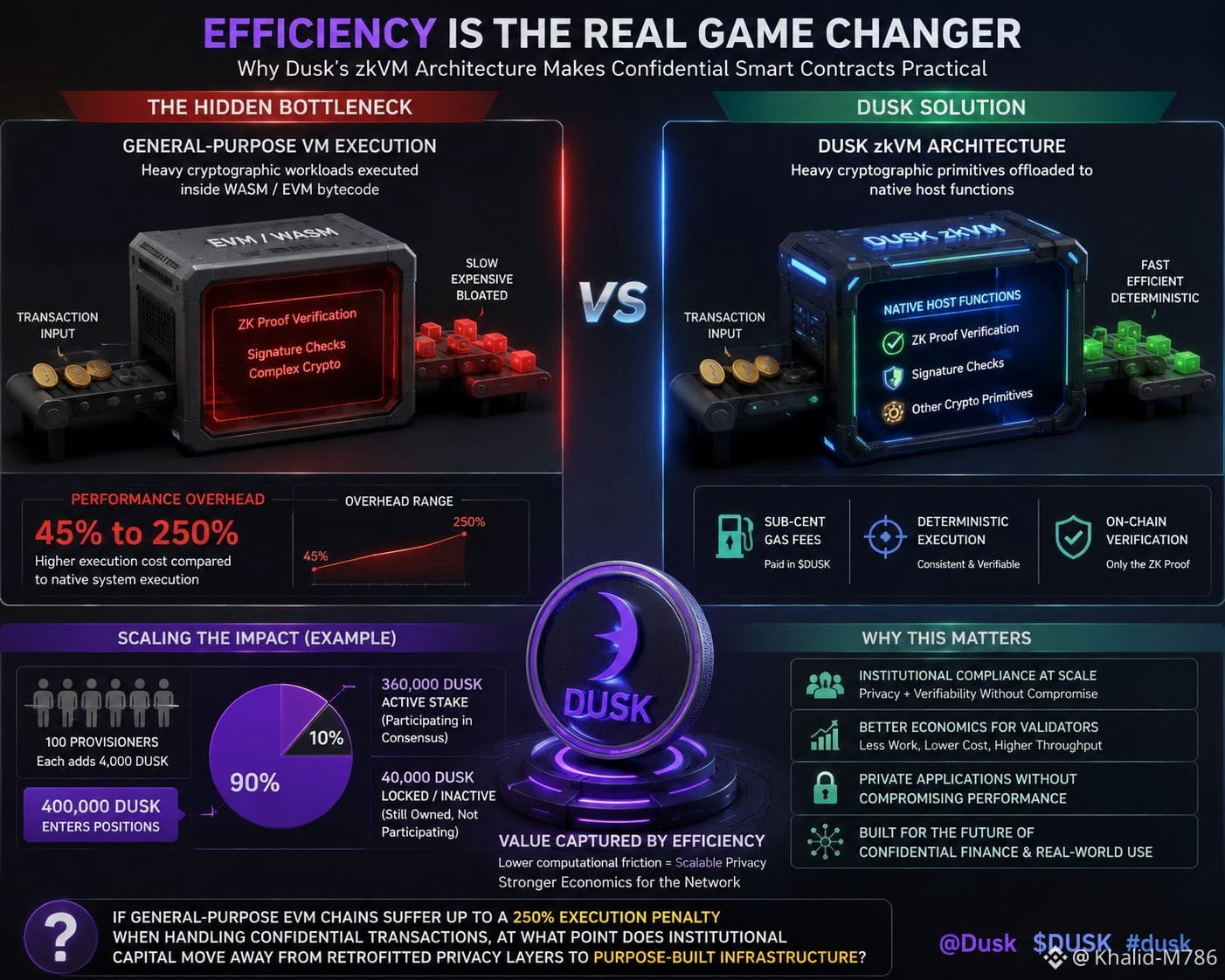
I was looking at the 45%–250% performance gap reported for heavy cryptographic workloads, and honestly, that made Dusk’s approach look more interesting to me.
If ZK proofs and signature checks become that much heavier inside a general-purpose VM, privacy can get expensive very quickly.
Dusk takes a different route.
Its purpose-built zkVM can use native host functions for heavy cryptographic work, while the network still keeps execution deterministic. The important part is that validators don’t need to treat every private computation as another huge VM workload; they can verify the resulting proof on-chain.
That 45%–250% range may look like just a technical statistic, but it points to a bigger issue: private smart contracts have to be practical, not just possible.
For me, this is where Dusk gets interesting. If confidential applications really scale, efficiency could matter just as much as privacy itself.
So how much extra computation will institutions tolerate before purpose-built infrastructure starts looking like the obvious choice?
@Dusk $DUSK #dusk
If ZK proofs and signature checks become that much heavier inside a general-purpose VM, privacy can get expensive very quickly.
Dusk takes a different route.
Its purpose-built zkVM can use native host functions for heavy cryptographic work, while the network still keeps execution deterministic. The important part is that validators don’t need to treat every private computation as another huge VM workload; they can verify the resulting proof on-chain.
That 45%–250% range may look like just a technical statistic, but it points to a bigger issue: private smart contracts have to be practical, not just possible.
For me, this is where Dusk gets interesting. If confidential applications really scale, efficiency could matter just as much as privacy itself.
So how much extra computation will institutions tolerate before purpose-built infrastructure starts looking like the obvious choice?
@Dusk $DUSK #dusk