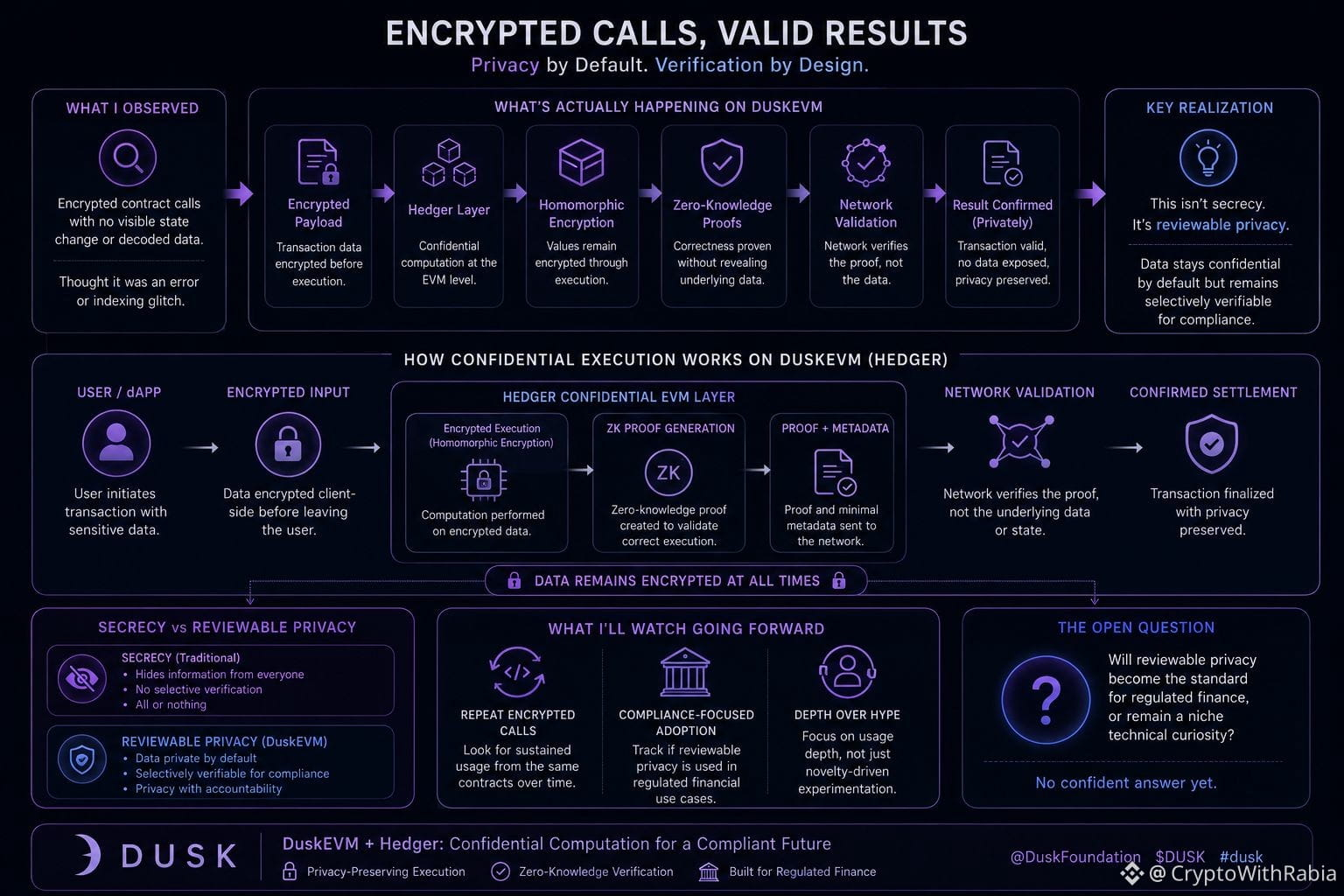
While checking transaction data on DuskEVM, I noticed certain contract calls carried encrypted payloads that still passed validation without any visible state change I could decode. I assumed this was just malformed data or an indexing glitch on my end.
Looking closer, I found these weren't errors at all but transactions processed through Hedger, the layer handling confidential computation directly at the EVM level. Values stayed encrypted through execution using homomorphic encryption paired with zero-knowledge proofs, yet the network could still confirm correctness without ever exposing the underlying numbers.
That distinction reframed something I'd been sloppy about. I had been treating privacy and secrecy as interchangeable, but they aren't. Secrecy hides information from everyone. What I was watching was reviewable privacy, where data stays confidential by default but remains selectively verifiable for compliance purposes. That's a fundamentally different design goal than simply obscuring activity.
What I still can't gauge is real usage depth. Encrypted execution is elegant in theory, but regulated financial applications tend to move slowly, and I don't yet know if current activity reflects genuine institutional testing or just developers exploring the primitive out of curiosity.
Going forward I want to track how often the same contracts see repeat encrypted calls rather than isolated tests, since sustained usage says more than experimentation. I'll also watch whether reviewable privacy features get adopted specifically by applications built for compliance-heavy use cases, since that would signal real product fit rather than novelty interest.
I'm still sitting with an open question about whether reviewable privacy becomes a genuine standard for regulated finance or stays a niche technical curiosity. I don't have a confident answer yet.
@Dusk #dusk $DUSK
$EDEN
$SCRT
Looking closer, I found these weren't errors at all but transactions processed through Hedger, the layer handling confidential computation directly at the EVM level. Values stayed encrypted through execution using homomorphic encryption paired with zero-knowledge proofs, yet the network could still confirm correctness without ever exposing the underlying numbers.
That distinction reframed something I'd been sloppy about. I had been treating privacy and secrecy as interchangeable, but they aren't. Secrecy hides information from everyone. What I was watching was reviewable privacy, where data stays confidential by default but remains selectively verifiable for compliance purposes. That's a fundamentally different design goal than simply obscuring activity.
What I still can't gauge is real usage depth. Encrypted execution is elegant in theory, but regulated financial applications tend to move slowly, and I don't yet know if current activity reflects genuine institutional testing or just developers exploring the primitive out of curiosity.
Going forward I want to track how often the same contracts see repeat encrypted calls rather than isolated tests, since sustained usage says more than experimentation. I'll also watch whether reviewable privacy features get adopted specifically by applications built for compliance-heavy use cases, since that would signal real product fit rather than novelty interest.
I'm still sitting with an open question about whether reviewable privacy becomes a genuine standard for regulated finance or stays a niche technical curiosity. I don't have a confident answer yet.
@Dusk #dusk $DUSK
$EDEN
$SCRT