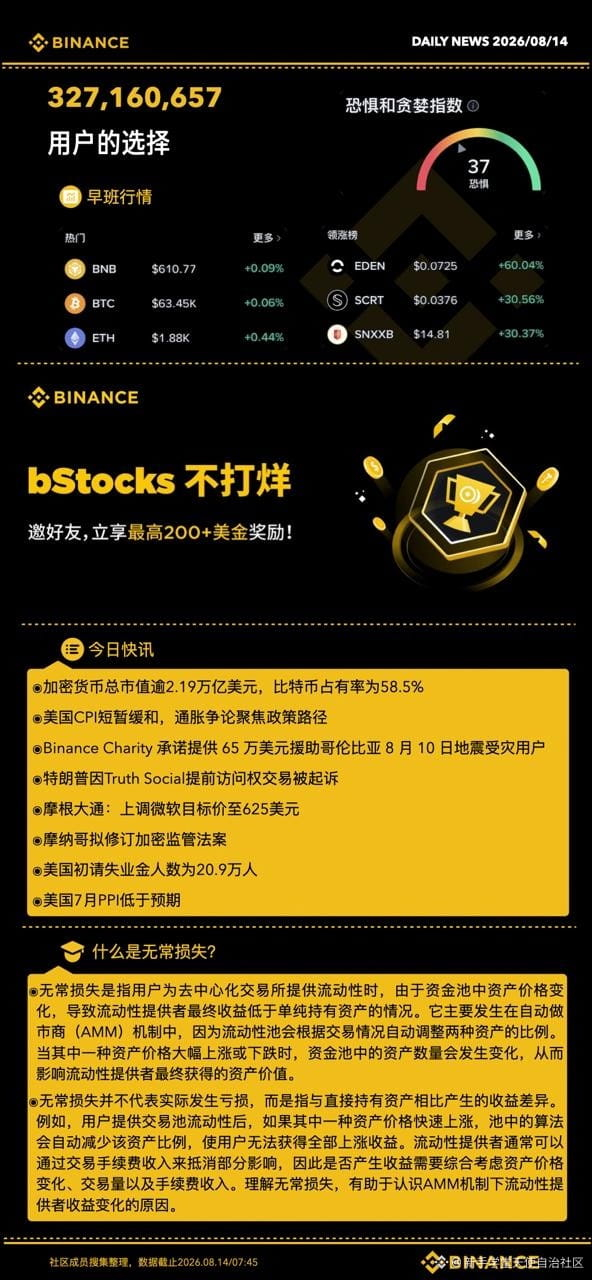

Gm, #学堂日报 August 14 Market Overview
1️⃣ Market Overview
▪ Total cryptocurrency market capitalization is approximately $2.19 trillion, with Bitcoin accounting for 58.5%.
▪ The Fear & Greed Index is 37 (Fear), and market sentiment has dipped slightly.
▪ The market continues to focus on U.S. inflation data, the interest-rate cut path, and global regulatory developments.
2️⃣ Binance Updates
▪ Binance launched a bStocks invite-a-friend campaign, offering up to 200+ USD in rewards for participating friends.
▪ Binance Charity has pledged $650,000 in aid to support users affected by the August 10 earthquake in Colombia.
▪ Binance continues to expand the bStocks and TradFi product ecosystem, bringing more traditional assets into crypto trading scenarios.
3️⃣ Industry Highlights
▪ With the U.S. CPI cooling temporarily, discussions have shifted to the Fed’s subsequent rate-cut path.
▪ Trump’s Truth Social has been sued over issues related to trading access obtained early.
▪ JPMorgan Chase raised its target price for Microsoft to $625.
▪ Monaco plans to revise its crypto regulatory bill to further完善 the digital-asset regulatory framework.
▪ Initial U.S. jobless claims are about 209,000.
▪ U.S. July PPI came in below expectations, and inflation pressure remains a continued focus for the market.
4️⃣ Today’s Explainer: What Is Impermanent Loss?
🔸 What is impermanent loss?
▪ Impermanent loss mainly occurs in AMM liquidity pools.
▪ When users deposit two assets into the pool, if one asset’s price rises or falls significantly, the proportion of assets in the pool adjusts automatically.
🔸 Why does it happen?
▪ AMMs rebalance the pool’s assets continuously based on trading activity.
▪ When price changes are large, the asset combination ultimately held by liquidity providers may be worth less than the value of simply holding the assets—this difference is impermanent loss.
🔸 Why is it called “impermanent”?
▪ Because as long as the asset prices return to the original ratio, the loss may shrink or even disappear.
▪ But if the user exits the liquidity pool when prices have deviated significantly, this loss becomes real.
🔸 Can the returns offset it?
▪ Liquidity providers typically earn trading fees or protocol rewards.
▪ Actual returns need to be considered by combining fee income, incentive rewards, and impermanent loss.
Follow @新手学堂天使自治社区 for more updates 🚀
1️⃣ Market Overview
▪ Total cryptocurrency market capitalization is approximately $2.19 trillion, with Bitcoin accounting for 58.5%.
▪ The Fear & Greed Index is 37 (Fear), and market sentiment has dipped slightly.
▪ The market continues to focus on U.S. inflation data, the interest-rate cut path, and global regulatory developments.
2️⃣ Binance Updates
▪ Binance launched a bStocks invite-a-friend campaign, offering up to 200+ USD in rewards for participating friends.
▪ Binance Charity has pledged $650,000 in aid to support users affected by the August 10 earthquake in Colombia.
▪ Binance continues to expand the bStocks and TradFi product ecosystem, bringing more traditional assets into crypto trading scenarios.
3️⃣ Industry Highlights
▪ With the U.S. CPI cooling temporarily, discussions have shifted to the Fed’s subsequent rate-cut path.
▪ Trump’s Truth Social has been sued over issues related to trading access obtained early.
▪ JPMorgan Chase raised its target price for Microsoft to $625.
▪ Monaco plans to revise its crypto regulatory bill to further完善 the digital-asset regulatory framework.
▪ Initial U.S. jobless claims are about 209,000.
▪ U.S. July PPI came in below expectations, and inflation pressure remains a continued focus for the market.
4️⃣ Today’s Explainer: What Is Impermanent Loss?
🔸 What is impermanent loss?
▪ Impermanent loss mainly occurs in AMM liquidity pools.
▪ When users deposit two assets into the pool, if one asset’s price rises or falls significantly, the proportion of assets in the pool adjusts automatically.
🔸 Why does it happen?
▪ AMMs rebalance the pool’s assets continuously based on trading activity.
▪ When price changes are large, the asset combination ultimately held by liquidity providers may be worth less than the value of simply holding the assets—this difference is impermanent loss.
🔸 Why is it called “impermanent”?
▪ Because as long as the asset prices return to the original ratio, the loss may shrink or even disappear.
▪ But if the user exits the liquidity pool when prices have deviated significantly, this loss becomes real.
🔸 Can the returns offset it?
▪ Liquidity providers typically earn trading fees or protocol rewards.
▪ Actual returns need to be considered by combining fee income, incentive rewards, and impermanent loss.
Follow @新手学堂天使自治社区 for more updates 🚀