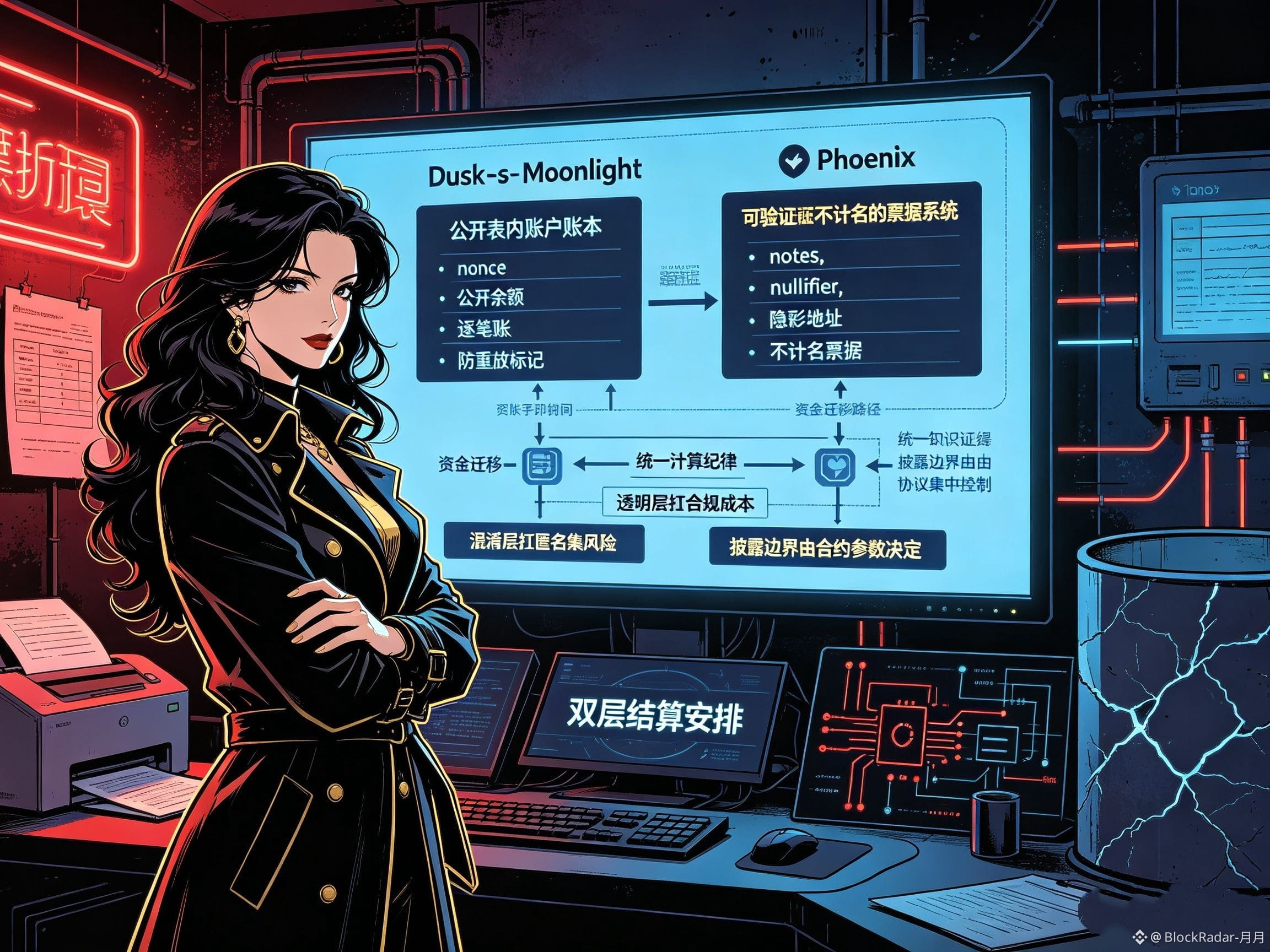
When you look at Moonlight and Phoenix side by side for @Dusk , it feels less like a standalone feature and more like a two-tier settlement setup: one layer is a publicly listed account, the other is a verifiable but non-custodial note system, both governed by the same settlement rules. After reviewing the contract permissions and the fund-migration paths, the conclusion is straightforward—the risk-reward structure is fundamentally asymmetric. Users think they’re getting the convenience of privacy and compliance, but that convenience is split into two pools of funds; the disclosure boundaries between the two pools are determined centrally by the protocol.
Moonlight’s account relies on nonces and publicly visible balances to build replay protection and an auditable settlement account—close to traditional brokerage-style per-transaction reconciliation. Phoenix, by contrast, uses notes, nullifiers, and stealth addresses to create an anonymous note system. The nullifier only proves the note has been spent; it does not expose the holder. The line from the Dusk whitepaper—“the two models are indispensable”—when translated into financial terms becomes graded disclosure: the transparent layer bears the burden of compliance and traceability costs, while the obfuscation layer bears the risk of concentrated anonymity-set exposure. Liquidity depth and disclosure rules for both layers are decided by contract parameters, not by user agreements. Can users truly freely switch between privacy and transparency? It feels more like being pushed into two pools with different risk exposures and ending up with passive configuration.
Where would the $DUSK risk show up? Most likely not in signature verification itself, but in instability at the boundaries between the two layers. If the anonymity set narrows, Phoenix’s privacy strength drops accordingly. If fund flows between the transparent and obfuscated layers are systemically tagged, “selective disclosure” will quickly devolve into practical full tracking. Add to that incoming capital falling below the maintenance threshold, or large addresses migrating centrally between the two pools, and the endpoint of this two-layer settlement arrangement very likely becomes a credit event of a structured product. The only difference is: here, credit is algorithmically endorsed, but the algorithm never assumes any obligation to redeem.
At this stage, I have no directional position on #dusk —I’m only keeping a small risk budget. I keep single exposure within an allowable loss limit; if the anonymity-set size shrinks or migration between the two pools shows anomalies, I exit first rather than waiting for a narrative reversal. There aren’t many on-chain indicators to watch day-to-day: overall locked-asset trend, changes in large-address holdings, and records of contract admin permission updates. For this project, I don’t take a stance—what I can offer is a risk-adjusted expected return rate figure.
Moonlight’s account relies on nonces and publicly visible balances to build replay protection and an auditable settlement account—close to traditional brokerage-style per-transaction reconciliation. Phoenix, by contrast, uses notes, nullifiers, and stealth addresses to create an anonymous note system. The nullifier only proves the note has been spent; it does not expose the holder. The line from the Dusk whitepaper—“the two models are indispensable”—when translated into financial terms becomes graded disclosure: the transparent layer bears the burden of compliance and traceability costs, while the obfuscation layer bears the risk of concentrated anonymity-set exposure. Liquidity depth and disclosure rules for both layers are decided by contract parameters, not by user agreements. Can users truly freely switch between privacy and transparency? It feels more like being pushed into two pools with different risk exposures and ending up with passive configuration.
Where would the $DUSK risk show up? Most likely not in signature verification itself, but in instability at the boundaries between the two layers. If the anonymity set narrows, Phoenix’s privacy strength drops accordingly. If fund flows between the transparent and obfuscated layers are systemically tagged, “selective disclosure” will quickly devolve into practical full tracking. Add to that incoming capital falling below the maintenance threshold, or large addresses migrating centrally between the two pools, and the endpoint of this two-layer settlement arrangement very likely becomes a credit event of a structured product. The only difference is: here, credit is algorithmically endorsed, but the algorithm never assumes any obligation to redeem.
At this stage, I have no directional position on #dusk —I’m only keeping a small risk budget. I keep single exposure within an allowable loss limit; if the anonymity-set size shrinks or migration between the two pools shows anomalies, I exit first rather than waiting for a narrative reversal. There aren’t many on-chain indicators to watch day-to-day: overall locked-asset trend, changes in large-address holdings, and records of contract admin permission updates. For this project, I don’t take a stance—what I can offer is a risk-adjusted expected return rate figure.