


Plume: A compliance bet in the RWA track
1. What is this project doing?
Plume was approved/initiated at the end of 2023, went live on the mainnet in June 2025, and positions itself as “a chain built specifically for RWAs.” The founders’ backgrounds are especially interesting—the CEO Chris Yin previously worked at Coinbase and in traditional finance, GC Salman Banaei used to be a lawyer at the SEC and CFTC, and in 2026 he also went to the U.S. Congress to testify on the tokenization topic.
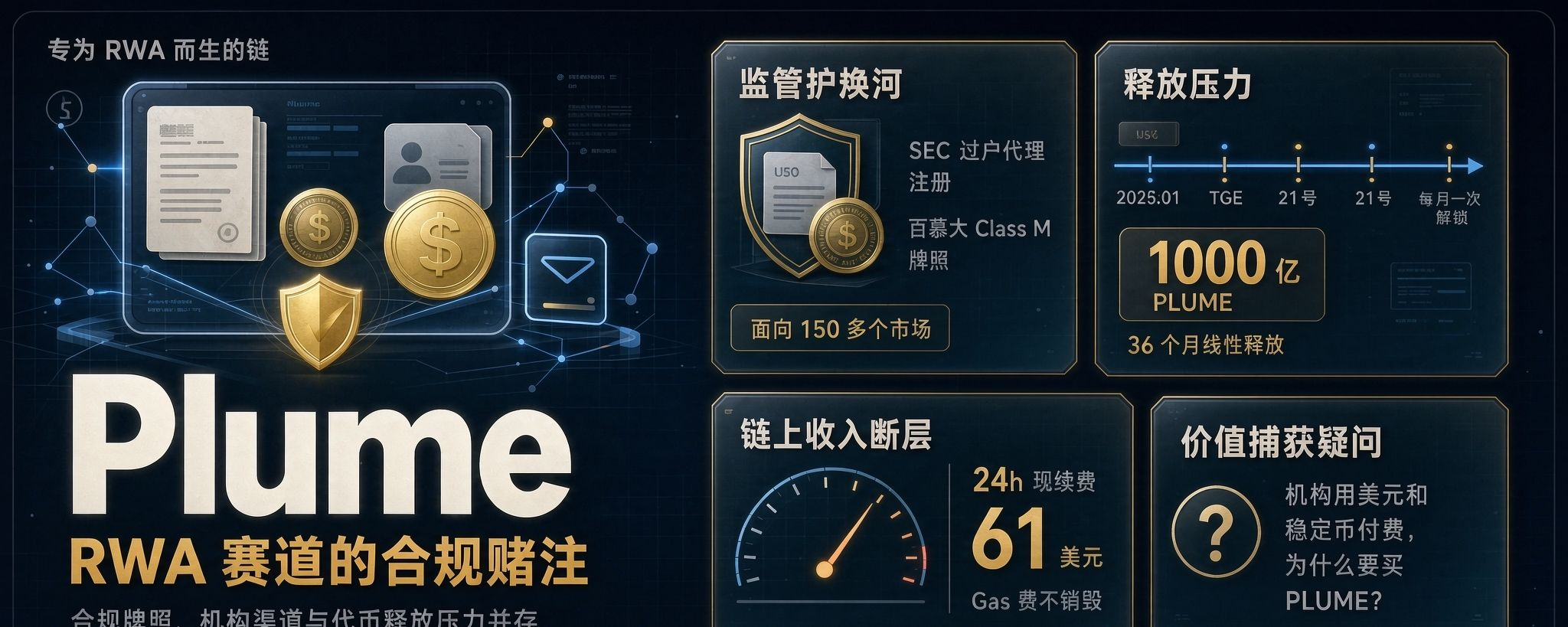
This chain’s stack isn’t particularly original: Arbitrum Nitro is used for the execution layer, Celestia for the data availability layer, and Ethereum for final settlement. The real differentiator is the compliance layer— they obtained SEC transfer agent registration in October 2025, and then a Bermuda Class M license in May 2026. Put simply: within the legal framework, this company is allowed to tokenize and facilitate the transfer of digital securities, which is extremely rare in the crypto industry.
II. How does the money get split
Total supply: 100 billion PLUME—no small amount. The TGE was in January 2025, nearly half a year before mainnet launch.
In allocation: community and ecosystem 39%, airdrops 7%, early investors 21%, core team 20%, foundation 13%. The unlock cycle is 36 months of linear release, with a fixed batch released every 21st of the month—about 279 million tokens. By mid-2026, circulating supply is 43%–57%, and full unlocking won’t be until January 2028.
Here’s a key turning point: in January 2026 there was a large unlock that directly released 39.75% of the circulating supply at the time. The token price fell from a high of $0.25 to 0.011—a drop of 94%.
The burn mechanism is basically zero. On-chain it uses an EIP-1559-style dynamic transaction fee, but all gas fees go to validators and orderers—nothing is burned. In mid-2026, on a certain day, total 24-hour fees across the whole network were only $61. You didn’t misread—$61. Compare that with the amount released daily—the gap is so large it’s hard to look at.
Validator staking annualized is about 8.2%, but this isn’t fee dividends—it’s newly issued coins. Unstaking requires a 21-day cooldown.
III. What are you doing in 2026
This year’s main line is: turning “issuing assets on-chain” into “putting assets into users’ wallets.”
Nest is their self-built RWA yield vault. Users deposit USDC into it; the underlying integration includes the Invesco short-term bond fund, Bitwise’s carry fund, Apollo’s private credit, WisdomTree’s 14 funds, and more. In July 2026, Nest’s vault product nBASIS entered Binance Wallet—meaning the tens of millions of Binance users can buy directly in their wallets.
Also, ether.fi invested $100 million into Plume’s RWA vault, and Bybit has also integrated its structured-yield products. They even built an asset issuance framework called Arc, as well as the SkyLink oracle system—writing the custody bank’s NAV data and interest rates into the contract.
Multi-chain deployment is also underway: Nest vault synchronization deployment to Solana, Ethereum, Avalanche, and BNB Chain. The idea is: “Plume handles issuance and compliance; other chains handle liquidity.”
IV. What do the data really look like
First, the good-looking part:
Official website RWA TVL: $115 million
RWA holder addresses: 200k to 280k
List of partnered institutions: Apollo, WisdomTree, BlackRock family (indirect), Invesco, Bitwise, FalconX
Let’s look at the real picture:
Native DeFi TVL as counted by DefiLlama: $12.4 million to $16.7 million—that’s the money truly locked in Plume-chain contracts
Active RWA market cap: it surged to over 600 million in spring 2026, then fell back to 55 million in summer—extremely volatile
Total 24-hour transaction fees: $61 (data from a certain day in June 2026)
Number of vaults: more than 10. The largest BlackOpal has 62 million, and FALX has 28.7 million
To be honest: a substantial portion of RWA TVL comes from Points Farmers and mining rotation capital, not institutional locked deposits. The trajectory—600 million in spring, 55 million in summer—already tells you a lot. If it were true institutional allocations, the curve wouldn’t be this steep.
V. How does it compare with competitors
Players in the RWA track right now:
Ondo Chain: backed by OUSG/USDY Treasury-bond flow, with an indirect line to BlackRock—but more like a “private chain for its own treasury products”
Centrifuge: an established RWA credit pool—real TVL, but the narrative is old
Mantra (OM): a Cosmos-based project that pulls in Middle Eastern capital; it exploded once with a major “recoil” in 2026
Polymesh: focuses on security STOs—compliance-heavy, but the ecosystem is quiet
Plume’s advantages: it has the most complete compliance licenses, the strongest institutional relationships, and the widest distribution channels (Binance Wallet, Bybit, ether.fi). Its disadvantages: the tech stack is essentially pure “shell-and-copy,” on-chain revenue is almost zero, and the path to token value capture isn’t clear.
VI. Regulatory card
This is the part where Plume is most different from the vast majority of projects.
Most projects are being chased and beaten by the SEC. Plume is the one that walked into the SEC office and signed the documents by itself. Registering a transfer agent with the SEC means it can legally handle the registration, transfer, and dividend accounting of digital securities. The Bermuda license allows it to operate in more than 150 countries (excluding U.S. retail).
But it’s also a double-edged sword: proactively binding itself into the U.S. securities regulatory framework means the more tokenized securities issued on-chain, the heavier the compliance costs and regulatory scrutiny. PLUME itself hasn’t been listed by the SEC as a security, but all RWA products running on top of it are under the SEC’s watchful eyes.
Salman Banaei testifying before Congress is also quite delicate—on the one hand it shows they’re actively shaping policy; on the other hand it shows this track is still waiting for a clear regulatory framework.
VII. Token/coin allocation structure
There’s no address distribution data as precise as Filfox, but you can infer from the allocation structure: early investors 21%, team 20%, foundation 13%—together 54% is held internally. In 2026, 2.79 billion tokens are released every month throughout the year, and this schedule continues until January 2028.
That big unlock in January 2026 pushed the price above 0.011, showing that as long as internal coins move, market absorbency is very weak.
The real high-frequency circulating supply is estimated to be between 1 billion and 1.5 billion tokens. Most circulating tokens are either in deep liquidity pools on exchanges or locked through staking.
The upside is: after January 2028, new emissions go to zero. If by then the RWA track hasn’t died, PLUME is a symmetric bet of “selling pressure reset to zero + compliance fully matured.”
VIII. Nodes worth watching
Every 21st of 2026: 279 million tokens unlocked, continuing until January 2028
Second half of 2026: nBASIS’s real AUM growth on Binance Wallet
Throughout 2026: Can it attract real money from non-U.S. institutions under the Bermuda license
2027: Will the SEC issue detailed rules on “on-chain transfer agents”
January 2028: the final unlock, the supply inflection point
IX. Where is the risk?
First, the unlock peak collided with the RWA narrative downturn. The 94% drop in January 2026 already demonstrated it once.
Second, Nest TVL is users depositing USDC to buy RWA yield—PLUME itself doesn’t capture this value. Institutions pay in USD for management fees and don’t buy PLUME. If the RWA scale grows but PLUME doesn’t, don’t be surprised.
Third, on-chain transaction fees have consistently been in the double-digit USD range year-round. Validators’ security budget depends entirely on newly issued coins. If the token price falls below a certain threshold, validators exit, which would affect consensus security.
Fourth, the identity of L2 means it doesn’t hold underlying security. Settlement relies on Ethereum; DA relies on Celestia; execution relies on Arbitrum Nitro. Plume’s core value is compliance middleware plus an orderer, not an independent security layer.
X. Final few words
Plume reminds me of Polygon in 2021—technology isn’t original, TVL relies on incentives, tokens rely on emissions, but the narrative hit the right time window.
Plume is betting on “RWA becoming the default for TradFi” to unlock token value capture.
But there’s one issue that always can’t be dodged: institutions pay in USD—why buy PLUME?
If the RWA track really explodes, Plume as infrastructure will definitely benefit. But whether that benefit is reflected in the price of PLUME or reflected on Plume Foundation’s balance sheet is completely different.
