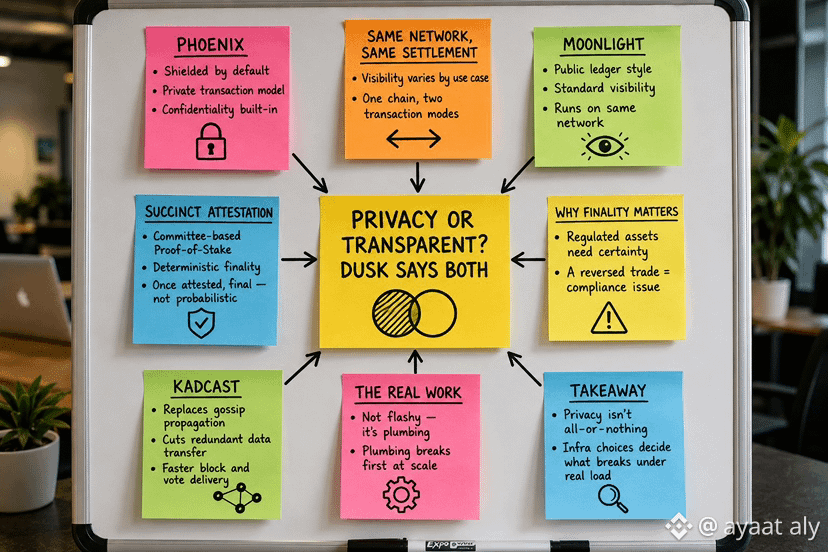
The majority of individuals believe that a blockchain is either completely private or completely transparent. $DUSK doesn't choose one.
It operates two transaction models side by side: Phoenix, which is shielded and private by default, and Moonlight, which functions similarly to a typical public ledger transaction. Depending on the requirements of the use case, the same network, settlement layer, and visibility can vary.
Succinct Attestation, a committee-based Proof-of-Stake consensus designed for deterministic finality—that is, once a block is attested, it is final rather than "probably final" as in probabilistic consensus models—sits beneath both. For regulated assets, this is important because a reversed trade is not just inconvenient but also a compliance issue.
Instead of using traditional gossip propagation, networking uses Kadcast, which reduces redundant data transfer and speeds up the movement of votes and blocks between nodes.
Nothing about this is ostentatious. Plumbing is the issue. However, when a network attempts to host actual financial infrastructure, plumbing is precisely what breaks first.
@Dusk #dusk
It operates two transaction models side by side: Phoenix, which is shielded and private by default, and Moonlight, which functions similarly to a typical public ledger transaction. Depending on the requirements of the use case, the same network, settlement layer, and visibility can vary.
Succinct Attestation, a committee-based Proof-of-Stake consensus designed for deterministic finality—that is, once a block is attested, it is final rather than "probably final" as in probabilistic consensus models—sits beneath both. For regulated assets, this is important because a reversed trade is not just inconvenient but also a compliance issue.
Instead of using traditional gossip propagation, networking uses Kadcast, which reduces redundant data transfer and speeds up the movement of votes and blocks between nodes.
Nothing about this is ostentatious. Plumbing is the issue. However, when a network attempts to host actual financial infrastructure, plumbing is precisely what breaks first.
@Dusk #dusk