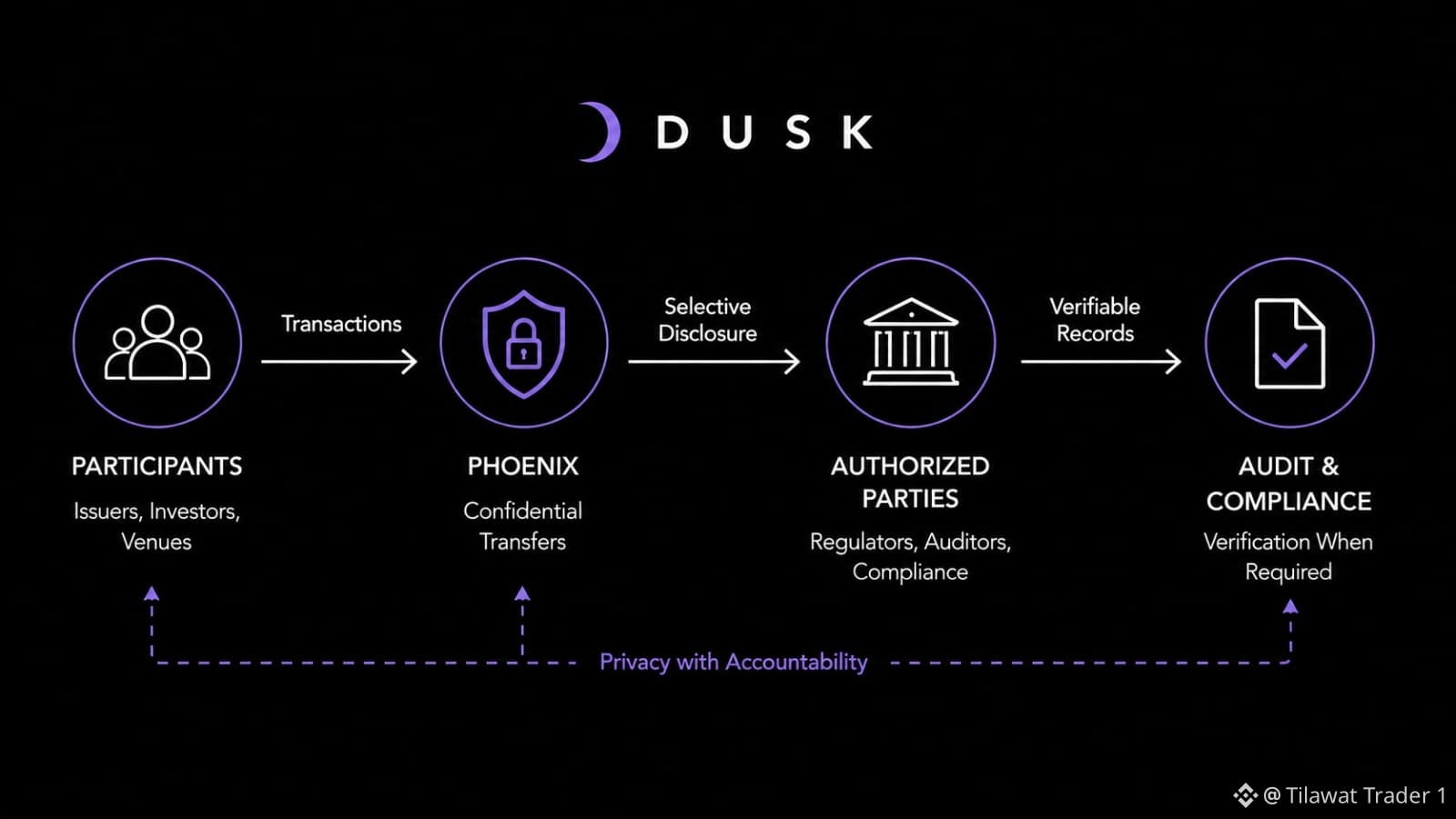
I’ve been looking at Dusk from an accounting perspective, and one detail seems more useful than simply tracking how many transactions the network processes: whether its privacy controls make regulated activity easier to verify without making the underlying market harder to audit.
Phoenix gives Dusk confidential transfers, while selective disclosure lets authorized participants reveal the information needed for compliance. That creates an interesting operational test. If an issuer, venue, or investor can keep sensitive details restricted while still producing verifiable records when required, privacy becomes part of the market’s control system rather than just a transaction feature.
I’d therefore watch the quality of settlement activity, not just its volume. Are regulated assets repeatedly transferred? Do applications actually use confidential flows? Does activity remain after incentives become less attractive? Those signals tell me whether Dusk is becoming infrastructure or simply accumulating technically impressive capabilities.
There is also a practical weakness: institutional workflows can remain fragmented even when the underlying blockchain works well. Without enough venues, issuers, custodians, and users coordinating around the same rails, privacy may improve the architecture without creating meaningful economic throughput.
Useful privacy should leave an auditable footprint.
That distinction is where I’d look for evidence that Dusk’s technology is translating into durable network value.
#dusk $DUSK @Dusk