#dusk $DUSK I noticed something while scrolling through recent block producers on the @Dusk explorer. A handful of provisioner addresses kept showing up far more often than others over a short window, and I assumed it was just latency or an uneven peer connection skewing the sample I happened to catch.
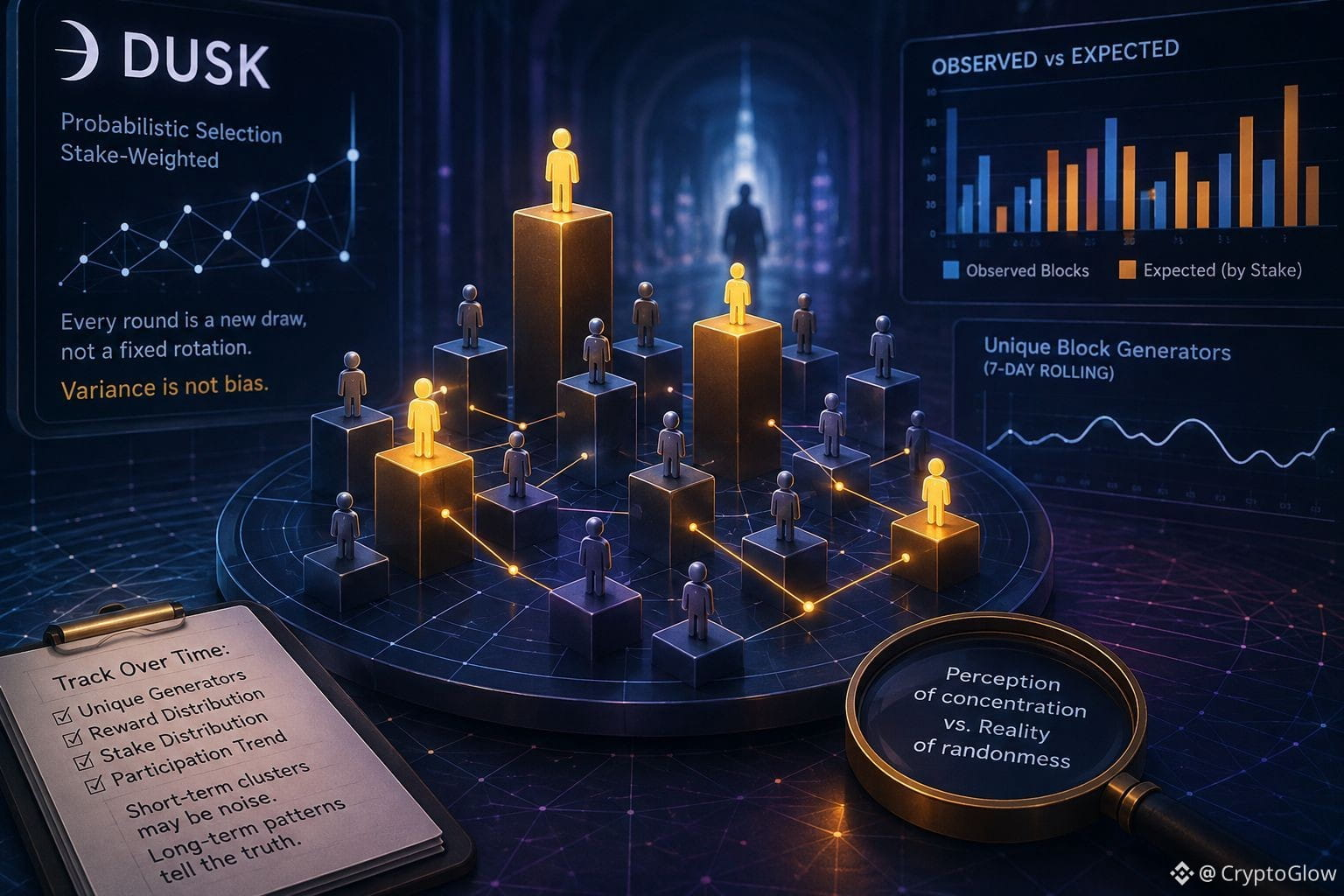
Widening the window changed that read. Dusk selects its block generator and voting committee each round through a probabilistic process weighted by stake, not a fixed rotation schedule. Larger stakes get selected more often on average, but "on average" is doing real work there. Over any short stretch, selection can cluster hard around a few addresses purely from the math of the draw, not from any advantage being exploited.
That distinction rewired how I was thinking about it. I'd been treating stake weight and actual visibility as the same thing, like proportional stake guarantees proportional appearance. It doesn't, not in small samples. A provisioner can hold a modest stake and still vanish from block production for stretches, while a mid-sized one runs hot for a while. The gap between statistical entitlement and observed participation is where perception of concentration quietly forms.
What I haven't settled is whether that variance actually discourages smaller provisioners from staying active, or whether they understand it's noise and hold steady. If uneven short-term rewards push smaller stakers toward pooling or exiting, the committee composition drifts even though the underlying selection math stayed neutral.
I'm going to track unique block generator counts across rolling weekly windows, not just single snapshots, alongside how reward distribution compares to stake distribution over the same periods. That tells me whether clustering evens out or compounds.
Still unclear to me whether what I'm seeing is just the natural texture of probabilistic selection or an early signal of something structural pulling participation toward fewer hands.
Widening the window changed that read. Dusk selects its block generator and voting committee each round through a probabilistic process weighted by stake, not a fixed rotation schedule. Larger stakes get selected more often on average, but "on average" is doing real work there. Over any short stretch, selection can cluster hard around a few addresses purely from the math of the draw, not from any advantage being exploited.
That distinction rewired how I was thinking about it. I'd been treating stake weight and actual visibility as the same thing, like proportional stake guarantees proportional appearance. It doesn't, not in small samples. A provisioner can hold a modest stake and still vanish from block production for stretches, while a mid-sized one runs hot for a while. The gap between statistical entitlement and observed participation is where perception of concentration quietly forms.
What I haven't settled is whether that variance actually discourages smaller provisioners from staying active, or whether they understand it's noise and hold steady. If uneven short-term rewards push smaller stakers toward pooling or exiting, the committee composition drifts even though the underlying selection math stayed neutral.
I'm going to track unique block generator counts across rolling weekly windows, not just single snapshots, alongside how reward distribution compares to stake distribution over the same periods. That tells me whether clustering evens out or compounds.
Still unclear to me whether what I'm seeing is just the natural texture of probabilistic selection or an early signal of something structural pulling participation toward fewer hands.