
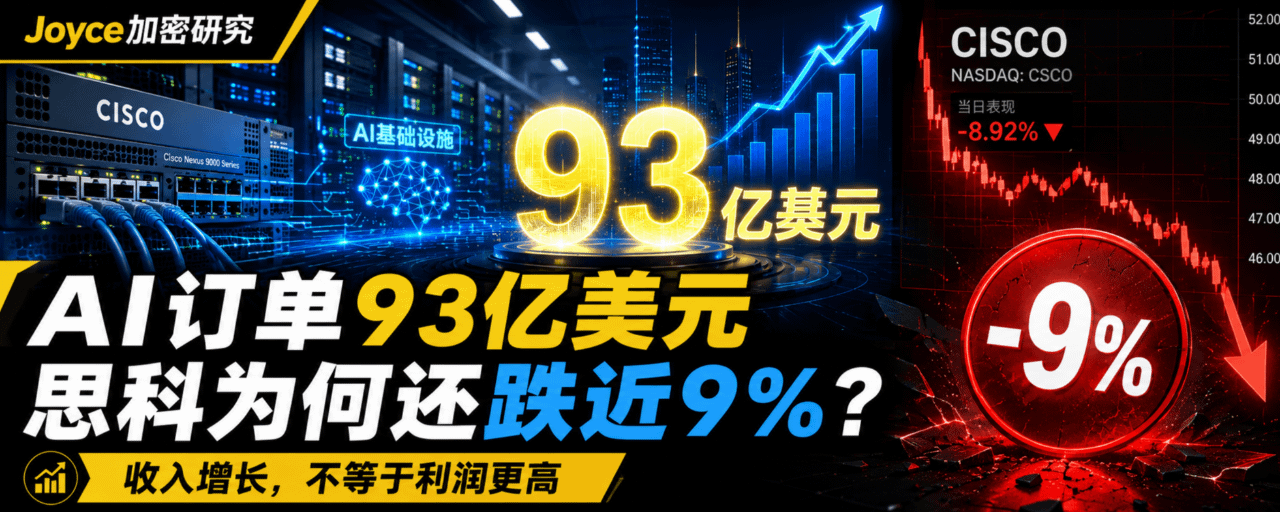
If you look only at the earnings report figures, Cisco should be up this time. Q4 revenue was $17.25 billion, up 17.6% year over year. Adjusted EPS was $1.22, also above market expectations. Even more striking is the AI infrastructure orders: $4.0 billion in the quarter, with the full-year total already reaching $9.3 billion. In other words, AI data centers aren’t not spending—they’re aggressively buying networking equipment.
The market today directly smashed Cisco by nearly 9%. The issue isn’t that “AI demand isn’t there,” but rather another, more realistic number: the gross margin. Cisco’s adjusted Q4 gross margin was about 66.3%, compared with 68.4% in the same period last year. For the next quarter, the company’s gross margin guidance is only 65%—66%, which is also slightly below market expectations.
Why can more AI orders actually put pressure on profit margins? Because many of the things Cisco is selling now are switches, routers, and data center networking hardware. As AI data centers expand at a frantic pace, hardware’s share of revenue rises, while the costs of components like memory are also increasing. Revenue is definitely getting bigger, but the share of profit left from each $1 of revenue may actually shrink.
This is the change that’s happening in the current AI market. Previously, the market asked: “Do they have AI orders?” Now that $9.3 billion in orders has already demonstrated strong demand, the market is starting to ask a second question: “With so many orders, how profitable are they, really?” Cisco even expects FY2027 AI infrastructure revenue to reach $7.5 billion, with full-year total revenue guidance of $72.2 billion—$73.4 billion, above Wall Street’s prior expectations. But even these good pieces of news couldn’t stop the stock from falling.
【My take】This isn’t an AI demand peak. It’s that AI trading is shifting from “who can get the orders” to “who can turn orders into high profit.” Scenario A: AI network demand continues to surge, while component costs fall and gross margins improve again—then today’s selloff looks more like a repricing after overly optimistic expectations. Scenario B: revenue keeps soaring, but gross margins trend downward for the long run, and the market will realize that AI infrastructure isn’t able to earn high profits at every layer the way Nvidia can.
Cisco is now around $112.8, down nearly 9% intraday, with a low of about $111.5 during the session. The signal the market is sending is very direct this time: strong performance alone is no longer enough—AI companies now have to prove both growth and profitability efficiency at the same time.
One-sentence translation: AI data centers really are buying Cisco equipment like crazy, but the market no longer settles for “selling a lot.” It’s now asking—after selling so much, how much profit can they truly keep?