
Why "privacy + compliance" is said to be a false proposition, and how Dusk wants to dismantle this wall
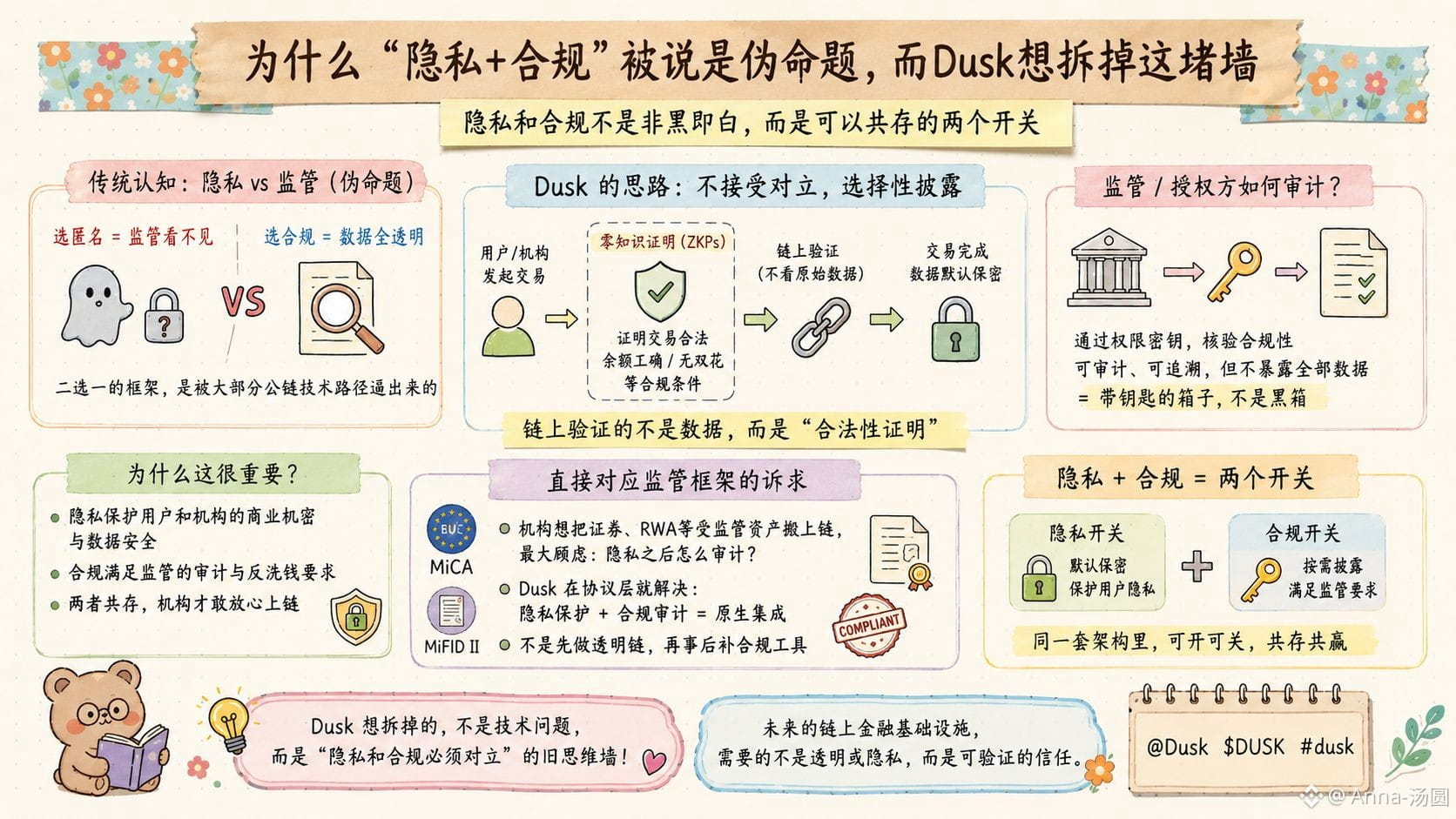
Mainstream narratives have long put privacy and regulation in opposition—either you choose anonymity and regulators can’t see you; or you choose compliance and you have to lay everything bare for everyone to view. This either-or framework is, in fact, pushed by the technical approaches of most public chains, not something that was destined to be this way from the start
//
Dusk’s thinking isn’t about making a trade-off between these two ends—it fundamentally rejects the premise of this dichotomy.
Its core isn’t "complete anonymity"; it’s "selective disclosure." Using zero-knowledge proofs (ZKPs) as the underlying execution primitive, what gets verified on-chain isn’t the raw transaction data, but a cryptographic proof that can mathematically demonstrate: this transaction is legitimate, balances weren’t fabricated, and there’s no double-spending. The transaction itself is kept confidential by default, yet regulators or authorized parties can still verify compliance when needed.
In daily user and institutional transactions, data remains private—but when regulators want to audit, the chain leaves a controllable, permissioned verification channel. It’s not a black box; it’s a locked box with keys.
//
This design directly answers the goals of regulatory frameworks such as the EU’s MiCA and MiFID II. For institutions that want to bring regulated assets like securities and RWA onto the blockchain, the biggest concern has never been "whether to have privacy"—it’s "how to audit after privacy." Dusk fuses these two concerns together at the protocol level, instead of building a transparent chain first and then bolting on compliance tools afterward.
Privacy and compliance aren’t two absolutes on opposite ends of a spectrum; they’re two switches that can coexist within the same architecture. That’s probably the wall Dusk wants to take down
@Dusk $DUSK #dusk
Mainstream narratives have long put privacy and regulation in opposition—either you choose anonymity and regulators can’t see you; or you choose compliance and you have to lay everything bare for everyone to view. This either-or framework is, in fact, pushed by the technical approaches of most public chains, not something that was destined to be this way from the start
//
Dusk’s thinking isn’t about making a trade-off between these two ends—it fundamentally rejects the premise of this dichotomy.
Its core isn’t "complete anonymity"; it’s "selective disclosure." Using zero-knowledge proofs (ZKPs) as the underlying execution primitive, what gets verified on-chain isn’t the raw transaction data, but a cryptographic proof that can mathematically demonstrate: this transaction is legitimate, balances weren’t fabricated, and there’s no double-spending. The transaction itself is kept confidential by default, yet regulators or authorized parties can still verify compliance when needed.
In daily user and institutional transactions, data remains private—but when regulators want to audit, the chain leaves a controllable, permissioned verification channel. It’s not a black box; it’s a locked box with keys.
//
This design directly answers the goals of regulatory frameworks such as the EU’s MiCA and MiFID II. For institutions that want to bring regulated assets like securities and RWA onto the blockchain, the biggest concern has never been "whether to have privacy"—it’s "how to audit after privacy." Dusk fuses these two concerns together at the protocol level, instead of building a transparent chain first and then bolting on compliance tools afterward.
Privacy and compliance aren’t two absolutes on opposite ends of a spectrum; they’re two switches that can coexist within the same architecture. That’s probably the wall Dusk wants to take down
@Dusk $DUSK #dusk