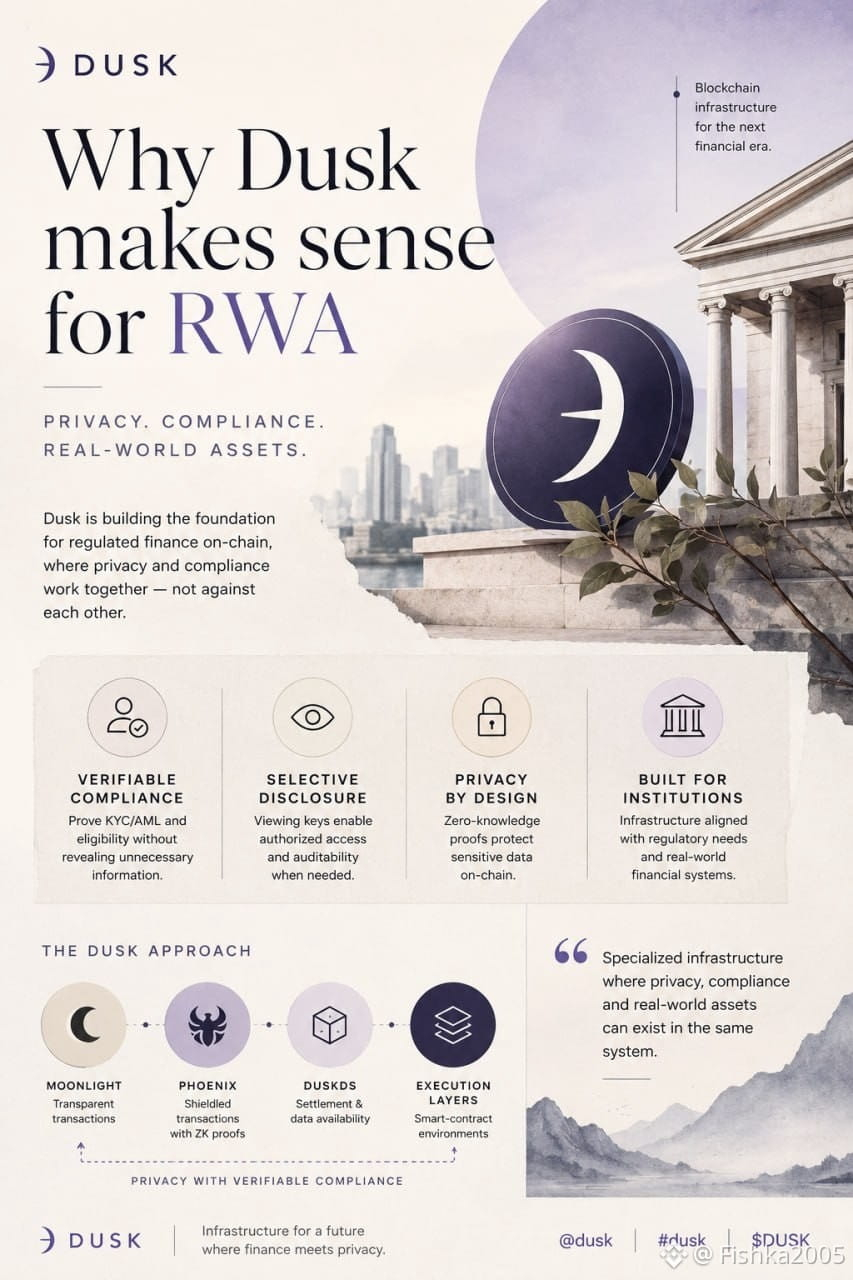
Why Dusk makes sense for RWA
The more I’ve been looking into Dusk, the more I see one particular use case where its design starts to make sense to me: real-world assets. At first, I was mainly interested in Dusk because of its privacy approach, but then I started thinking about what an institution would actually need if it wanted to move a regulated financial asset on-chain.
Simply creating a token isn’t enough. You need to know who is eligible to own it, who can receive it, what information regulators should be able to verify and how settlement can happen without exposing sensitive data to everyone on the network. This is where Dusk becomes particularly interesting to me, because its architecture is built around combining privacy with verifiable compliance.
The zero-knowledge approach changes the way I think about KYC and AML on-chain. Instead of putting all the underlying information on a public blockchain, a participant can potentially prove that certain requirements have been satisfied without exposing unnecessary private data. In other words, the network can verify that the rules were followed without making every detail visible to everyone.
After following crypto for years, I’ve seen plenty of projects compete around speed, fees and DeFi functionality, but Dusk is approaching a much less flashy problem: how do you make blockchain infrastructure work for regulated financial assets without forcing institutions to choose between complete transparency and complete privacy?
That’s why I don’t see Dusk simply as another general-purpose L1. What interests me is the idea of building specialized infrastructure where privacy, compliance and financial assets can exist in the same system.
For me, the biggest question is whether institutions will eventually consider privacy and verifiable compliance a basic requirement for bringing financial assets on-chain.
What do you think - will privacy become essential for institutional RWA, or will transparency remain the bigger priority?
@Dusk #dusk $DUSK
The more I’ve been looking into Dusk, the more I see one particular use case where its design starts to make sense to me: real-world assets. At first, I was mainly interested in Dusk because of its privacy approach, but then I started thinking about what an institution would actually need if it wanted to move a regulated financial asset on-chain.
Simply creating a token isn’t enough. You need to know who is eligible to own it, who can receive it, what information regulators should be able to verify and how settlement can happen without exposing sensitive data to everyone on the network. This is where Dusk becomes particularly interesting to me, because its architecture is built around combining privacy with verifiable compliance.
The zero-knowledge approach changes the way I think about KYC and AML on-chain. Instead of putting all the underlying information on a public blockchain, a participant can potentially prove that certain requirements have been satisfied without exposing unnecessary private data. In other words, the network can verify that the rules were followed without making every detail visible to everyone.
After following crypto for years, I’ve seen plenty of projects compete around speed, fees and DeFi functionality, but Dusk is approaching a much less flashy problem: how do you make blockchain infrastructure work for regulated financial assets without forcing institutions to choose between complete transparency and complete privacy?
That’s why I don’t see Dusk simply as another general-purpose L1. What interests me is the idea of building specialized infrastructure where privacy, compliance and financial assets can exist in the same system.
For me, the biggest question is whether institutions will eventually consider privacy and verifiable compliance a basic requirement for bringing financial assets on-chain.
What do you think - will privacy become essential for institutional RWA, or will transparency remain the bigger priority?
@Dusk #dusk $DUSK