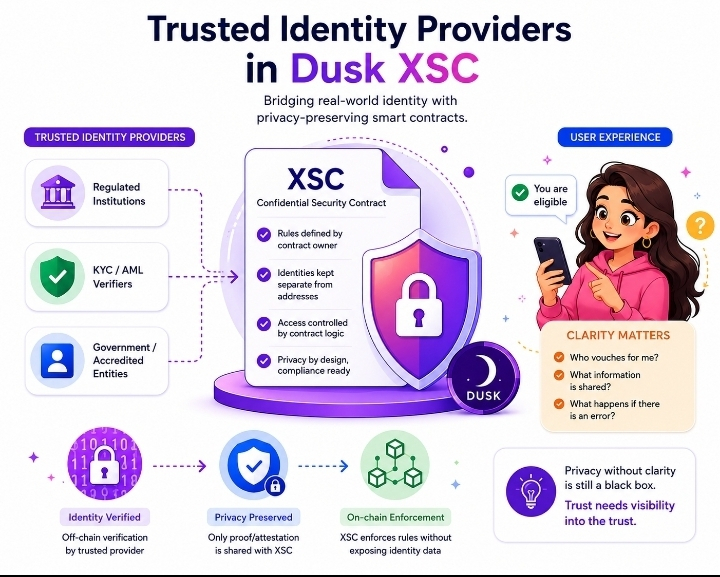
One thing about identity systems keeps bothering me: people usually accept verification when they understand who is making the decision. The moment that becomes unclear, even a technically sound system can start feeling untrustworthy.
That’s where Dusk’s XSC model gets interesting.
A concrete detail here is Citadel’s selective-disclosure approach. A user can prove an attribute such as residency, age bracket, or accreditation without revealing the underlying personal information. That proof can then support access and compliance rules around regulated assets.
Technically, that is a meaningful shift. But the user experience raises another question.
Imagine an investor seeing “You are eligible” on their screen. The system may only need proof that the required condition is satisfied. But who actually vouched for that condition? The identity provider? The issuer? Another authorized party? And what happens if that source gets it wrong?
This is where I think the usual “privacy creates trust” narrative falls short.
Privacy reduces unnecessary exposure. It doesn’t automatically explain the trust relationship behind the proof.
For @Dusk that distinction matters because XSC is designed around regulated asset workflows where eligibility and access controls become part of the system itself.
And $DUSK sits within an ecosystem where the credibility of those workflows may depend as much on understandable trust boundaries as on the underlying cryptography.
The interesting UX challenge isn’t only proving eligibility privately. It’s making the trust boundary understandable to the person using the system.
If users can verify the result but cannot understand who stands behind the verification, have we really removed the black box—or just made it cryptographically invisible?
#dusk
That’s where Dusk’s XSC model gets interesting.
A concrete detail here is Citadel’s selective-disclosure approach. A user can prove an attribute such as residency, age bracket, or accreditation without revealing the underlying personal information. That proof can then support access and compliance rules around regulated assets.
Technically, that is a meaningful shift. But the user experience raises another question.
Imagine an investor seeing “You are eligible” on their screen. The system may only need proof that the required condition is satisfied. But who actually vouched for that condition? The identity provider? The issuer? Another authorized party? And what happens if that source gets it wrong?
This is where I think the usual “privacy creates trust” narrative falls short.
Privacy reduces unnecessary exposure. It doesn’t automatically explain the trust relationship behind the proof.
For @Dusk that distinction matters because XSC is designed around regulated asset workflows where eligibility and access controls become part of the system itself.
And $DUSK sits within an ecosystem where the credibility of those workflows may depend as much on understandable trust boundaries as on the underlying cryptography.
The interesting UX challenge isn’t only proving eligibility privately. It’s making the trust boundary understandable to the person using the system.
If users can verify the result but cannot understand who stands behind the verification, have we really removed the black box—or just made it cryptographically invisible?
#dusk