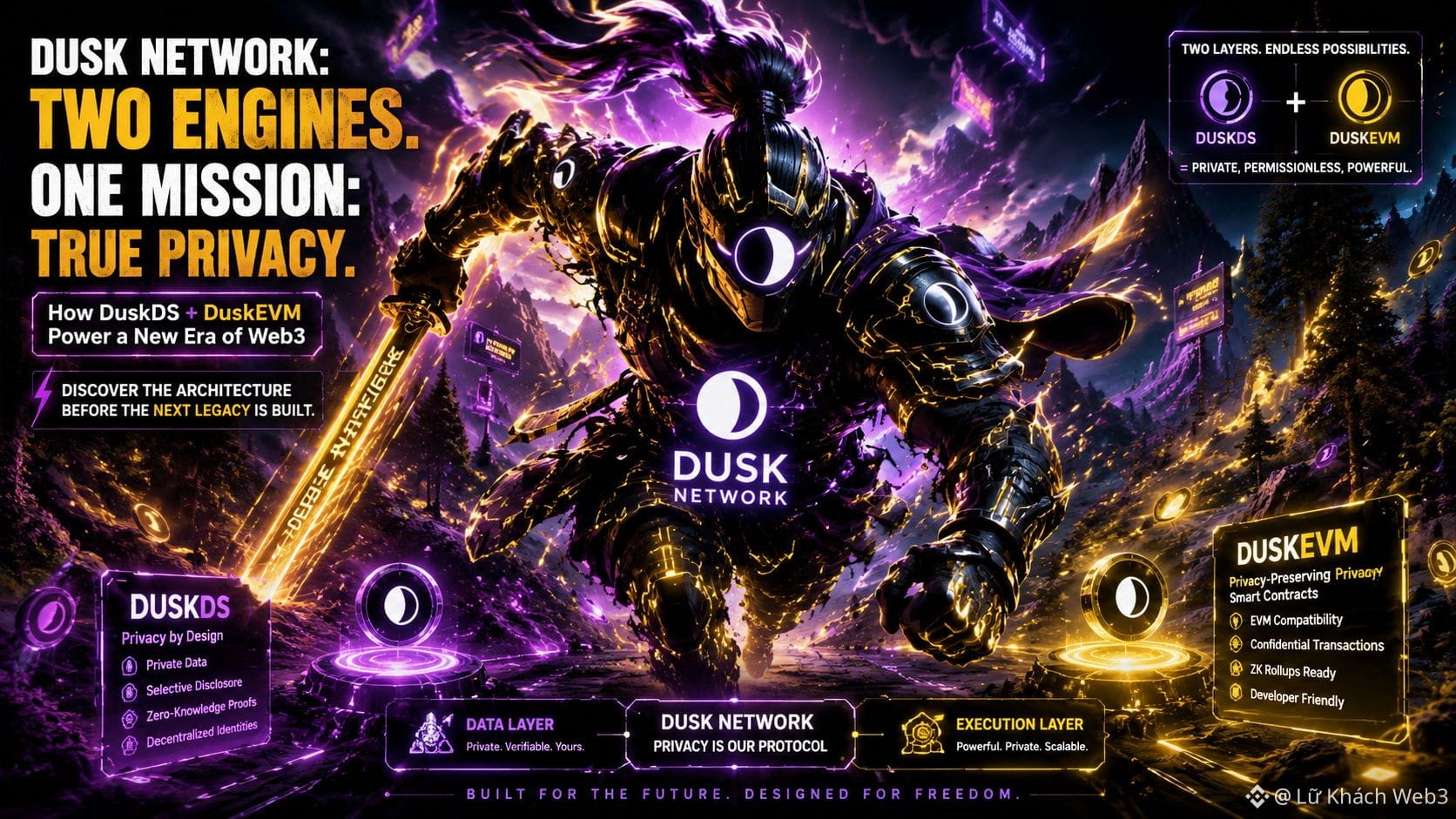
Something makes me pause when reading about Dusk Network: DuskDS and DuskEVM are described as two separate parts but they don’t stand independently.
I started with the architecture. The Dusk documentation calls DuskDS the settlement and data availability layer, responsible for consensus, finality, and the native transaction models of Dusk. DuskEVM is an EVM-compatible execution environment where Solidity smart contracts can run with familiar tooling. More importantly, DuskEVM uses DuskDS for settlement and data availability.
I want to check whether this is merely an architectural naming convention or whether there is a real separation of responsibilities.
Digging deeper, I find that DuskDS handles consensus, finality, and data availability along with transaction models like Moonlight and Phoenix. DuskEVM focuses on execution and allows using Hardhat, Foundry, and the broader EVM ecosystem. One side provides the settlement foundation; the other handles execution.
Wait—this still isn’t enough to say these two “complimentary” layers bring performance or security advantages in the usual sense. From what I was able to verify in the documentation, the clearest relationship is that execution is separated from settlement.
What’s interesting is that Dusk uses modularity to keep settlement separate while still giving developers access to the EVM. So if application adoption grows, does this separation between execution and settlement truly create an advantage—or is it simply an architectural way of organizing components?
#dusk $DUSK @Dusk $BTC
I started with the architecture. The Dusk documentation calls DuskDS the settlement and data availability layer, responsible for consensus, finality, and the native transaction models of Dusk. DuskEVM is an EVM-compatible execution environment where Solidity smart contracts can run with familiar tooling. More importantly, DuskEVM uses DuskDS for settlement and data availability.
I want to check whether this is merely an architectural naming convention or whether there is a real separation of responsibilities.
Digging deeper, I find that DuskDS handles consensus, finality, and data availability along with transaction models like Moonlight and Phoenix. DuskEVM focuses on execution and allows using Hardhat, Foundry, and the broader EVM ecosystem. One side provides the settlement foundation; the other handles execution.
Wait—this still isn’t enough to say these two “complimentary” layers bring performance or security advantages in the usual sense. From what I was able to verify in the documentation, the clearest relationship is that execution is separated from settlement.
What’s interesting is that Dusk uses modularity to keep settlement separate while still giving developers access to the EVM. So if application adoption grows, does this separation between execution and settlement truly create an advantage—or is it simply an architectural way of organizing components?
#dusk $DUSK @Dusk $BTC