
$CSCO In this FY2026 Q4 earnings report, what’s most worth focusing on isn’t only record-breaking revenue, but the fact that AI infrastructure orders have moved from concept into measurable business growth—and are now beginning to drive network, optical interconnect, and enterprise data center demand to accelerate in tandem.
First look at the core data
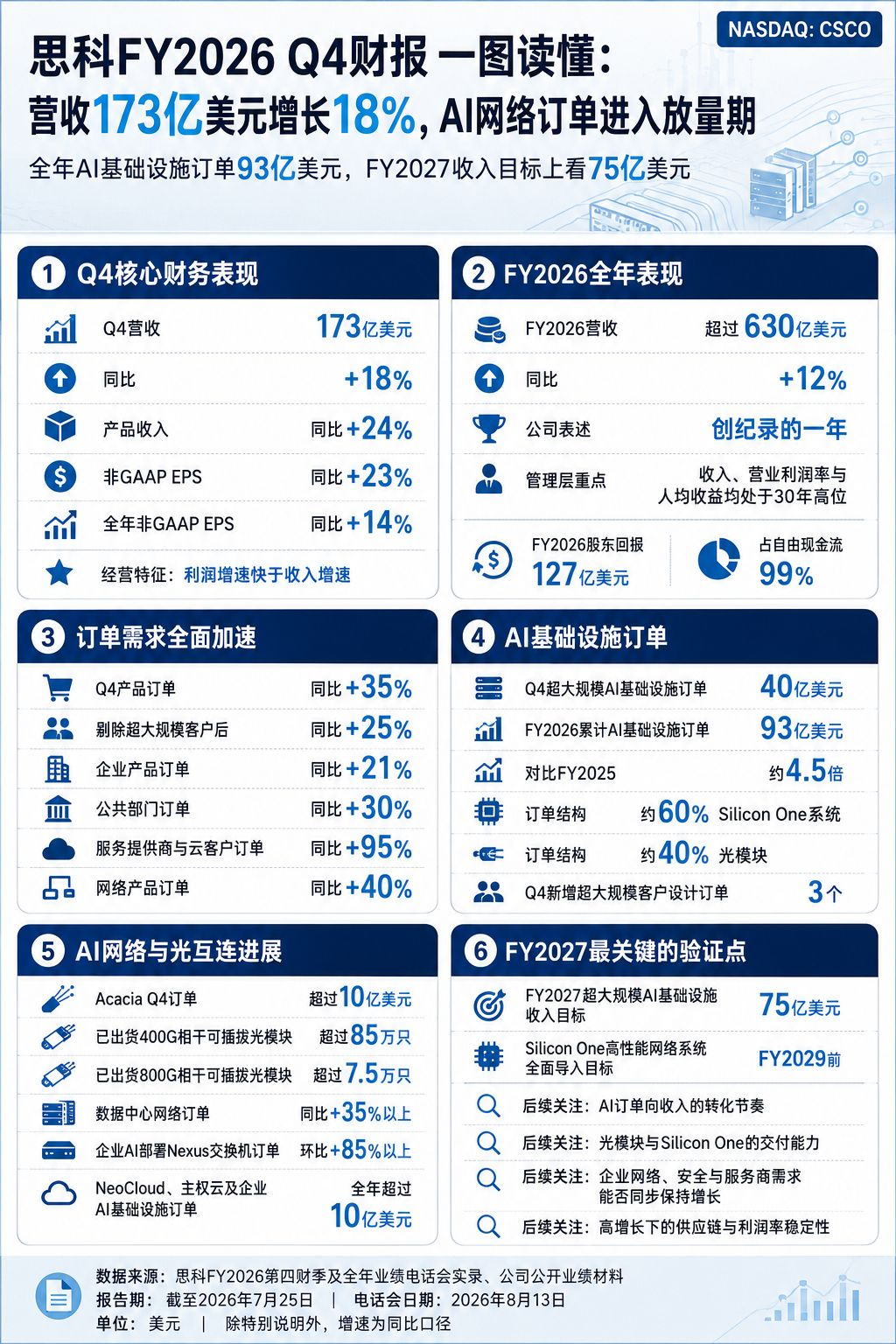
As of FY2026 Q4 on July 25, 2026, Cisco revenue was $17.3 billion, up 18% year over year. Product revenue grew 24% year over year, and non-GAAP EPS increased 23% year over year. For the full FY2026 year, revenue exceeded $63 billion, up 12%, and full-year non-GAAP EPS grew 14%. With both revenue and profit accelerating together, this earnings report’s strongest foundation is clear.
Order performance is the biggest highlight this quarter
Q4 product orders grew 35% year over year. Even excluding ultra-large-scale customers, they still grew 25%. Enterprise product orders grew 21%, public-sector orders grew 30%, orders from service providers and cloud customers grew 95%, and network product orders grew 40%. This suggests demand isn’t only supported by AI mega customers—enterprise refreshes, operator spending, and public-sector needs are also improving.
AI infrastructure is entering the order-to-cash realization phase
Cisco’s Q4 secured a massive $4.0 billion AI infrastructure order from a large-scale customer; the full FY2026 total reached $9.3 billion, about 4.5x FY2025. In the order mix, roughly 60% comes from Silicon One systems and about 40% from optical modules. The company expects FY2027 AI infrastructure revenue from large-scale customers to reach $7.5 billion. What the market will watch next is whether these orders can translate into revenue on schedule.
Optical interconnect is another key line of growth
Acacia’s Q4 orders exceeded $1 billion; cumulative shipments are already over 850,000 units of 400G pluggable coherent optical modules and over 75,000 units of 800G products. As AI clusters begin connecting more data centers, the importance of network bandwidth, coherent optical modules, and high-performance switching equipment will keep rising. Cisco’s opportunity isn’t only in switches—it’s also in the interconnection layer across data centers.
Enterprise AI and security demand are also spreading in parallel
Aside from ultra-large-scale customers, NeoCloud, sovereign cloud, and enterprise customers combined to contribute more than $1 billion in AI infrastructure orders in FY2026. In Q4, enterprise AI deployment-related Nexus switch orders increased sequentially by more than 85%, and data center network orders grew more than 35% year over year. The security business also delivered double-digit order growth, indicating that when customers expand AI infrastructure, they often invest together in networking, security, and observability.
What to focus on next
Cisco’s earnings report shows demand is strengthening, but there are still three things to verify going forward: the pace at which AI orders convert into revenue, the delivery capability of Silicon One and optical modules, and whether enterprise and service-provider network demand can continue growing. Strong order growth is just the start—the more critical next step is sustained conversion into revenue, profitability margins, and cash flow.
One sentence summary: The key change for Cisco this quarter is that AI cluster expansion is pushing the network, Silicon One, and optical interconnect into a new growth cycle. Whether it can realize $7.5 billion in AI infrastructure revenue in FY2027 is the most important validation point to watch next.

Follow me—I'll keep updating in a one-page chart to help you read key earnings reports of key companies in Hong Kong and the U.S. stock markets.