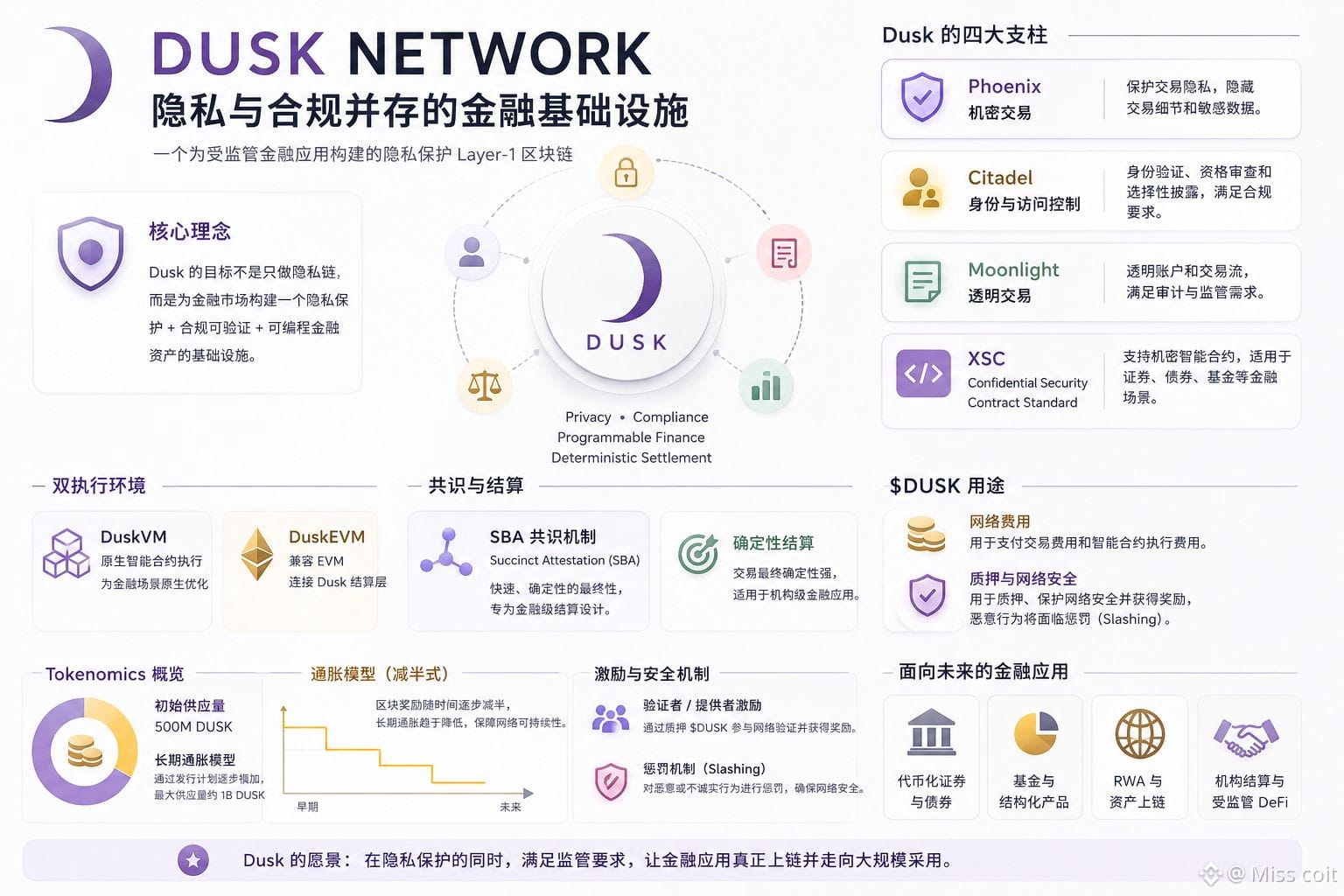
#dusk $DUSK After redrawing Dusk’s architecture diagram late at night, I found myself drawn to a design that seems contradictory at first: it doesn’t treat “privacy” and “compliance” as a simple either-or.
I stared at the relationship between XSC and Citadel for a long time. In financial markets, privacy that is truly valuable doesn’t necessarily mean “hiding everything.” Instead, it means that participants disclose only what is necessary, while preserving the verifiability of their identity, credentials, and the rules governing transactions. The significance of Zero-Knowledge here is not only to protect privacy, but also to reduce exposure of sensitive data.
This made me rethink Dusk’s positioning. It’s more like an attempt to solve a real-world problem: when digital assets such as securities, funds, and bonds need to enter regulated markets, institutions must both keep things confidential and prove that they meet the rules. Designs like XSC, Phoenix, and Citadel are built exactly around this contradiction.
I think this is the most interesting part of Dusk.
But I won’t ignore the other side: no matter how elegant the architecture is, it ultimately still has to face institutional adoption, liquidity, and regulatory deployment. Privacy and compliance can coexist, but that doesn’t mean the market will automatically form network effects.
For me, $DUSK is really worth watching not for whether it “can do privacy,” but for whether this privacy-compliant infrastructure can ultimately become a settlement layer for real financial activity?
If institutions truly need this model, will Dusk have a longer lifecycle than a purely privacy-focused chain? @Dusk