The moment I first heard that Dusk was doing a privacy chain, I didn’t really feel anything. Over the years, I’ve been fooled by so many privacy projects. Some were watched by regulators, and some were compliant but nobody used them. So when I first saw Dusk, I thought the same thing most people do: “Here we go again—another project trying to revolutionize finance.” But after I took the time to really look into DuskEVM and Hedger, my reaction changed to: “Wait… maybe there’s something here!”
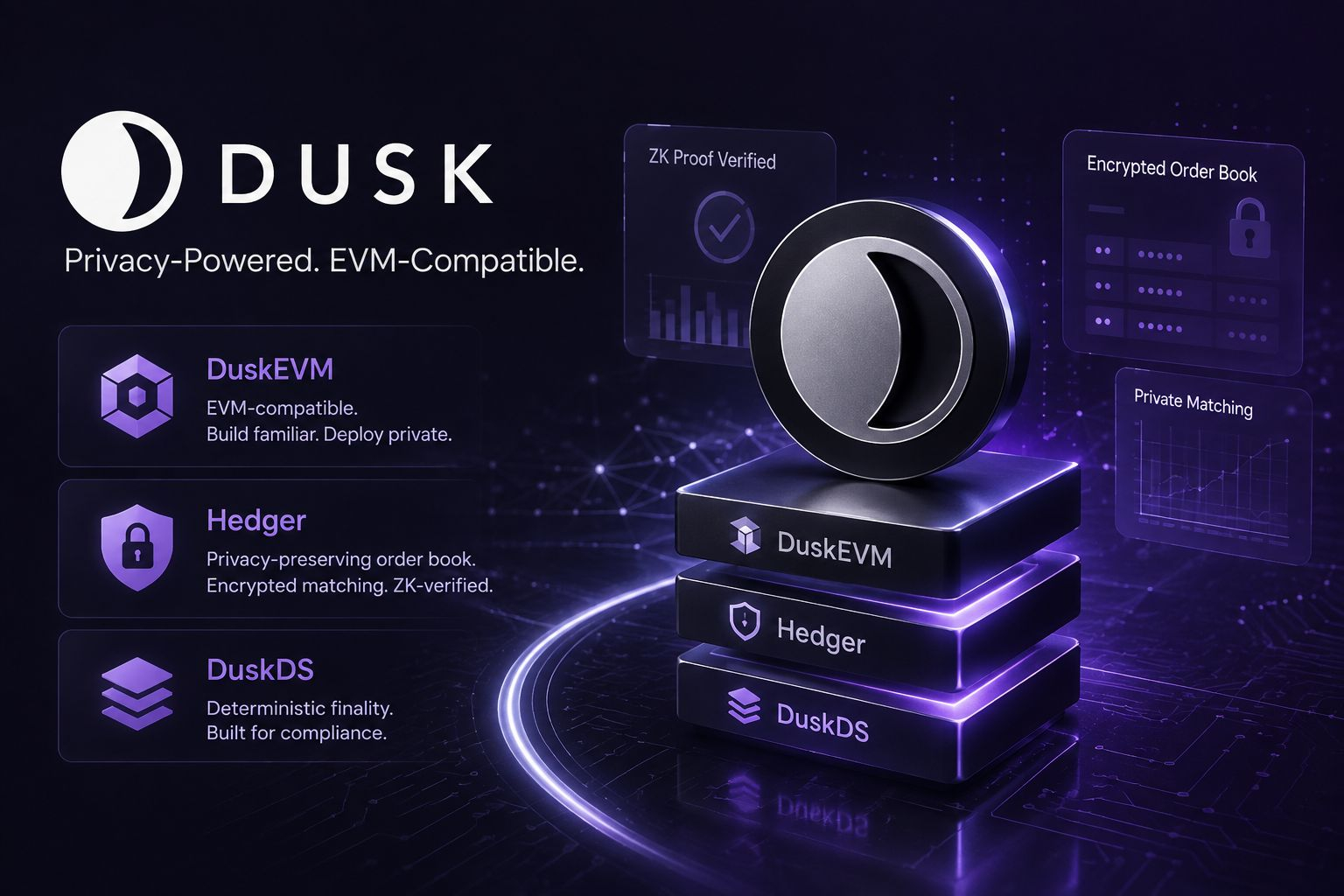
@Dusk got one thing right: it didn’t make developers learn an entirely new language. It’s EVM-compatible. Smart contracts written in Solidity for Ethereum can be brought over with almost no changes and run right away—Hardhat, Foundry, and MetaMask all work. The real difference is underneath: it separates the execution layer from the settlement layer. You run applications on top, and asset settlement and consensus land on Dusk—that’s its own L1, specifically designed for deterministic finality. In other words, you use the familiar toolchain on the front end, while compliance and privacy capabilities run underneath. This approach makes a lot of sense. No institution is going to rebuild and retrain a development team from scratch just to deploy on-chain—this path is no longer viable.
Now about Hedger: most DeFi privacy projects just rely on ZK proofs to brute-force the solution. Hedger is different—it brings both homomorphic encryption and zero-knowledge proofs into the picture. Using an elliptic-curve-based ElGamal scheme, the system can compute directly on encrypted data without exposing raw information, while ZK proofs verify the results. Why does this design make me feel there’s sincerity? Because order book privacy is a real problem. Most DEX order books are completely public. You post an order, and front-running bots and market makers swoop in—retail users end up being harvested. The idea is to encrypt orders on-chain: both price and quantity are ciphertext. The matching engine computes on the ciphertext, and only decrypts after the final trade price is determined. Order details never leak throughout, yet the matching logic remains verifiable. No brokerage is willing to put its holdings and strategies out under the sun—but Hedger enables proof generation on the browser side, and the official claim is that it can be done within two seconds.
But Dusk still isn’t at perfection yet. Homomorphic encryption computation has higher gas costs, and during the test phase there was also exposure of matching latency delays before the mainnet went live. Its large-scale performance will depend on more data. Still, it didn’t dodge the real issues: Dusk lowers the development barrier and addresses privacy concerns by providing a solid compliance foundation. In an era where regulation is tightening, this is the kind of reason institutions would seriously look at.#dusk $DUSK
@Dusk got one thing right: it didn’t make developers learn an entirely new language. It’s EVM-compatible. Smart contracts written in Solidity for Ethereum can be brought over with almost no changes and run right away—Hardhat, Foundry, and MetaMask all work. The real difference is underneath: it separates the execution layer from the settlement layer. You run applications on top, and asset settlement and consensus land on Dusk—that’s its own L1, specifically designed for deterministic finality. In other words, you use the familiar toolchain on the front end, while compliance and privacy capabilities run underneath. This approach makes a lot of sense. No institution is going to rebuild and retrain a development team from scratch just to deploy on-chain—this path is no longer viable.
Now about Hedger: most DeFi privacy projects just rely on ZK proofs to brute-force the solution. Hedger is different—it brings both homomorphic encryption and zero-knowledge proofs into the picture. Using an elliptic-curve-based ElGamal scheme, the system can compute directly on encrypted data without exposing raw information, while ZK proofs verify the results. Why does this design make me feel there’s sincerity? Because order book privacy is a real problem. Most DEX order books are completely public. You post an order, and front-running bots and market makers swoop in—retail users end up being harvested. The idea is to encrypt orders on-chain: both price and quantity are ciphertext. The matching engine computes on the ciphertext, and only decrypts after the final trade price is determined. Order details never leak throughout, yet the matching logic remains verifiable. No brokerage is willing to put its holdings and strategies out under the sun—but Hedger enables proof generation on the browser side, and the official claim is that it can be done within two seconds.
But Dusk still isn’t at perfection yet. Homomorphic encryption computation has higher gas costs, and during the test phase there was also exposure of matching latency delays before the mainnet went live. Its large-scale performance will depend on more data. Still, it didn’t dodge the real issues: Dusk lowers the development barrier and addresses privacy concerns by providing a solid compliance foundation. In an era where regulation is tightening, this is the kind of reason institutions would seriously look at.#dusk $DUSK