


$COHR This FY2026 Q4 earnings report appears, at first glance, to have delivered results and guidance that exceeded expectations. What’s truly worth focusing on, however, is that AI data center optical interconnect demand has driven revenue, improved profit margins, and provided a strong outlook for the next quarter. But after the stock price surged significantly ahead of time, the market’s bar for “beating expectations” has clearly risen as well.
First, look at the core data
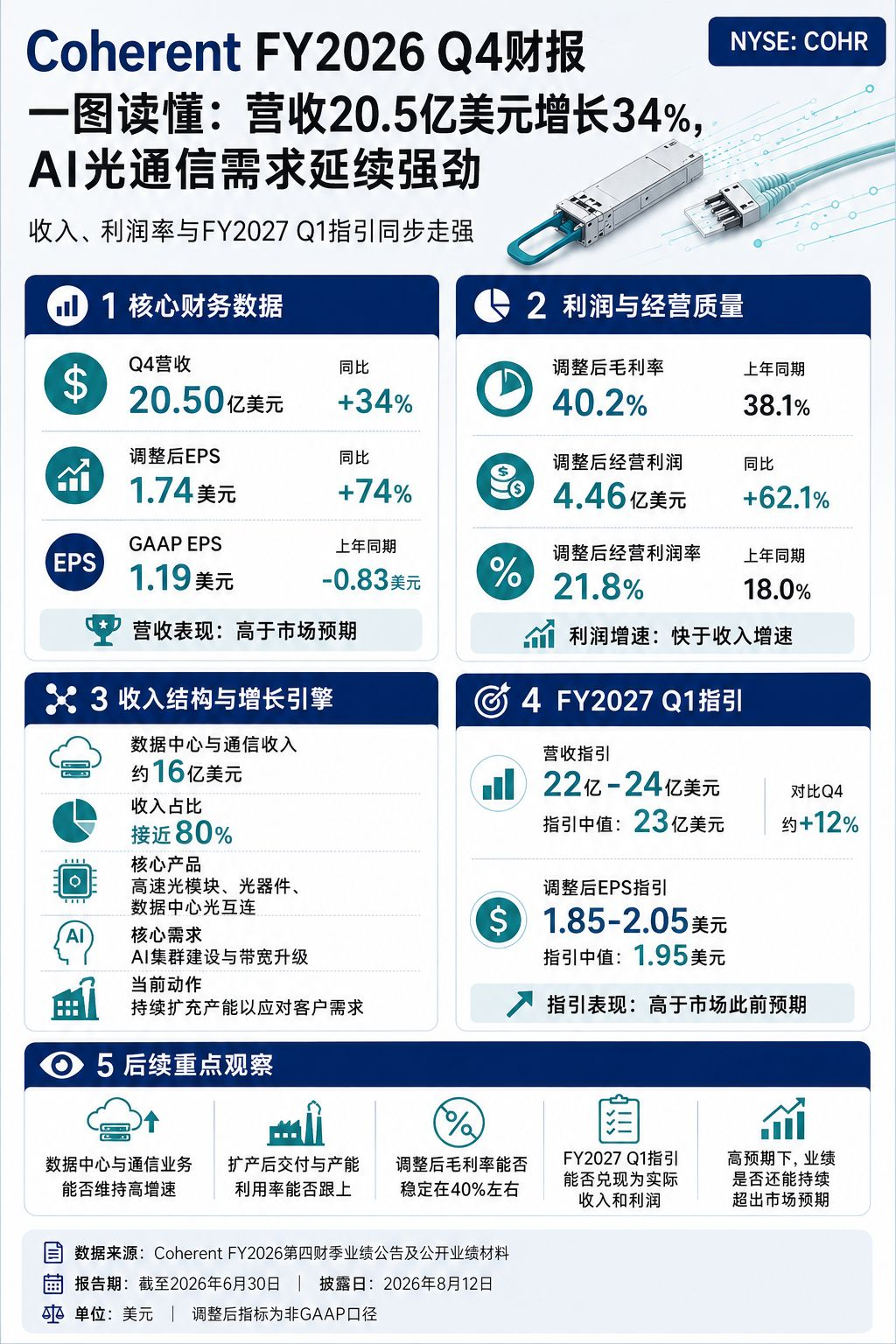
For FY2026 Q4 ended June 30, 2026, Coherent reported revenue of $2.05 billion, up 34% year over year. Adjusted EPS was $1.74, up 74%, beating market expectations. GAAP EPS was $1.19, compared with a loss of $0.83 in the prior-year quarter. Looking at the income statement alone, this is an earnings report showing simultaneous improvement in both growth and profitability.
Improving profit margins is more important than just growing revenue
This quarter’s adjusted gross margin was 40.2%, up 2.15% year over year. Adjusted operating profit was $446 million, up 62.1% year over year. Adjusted operating margin reached 21.8%, up 3.81% year over year. This indicates that revenue growth is not achieved purely by expanding volume; the product mix and operating leverage are also improving. For optical communications companies, whether gross margin can be sustained is an important indicator of whether the industry’s momentum can translate from strong orders into realized profitability.
Data center and communications remain the main thread
Revenue from data center and communications is about $1.6 billion, accounting for nearly 80% of total revenue, and remains the main source of growth this quarter. As AI clusters keep expanding, demand for high-speed optical modules, optical components, and data center interconnects rises. Coherent benefits from its positioning across optical communications, materials, and manufacturing.
However, this also means that the company’s subsequent performance will be more dependent on the cadence of AI infrastructure capital expenditures. When demand is strong, optical interconnect suppliers can benefit from increased orders and higher capacity utilization; once a client’s purchasing schedule changes, the market will quickly reassess inventory, deliveries, and gross margins.
Next quarter’s guidance continues to send positive signals
The company expects FY2027 Q1 revenue of $2.2 billion to $2.4 billion, with the midpoint at $2.3 billion. Adjusted EPS is expected to be $1.85 to $2.05, both above market expectations earlier. Management’s comments on demand remain positive, and they said they are expanding capacity to meet customer demand.
Guidance came in above expectations, which suggests that current order and delivery cadence is still strong. But from an investment perspective, guidance itself is not the endpoint. The market will next look at whether capacity expansion goes smoothly, whether growth can continue to be driven by higher-gross-margin products, and whether gross margin around 40% can be maintained.
Why is the earnings report strong, but the market reaction may not be
After the earnings release, the stock price weakened in after-hours trading. This doesn’t mean the results are poor; it more likely reflects that market expectations had already been very high. In the past stretch, the AI optical communications sector has risen significantly. Investors are now trading not just for “demand moving higher,” but for “performance that keeps coming and clearly beats expectations.”
This is also a shared characteristic of today’s AI infrastructure supply chain: fundamentals are still important, but valuations have already priced in a good amount of optimism ahead of time. Going forward, stock performance will depend more on how quickly earnings execution continues to exceed the market’s raised expectations—not just on year-over-year high growth.
What should we focus on next?
The three most important things to track next are: whether data center and communications business can maintain high growth rates; whether gross margin can stay stable after capacity expansion; and whether the FY2027 Q1 guidance can continue to be validated by actual revenue and profit.
In one sentence: Coherent’s FY2026 Q4 earnings report shows that demand for AI optical interconnects is still strong. But against the backdrop of high expectations and high valuations, what the market cares about most now is profit margins, capacity execution, and the next round of upside surprises.


Follow me—I'll continue to update with a one-page chart explaining key earnings reports for major companies in Hong Kong and the U.S.