I had a bit too much to drink today, so I’ll share something that surprised me about Dusk Network.
To be honest, when I first heard about this project, I didn’t feel much—just another privacy blockchain. But after it launched its mainnet on January 7th this year, I went through its whitepaper and technical documentation carefully. The more I read, the more there seemed to be something real here.
What truly impressed me about Dusk is that @Dusk solves a long-standing deadlock in the financial industry: how privacy and compliance can coexist. Traditional public chains are either fully transparent, so institutions don’t dare to use them; or they’re pure privacy coins that can’t properly support KYC and audits—regulators don’t recognize them. Dusk uses PLONK zero-knowledge proofs to connect these two sides. By default, transaction data is hidden, but when needed, cryptographic proofs can be generated to verify legitimacy. All of this is done without exposing any sensitive information. This logic fits precisely with the requirements of EU MiCA and MiFID regulations.
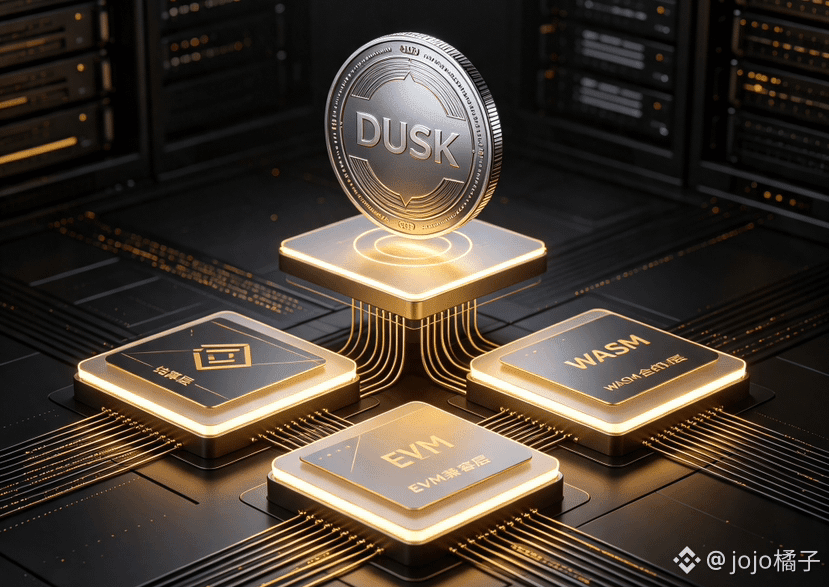
The technical architecture is also quite thoughtful. DuskDS handles settlement, DuskEVM is compatible with the Ethereum ecosystem, and Solidity developers can get started right away. There’s also a WASM-based DuskVM that supports writing smart contracts in Rust. The modular design makes it more extensible—unlike some blockchains where making changes is harder than climbing to the heavens.
I think the smartest thing about Dusk is that it didn’t treat itself as a speculative tool. Instead, it has quietly and diligently built compliant privacy infrastructure. This path isn’t easy, but once it’s made it through, it becomes a real moat.
#dusk $DUSK
To be honest, when I first heard about this project, I didn’t feel much—just another privacy blockchain. But after it launched its mainnet on January 7th this year, I went through its whitepaper and technical documentation carefully. The more I read, the more there seemed to be something real here.
What truly impressed me about Dusk is that @Dusk solves a long-standing deadlock in the financial industry: how privacy and compliance can coexist. Traditional public chains are either fully transparent, so institutions don’t dare to use them; or they’re pure privacy coins that can’t properly support KYC and audits—regulators don’t recognize them. Dusk uses PLONK zero-knowledge proofs to connect these two sides. By default, transaction data is hidden, but when needed, cryptographic proofs can be generated to verify legitimacy. All of this is done without exposing any sensitive information. This logic fits precisely with the requirements of EU MiCA and MiFID regulations.
The technical architecture is also quite thoughtful. DuskDS handles settlement, DuskEVM is compatible with the Ethereum ecosystem, and Solidity developers can get started right away. There’s also a WASM-based DuskVM that supports writing smart contracts in Rust. The modular design makes it more extensible—unlike some blockchains where making changes is harder than climbing to the heavens.
I think the smartest thing about Dusk is that it didn’t treat itself as a speculative tool. Instead, it has quietly and diligently built compliant privacy infrastructure. This path isn’t easy, but once it’s made it through, it becomes a real moat.
#dusk $DUSK