Seeing @Dusk , there are creator tasks again—by the way, let me chat about a hardcore “dark history” I came across earlier.
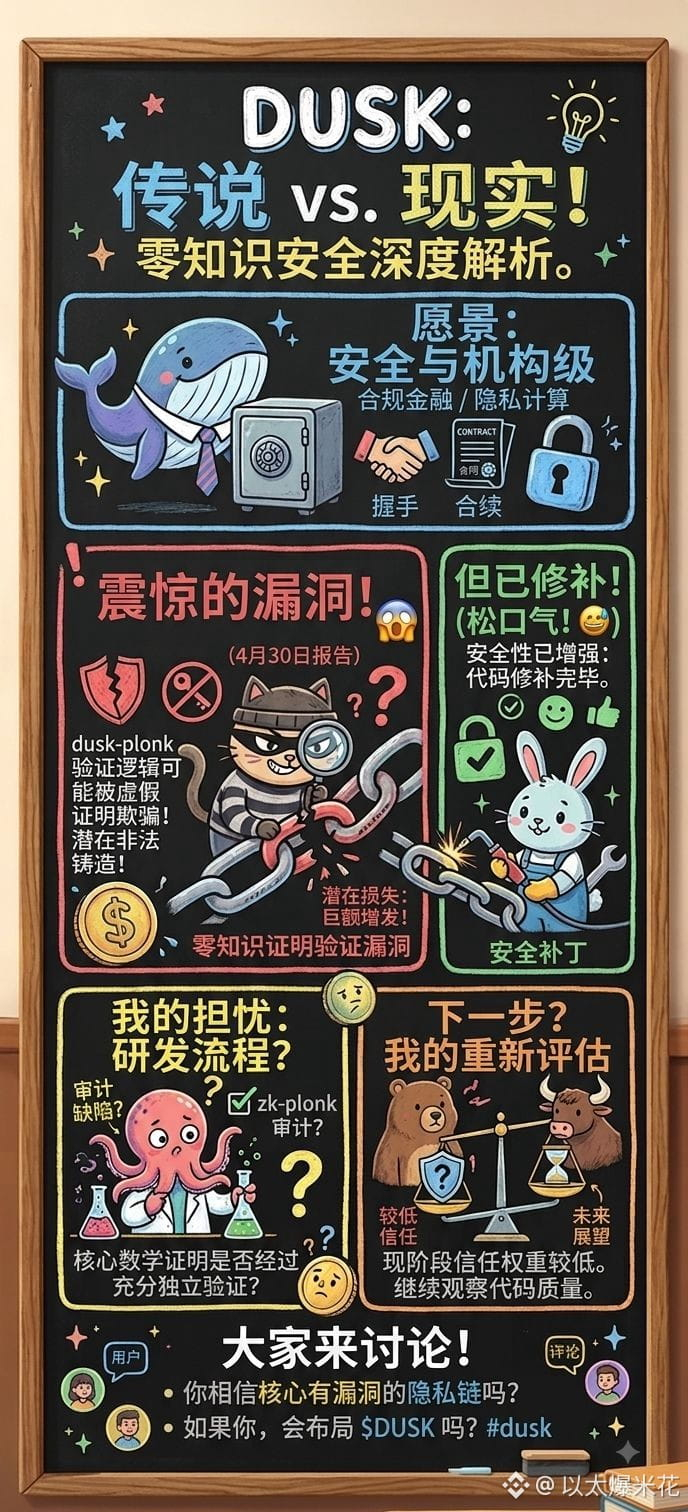
This April, the report OtterSec exposed really made me nervous! The issue wasn’t ordinary business logic—it actually stemmed from the most core part of ZK proof verification (dusk-plonk). Simply put, the attacker had the chance to forge proofs, creating infinite token issuance out of thin air or stealing assets 🥶🤮. For a privacy chain focused on institutional-grade privacy and compliant finance, being breached at the verification layer is a truly earth-shaking matter that shakes the foundation.
Although the vulnerability has long been fixed and no real loss occurred, after reading the audit report I still couldn’t shake the feeling: for the most critical zero-knowledge proof component, did the previous audits really not fully cover it? The privacy chain sells the trust of cryptographic security—if the core components haven’t been put through repeated stress and scrutiny, the engineering and development process definitely deserves a score reduction.
I’m not trying to write it off or dismiss it, but for projects that prioritize privacy, if their code-based risk control slips even once, the trust cost can double. At this stage, I’ve chosen to keep observing and see whether their subsequent security operations and technical iterations are truly solid.
Do you think a major security vulnerability in a privacy public chain can be “vetoed” in one go? If it were you, would you still consider positioning $DUSK ? Let’s discuss in the comments! #dusk
This April, the report OtterSec exposed really made me nervous! The issue wasn’t ordinary business logic—it actually stemmed from the most core part of ZK proof verification (dusk-plonk). Simply put, the attacker had the chance to forge proofs, creating infinite token issuance out of thin air or stealing assets 🥶🤮. For a privacy chain focused on institutional-grade privacy and compliant finance, being breached at the verification layer is a truly earth-shaking matter that shakes the foundation.
Although the vulnerability has long been fixed and no real loss occurred, after reading the audit report I still couldn’t shake the feeling: for the most critical zero-knowledge proof component, did the previous audits really not fully cover it? The privacy chain sells the trust of cryptographic security—if the core components haven’t been put through repeated stress and scrutiny, the engineering and development process definitely deserves a score reduction.
I’m not trying to write it off or dismiss it, but for projects that prioritize privacy, if their code-based risk control slips even once, the trust cost can double. At this stage, I’ve chosen to keep observing and see whether their subsequent security operations and technical iterations are truly solid.
Do you think a major security vulnerability in a privacy public chain can be “vetoed” in one go? If it were you, would you still consider positioning $DUSK ? Let’s discuss in the comments! #dusk