

(Source: Energy Storage Industry Network)
Recently, during a research interview with Jinko Technology (601778) regarding the question “What are the company’s development plans for its energy storage business this year?”, the company stated:
Energy storage business is one of the company’s core strategic priorities. Currently, the scale of its domestic projects under construction and in reserve has already exceeded 30GWh, including grid-side energy storage and user-side energy storage. In 2026, the company will further leverage its strengths in resources and experience to accelerate the commissioning and grid connection of projects. It will also continuously implement the development strategy of “heavy development, strong execution, high turnover, and high-efficiency operations.” By achieving rapid turnover, the company aims to generate profit contributions.
According to publicly available information, Jinko Technology was founded in 2011 and listed in May 2020. Its business began with investment, operation of PV power generation projects, and EPC turnkey contracting. It has gradually extended into areas such as PV + energy storage off-grid services and integrated energy services, and has been included among the Global Fortune 500 (top 500) global new energy enterprises.
Jinko Energy Storage is the implementation vehicle for Jinko’s energy storage strategy. Established in December 2022, the business covers both the source-grid side (large grid-side energy storage), the user side (industrial and commercial energy storage), and overseas PV-storage integrated projects. It provides end-to-end services from cell technology, system integration, to project development, construction, and operations. In just a few short years, it has grown from a newcomer in the industry to become a global Tier-1 energy storage manufacturer. It has been included in the BloombergNEF (BNEF) Tier-1 energy storage manufacturer rankings for many years, consistently maintaining a leapfrogging development trajectory and leading the global average level in the energy storage industry, with strong growth momentum.
Looking at specific data, in 2024 its energy storage product shipment volume reached 1.2GWh, and it grew significantly to 5.2GWh in 2025. Based on its mature business layout and market reserves, the company has clearly defined its energy storage business development targets for 2026: the annual shipment volume will strive to reach the 10GWh threshold, and it is expected to achieve another doubling growth, continuously expanding its market scale advantages.
As its business scale continues to expand, Jinko Energy Storage has officially completed a comprehensive upgrade of its operating strategy, bidding farewell to the industry’s extensive, disorderly expansion model. 2025 is a key year for scaling up and ramping the energy storage business volume, while 2026 will be the turning year for high-quality business development—marking its entry into a new phase of “balancing scale expansion with profit improvement.”
On the level of new technical products, Jinko Energy has recently officially launched the “Sunny Days 365” smart PV-storage system—a solution for AIDC artificial intelligence data centers. The solution deeply integrates efficient photovoltaic power generation, long-duration energy storage technology, and intelligent digital O&M capabilities, precisely meeting the core development needs of the computing industry for high energy consumption, high reliability, and low-carbon development.
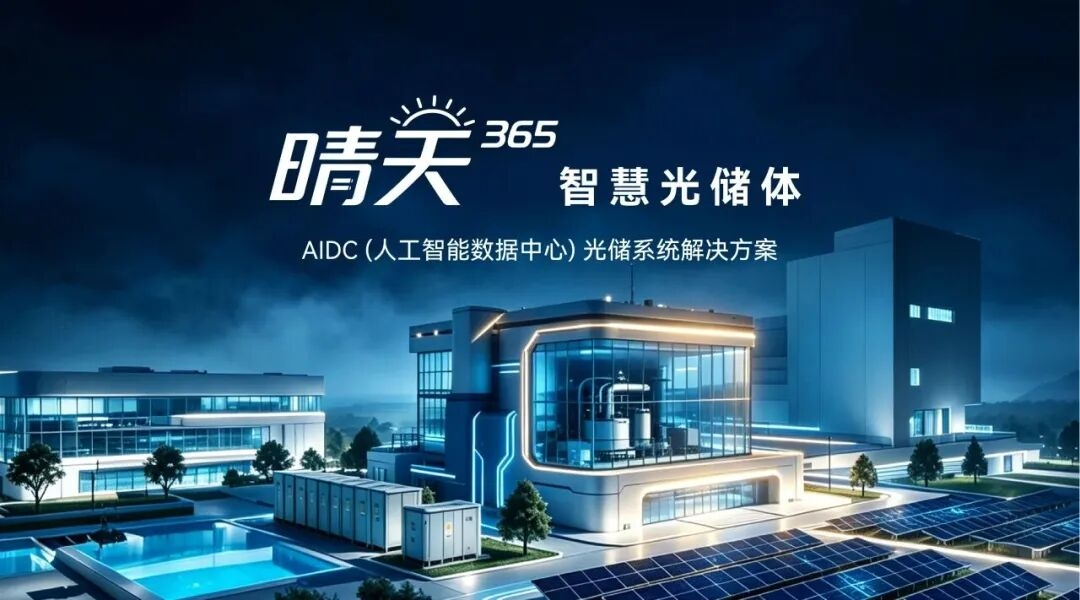
From the current long-term demand side, the energy storage demand accompanying AI data centers’ computing workloads will become the core driving force for Jinko Energy Storage’s long-term growth. At present, the penetration rate of PV-storage for data centers in the market is still below 10%, leaving a vast blue-ocean space. Meanwhile, as manufacturers such as NVIDIA promote the evolution of next-generation AI data centers toward an 800V HVDC (high-voltage DC) power-supply architecture, the high power density, rapid power fluctuations, and all-weather uninterrupted characteristics of AI computing loads pose extreme challenges to the dynamic response of power systems and their ability to support the grid.
In particular, Jinko Energy’s AIDC solution precisely captures the technology trend of “high-voltage DC + energy storage.” Through coordinated control among energy storage systems, PCS, and EMS, it enables fast power response, grid-forming support, and smooth transitions between grid-connected and islanded modes. This supports the evolution of the energy architecture for AI data centers—namely “short-term dynamic support + long-term energy storage”—improving the power supply continuity for critical computing workloads and strengthening system resilience.
Among them, the components rely on Jinko Energy’s mature Flying Tiger 3 platform technology. They are deeply focused on special requirements such as high-load operation in data centers, round-the-clock long-duration running, extreme weather resistance, stable and reliable performance, low maintenance needs, and large-scale deployment;
To meet the high-power, continuous-operation, and high-reliability power-supply requirements of AI data centers, Jinko Energy Storage’s Blue Whale energy storage system (SunTera) provides stable and reliable empowerment for data centers with high safety, strong support capability, and long service life.
Overall, competition in the energy storage track has long moved beyond a phase of simply vying by scale. From ramping up project pipeline reserves and pushing shipment targets, to shifting toward high-quality operations that balance scale and efficiency, Jinko has already completed an iterative advancement from a PV cross-over to energy storage.
With the launch of Jinko AIDC energy storage solutions, its business reach extends into a brand-new blue-ocean track of computing power and energy. Faced with the opportunity for energy transformation brought about by AI computing power, will Jinko Energy Storage be able to seize the industry window? With project pipeline reserves, product technology, and end-to-end operational capabilities, whether it can open a new growth curve in the incremental market is certainly worth continued observation by the industry.
Proofreading: Huanzi
Reviewed by: Lao Zhang
Special Statement: The Energy Storage Industry Network reposts content from other websites. This is done for the purpose of conveying more information rather than for profit. It does not represent approval of their views or verification of the descriptions. The content is for reference only. All copyrights belong to the original authors. If there is any infringement, please contact us to have it removed.