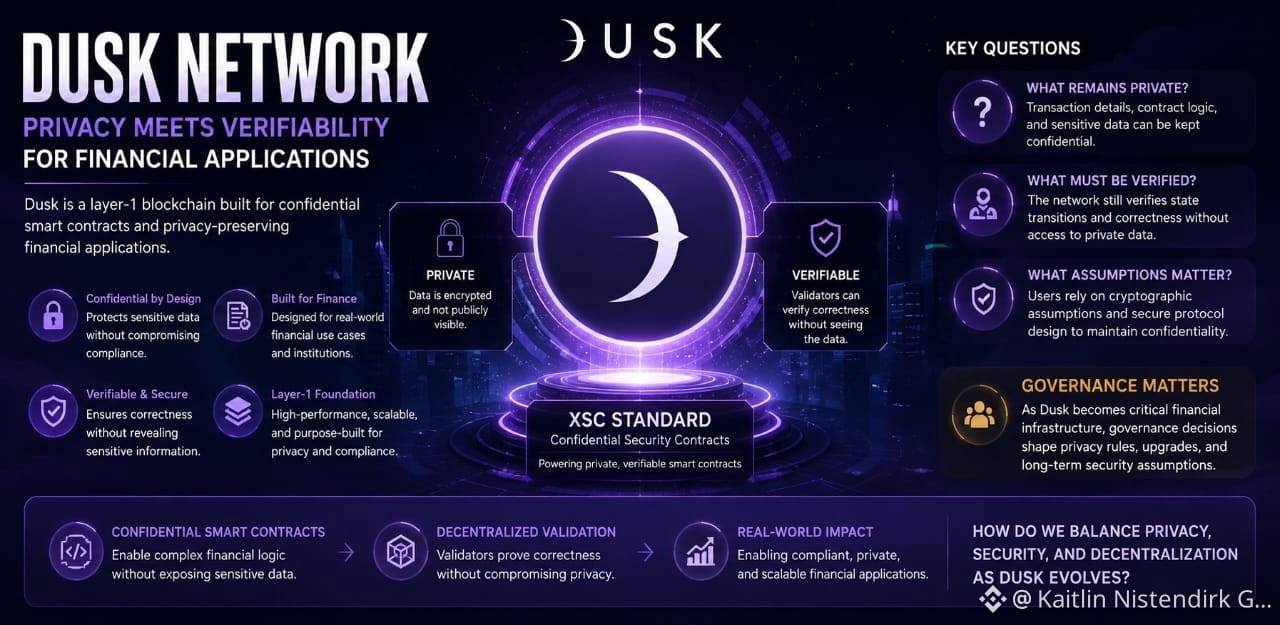
I went back to Dusk again because I realized I was looking at the privacy side of it too simply.
My first thought was basically, “it keeps financial transactions private.” But after spending more time with the documentation, that explanation started to feel incomplete.
What I’m more interested in now is the balance behind it. If some information is hidden, the network still has to prove that everything is valid. So what exactly do validators see? What stays private? And how much do users have to trust the system and its assumptions for that privacy to actually mean something?
The XSC approach made me think about this differently.
Then I started thinking about what happens further down the road. If financial applications really start depending on Dusk, governance becomes important too. Changes to the protocol or privacy system could affect applications that were built around the earlier rules.
I’m still learning here, and I’m sure there are parts I haven’t fully understood yet.
That’s honestly what keeps me interested in Dusk.
For those who have spent more time with the protocol, what part do you think deserves the most attention: the privacy model, verification, governance, or decentralization?
@Dusk $DUSK #dusk
My first thought was basically, “it keeps financial transactions private.” But after spending more time with the documentation, that explanation started to feel incomplete.
What I’m more interested in now is the balance behind it. If some information is hidden, the network still has to prove that everything is valid. So what exactly do validators see? What stays private? And how much do users have to trust the system and its assumptions for that privacy to actually mean something?
The XSC approach made me think about this differently.
Then I started thinking about what happens further down the road. If financial applications really start depending on Dusk, governance becomes important too. Changes to the protocol or privacy system could affect applications that were built around the earlier rules.
I’m still learning here, and I’m sure there are parts I haven’t fully understood yet.
That’s honestly what keeps me interested in Dusk.
For those who have spent more time with the protocol, what part do you think deserves the most attention: the privacy model, verification, governance, or decentralization?
@Dusk $DUSK #dusk