
Source: China Automotive News Network
Recently, news that Chevrolet has stopped selling new cars in China has gone viral across the auto industry. The familiar golden bowtie logo is making its exit from China’s new-car market in an almost quiet manner.
Many people can’t tell whether Chevrolet has fully withdrawn from China or is simply not selling new cars. In response, General Motors said: “SAIC-GM will continue producing Chevrolet in China and actively explore opportunities in overseas markets outside the United States.” In other words, Chevrolet models will still be produced, but they will no longer be sold domestically—instead, they will be exported.
One generation of American-style family cars rose to prominence and then declined
Time goes back to 2005, when it was the golden age for joint-venture brands. The home-sedan market in the 100,000-150,000 CNY tier was almost entirely dominated by joint-venture brands. That year, SAIC-GM formally introduced the Chevrolet brand to China. At that time, SAIC-GM’s layout was clear: Cadillac was positioned for the luxury market, Buick for mainstream mid-to-high-end, and Chevrolet focused on entry-level family markets.
With a value-for-money joint-venture positioning, Chevrolet quickly opened the market in China. In April 2009, the first-generation Cruze was launched in the domestic market. With its rugged sporty appearance, WTCC (World Touring Car Championship) motorsports marketing, and endorsement by (the prison-break male lead) Wentworth Miller, it quickly went viral in that year’s relatively mainstream family sedan market, spawning a massive culture of car customization. For countless post-80s and post-90s, it was their first joint-venture sedan in life—arguably Chevrolet’s “legendary” model in China.
In 2012, the 8th-generation Chevrolet Malibu was officially introduced to the domestic market. Backed by authentic American muscle-style sporty looks, solid handling fundamentals, and people-friendly pricing, it successfully established a clear label for American-style accessible sporty midsize sedans, quickly deepening its presence in the domestic joint-venture family-car market.
2014 was Chevrolet’s peak that couldn’t be replicated in China—full-year sales reached 767,000 units, accounting for more than 40% of SAIC-GM’s total sales. Nearly 1,000 dealers across the country meant you could see golden bowtie badges everywhere on streets and in alleys. Even today, this kind of volume is still a goal that most new-energy brands find hard to reach. Chevrolet remained firmly in the first tier among joint-venture brands.
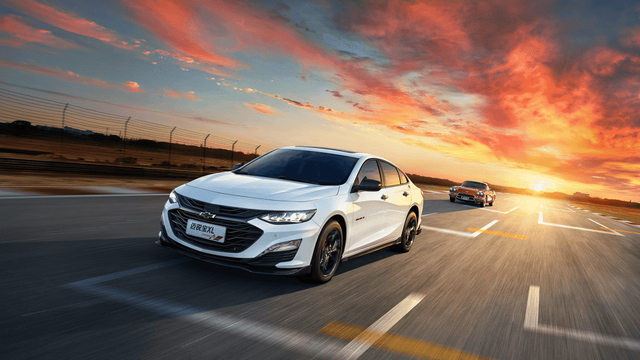
The turning point came in 2018. General Motors promoted a three-cylinder engine strategy globally, and SAIC-GM pushed it aggressively at home. Chevrolet’s main models were rolled out with three-cylinder powertrains one after another: the Cruze (科鲁泽), the Corvair? (科沃兹), and the Malibu XL (迈锐宝XL) all introduced three-cylinder versions, and even the small SUV Tracker (创酷) wasn’t an exception.
However, unlike European consumers’ greater tolerance for three-cylinder powertrains, China’s market has formed a deeply rooted perception that “a three-cylinder is inherently inferior to a four-cylinder.” Consumers are strongly resistant to three-cylinder engine vibration, noise, and residual value—placing sustained pressure on brand reputation. In 2019, Chevrolet’s sales in China fell to 410,000 units, nearly halving compared with its peak. Even though major models later returned to four-cylinder powertrains one after another, the damaged brand trust still couldn’t be fully repaired, and it never managed to return to its peak volume.
Meanwhile, branding within the group was in heavy internal competition. Buick’s core-selling models’ terminal prices kept moving downward, directly competing with Chevrolet in the 100,000-150,000 CNY mainstream home-car market. Chevrolet lacked high-end model support upward, and also lost its value-for-money advantage downward—shrinking its survival space. During the rollout period of GM’s Autonome (Ultium) platform, new electric products and marketing resources were prioritized for Buick and Cadillac, while Chevrolet’s electrification plans lagged significantly.
In addition, as domestic new-energy brands rose rapidly and took over the 100,000-CNY and above home-sedan and SUV segments, they overwhelmed older joint-venture fuel models with advantages in intelligence, long range, and low prices. The era of joint-venture fuel-car dividends gradually came to an end. Chevrolet’s product update pace was slow, and its brand presence nearly disappeared.
The falling figures are shocking. In 2022, retail sales were 200,000 units; in 2023, 169,000; in 2024, it fell below the industry survival line to just 52,700 units. In 2025, full-year retail was fewer than 9,000 vehicles. In multiple cities, there were no independent Chevrolet dealers, and many stores were shut down in large numbers. In the first half of 2026, Chevrolet’s new-car retail system in China basically came to a standstill. Third-party retail data shows that in June, the whole country sold only 1 unit—exiting the market is just a matter of time.
Anchored in China, heading overseas
This adjustment is GM’s strategic trade-off. In the Chinese market, it abandoned Chevrolet retail sales and focused resources on Buick and Cadillac’s new-energy transition. Domestic factories would be converted into export manufacturing bases. Relying on a mature supply chain, Chevrolet models would be produced for overseas sales—maximizing existing production capacity and achieving “manufacturing cars in China and selling them to the world.”
Regarding after-sales service issues for existing Chevrolet owners in China, GM said it will continue to honor its commitments and provide comprehensive after-sales service guarantees for more than 7 million Chinese car owners who currently have GM vehicles.
It is worth noting that on August 5 of this year, SAIC Group and General Motors signed a joint-venture renewal agreement, extending the SAIC-GM joint-venture term by 20 years to 2047. The two shareholders will further coordinate in areas such as technology R&D, supply chains, and global market resources, providing continued support for SAIC-GM’s intelligent and electrified transformation, local innovation, global expansion, and long-term healthy development. The plan calls for launching at least 30 new-energy vehicle models by 2030, mainly focusing on the Buick and Cadillac brands.
Looking back on Chevrolet’s 21-year journey in China, the contrast between its glorious annual sales of over 760,000 units and the loneliness of just one unit per month is striking. Chevrolet silently withdrew from the new-car market in China. It’s not only the end of an American brand—it’s a typical example of how a fuel-only joint-venture brand lost speed in its transformation amid the electricization wave. With missteps in product-route choices, misjudgments of local demand, a slow electrification layout, and imbalanced internal resource allocation—multiple contradictions piled up—Chevrolet ultimately couldn’t keep pace with the electric and intelligent transformation of China’s auto market.
While the Cruze and Malibu are still weaving through the streets, the golden bowtie carries the precious car-buying memories of a generation. But from then on, the domestic market would no longer plan to launch new Chevrolet models; only a small batch of inventory cars would be delivered. This brand that accompanied countless families as they grew up changed its identity—staying within China’s manufacturing supply chain and moving toward the world.