
(Source: Financial News)
In the first half of 2026, China’s innovative drug License-out overseas total amount is approximately US$99.7 billion, about twice the full-year figure for 2024.
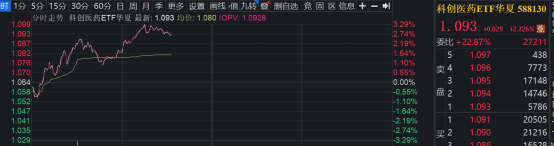
Benefiting from multiple catalysts, including favorable policy signals and the clustered release of strong interim results from leading companies, on August 13 the biotech innovation drug sector collectively rebounded. Among them, the leaders in innovative drugs showed outstanding upside momentum, the CXO industry chain stabilized amid volatility, and capital accelerated its布局 at the sector’s bottom as valuations moved toward recovery. As of 11:03, the Huaxia Biotech Innovation Drug ETF (588130) was up 2.73%. Among its holdings, Chengdu Saidao was up 8.02%, Reheat Bio was up 6.83%, Junshi Bio-U was up 6.52%, and Hao Yuan Pharma was up 6.40%.
I. News items
(1)? Performance: mid-year results from leading pharmaceutical companies have exceeded expectations
BeiGene’s 2026 first-half attributable net profit surged by more than 600% year over year. Its core product, BaiyuezE? (as written) (BaiyuezE), achieved single-quarter sales of over $1.2 billion and raised its full-year guidance. Zijing? (as written) Zhenjing? Pharma delivered its first profitable semi-annual report since listing, with cash flow turning positive. The innovative drug sector has entered a performance-driven stage.
(2)? CXO business sentiment has rebounded significantly; leading companies collectively raise full-year guidance
CSPC? (Note: As written) WuXi AppTec: revenue in the first half of 2026 grew 38.9% year over year; the company’s orders in continuing operations grew 25.2% year over year. The company has sharply raised its full-year revenue guidance to RMB 58.5–60.5 billion. After Tannox? (Note: As written) Tenon? Melbo’s core products entered reimbursement and volume surged, 2026 revenue is expected to increase by more than 570% year over year. The overall innovative drug industrial chain has entered a high-growth execution period.
(3)? Innovative drug overseas business development (BD) transactions remain highly active, as the global M&A window opens
In the first half of 2026, China’s innovative drug License-out overseas total amount was approximately $99.7 billion—about twice the total for all of 2024. As of July 10, the global TOP 15 multinational pharmaceutical companies’ external capital expenditures this year already reached $200.3 billion, close to 73.5% of the total for all of 2025. A high-activity landscape for M&A across the global pharmaceutical industry has basically been established.
(4)? The opening of bids in the 12th batch of centralized procurement releases positive signals. The tone is set as “stabilize clinical needs, counter against over-involution,” which will ease the suppression of the sector
In this round of centralized procurement, 10 original-research drugs are slated to be selected for the first time on record-breaking terms. At the policy level, the tone is set as “stabilize clinical needs, counter against over-involution.” The second-round weighting mechanism breaks the logic of only winning at the lowest price. Expectations for policy suppression on STAR Market innovative drugs and high-end devices have been significantly eased, and the valuation repair room for the sector has opened up.
(5)? Biopharmaceutical institutional research demand ranks first
From August 1 to 11, the number of biopharmaceutical-industry institutional research visits ranked first among all SW primary industries. Eleven companies, including BeiGene and Zijing? Pharma, attracted the most attention.
II. Breakdown of key individual stocks
1. United Imaging Healthcare
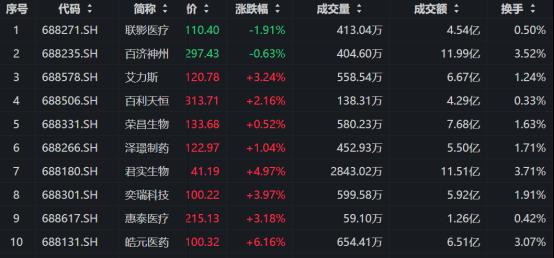
A leader in China’s high-end imaging and radiotherapy systems: it has won three consecutive crowns in CT and ranks #1 domestically in incremental market share for MR, PET-CT, PET-MR, and RT. The moat lies in coordinated synergy across the imaging chain—components, complete systems, and software. By end-2025, it has been granted over 6,100 authorized intellectual property rights (including over 3,990 inventions). Down 1.91% today, trading at RMB 110.40.
2. BeiGene
The most proven innovative drug company in global commercialization: Zanubrutinib is expected to generate RMB 28.07 billion worldwide sales in 2025; its Q4 U.S. BTK share of 43.3% topped the chart. With the hematologic-oncology pipeline and solid-tumor pipeline coming to fruition, the company’s global registration capability has been demonstrated. Down 0.63% today, trading at RMB 297.43.
3. Eliadis
A leading company in lung cancer EGFR-targeted therapy: Furmonertinib’s domestic market share for EGFR-mutated NSCLC is about 40%. It expands into brain metastases, with 20ins/PACC extensions, and has 86 invention patents reported in 2025 H1. Up 3.24% today, trading at RMB 120.78.
4. Bo Luheng
The world’s first EGFR×HER3 dual-antibody ADC (BL-B01D1) received a $800 million upfront payment as validation from BMS. The China and U.S. Phase 3 trials are advancing. It targets major cancers such as lung cancer and breast cancer, with potential of over $10 billion. Up 2.16% today, trading at RMB 313.71.
5. Rongchang Biotech
Driven by a dual engine: Taitexep (SLE biologics market share >30%) and Vydisotamab? (as written) (urothelial HER2 ADC market share >50%). PD-1/VEGF bispecific RC148 progresses into Phase 3, supported by a differentiated ADC plus T-cell platform. Up 0.52% today, trading at RMB 133.68.
6. Zijing? Pharma
Nonadine? (as written) Donafenib? / Gicax? (as written) Jix? / thrombin have all been approved and launched. DLL3 tri-specific antibody (global top-two order of precedence) licensed to AbbVie; PD-1/TIGIT liver cancer data exceeded expectations. Multi-platform approach across small molecules + proteins + antibodies. Up 1.04% today, trading at RMB 122.97.
7. Junshi Biosciences
Tremelimumab? (as written) Teplizumab? (Note: As written) Trepre? (Note: As written) Turipulizumab?—approved in China and the U.S., validating the company’s global registration strength. Its 2025 PD-1 sales are expected to be around RMB 2 billion (market share ~10%). Its weakness lies in the need for a second big-ticket product with a new mechanism to follow through. Up 4.97% today, trading at RMB 41.19.
8. Ascenion? (as written) YiRui Technology
Digital X-ray detectors: global unit sales market share reached 19.83% in 2024 (16.46% in 2021). It covers amorphous silicon, IGZO, and CMOS, with both medical and industrial use cases, and continues to grow across dynamic, intraoral, industrial, and overseas segments. Up 3.97% today, trading at RMB 100.22.
9. Haitai Medical
Strong combination in electrophysiology plus coronary/peripheral interventional consumables: in 2025, coronary pathways reached RMB 1.343 billion and electrophysiology RMB 571 million. Penetration in AF/PFA plus Mindray’s channel synergy. Up 3.18% today, trading at RMB 215.13.
10. Aoyuan Pharma
The company’s main businesses include molecular building blocks, tool compounds, APIs, and CDMO services. It is an innovation-enablement enterprise in the drug R&D industrial chain. Its core capabilities lie in the linkage between front-end compound variety, delivery speed, and back-end process development and GMP manufacturing. It also benefits from demand for ADC payloads and highly active APIs. Up 6.16% today, trading at RMB 100.32.
III. Institutional views
【Huatai Securities: The logic for innovative drugs is shifting from valuation-driven to performance and global execution】
According to Huatai Securities, innovative drugs and their industrial chain remain the clearest sub-sectors in the medical sector’s industry trends, with significant room for growth. During the period of dense earnings releases for August mid-year reports, investors’ focus will be on companies’ operating execution and BD progress; in the medium to long term, the allocation value stands out.
【Guojin Securities: The loss-turning-to-profit inflection point for innovative drugs has arrived; catalysts are dense throughout the year】
Guojin Securities believes that the loss-turning-to-profit inflection point for innovative drug companies has arrived. Clinical data catalysts will be dense throughout the year. Combined with overseas clinical progress for the pipelines that have already been BD-outlicensed, the company is bullish on investment opportunities in the sector.
【CITIC Securities: Rebalancing away from non-tech exposures; increase holdings of leading innovative drug companies】
CITIC Securities believes that in August, asset allocation should shift from chasing oversold rebound trades toward balancing across non-tech areas with solid fundamentals, low valuations, and lower positioning. Key additions should go to leading innovative drug firms.
【Fangzheng Securities: Core medical-sector leaders with easing negative pressure have allocation opportunities】
Fangzheng Securities believes that medical-sector core leaders with good fundamentals, not overly crowded positions, and easing negative pressure offer opportunities for allocation, and suggests focusing on the structural opportunities in innovative drugs and their industrial chain.
IV. ETF introduction
The Huaxia Kechuang Biopharmaceutical ETF (588130) offers a convenient, low-threshold one-click way to invest in the Kechuang biopharmaceutical sector. It tracks the SSE STAR Market Biopharmaceutical Index and uses a 20% daily limit on price movements for stocks in the STAR Market to provide high convexity. The index is highly concentrated in three core tracks—chemical pharmaceuticals, medical devices, and biopharmaceuticals—together accounting for more than 91% weight. This helps ordinary investors capture long-term opportunities in the innovative drug and med-tech sectors. (Off-exchange connection A: 027142; connection C: 027143).