(Source: Beike Finance)
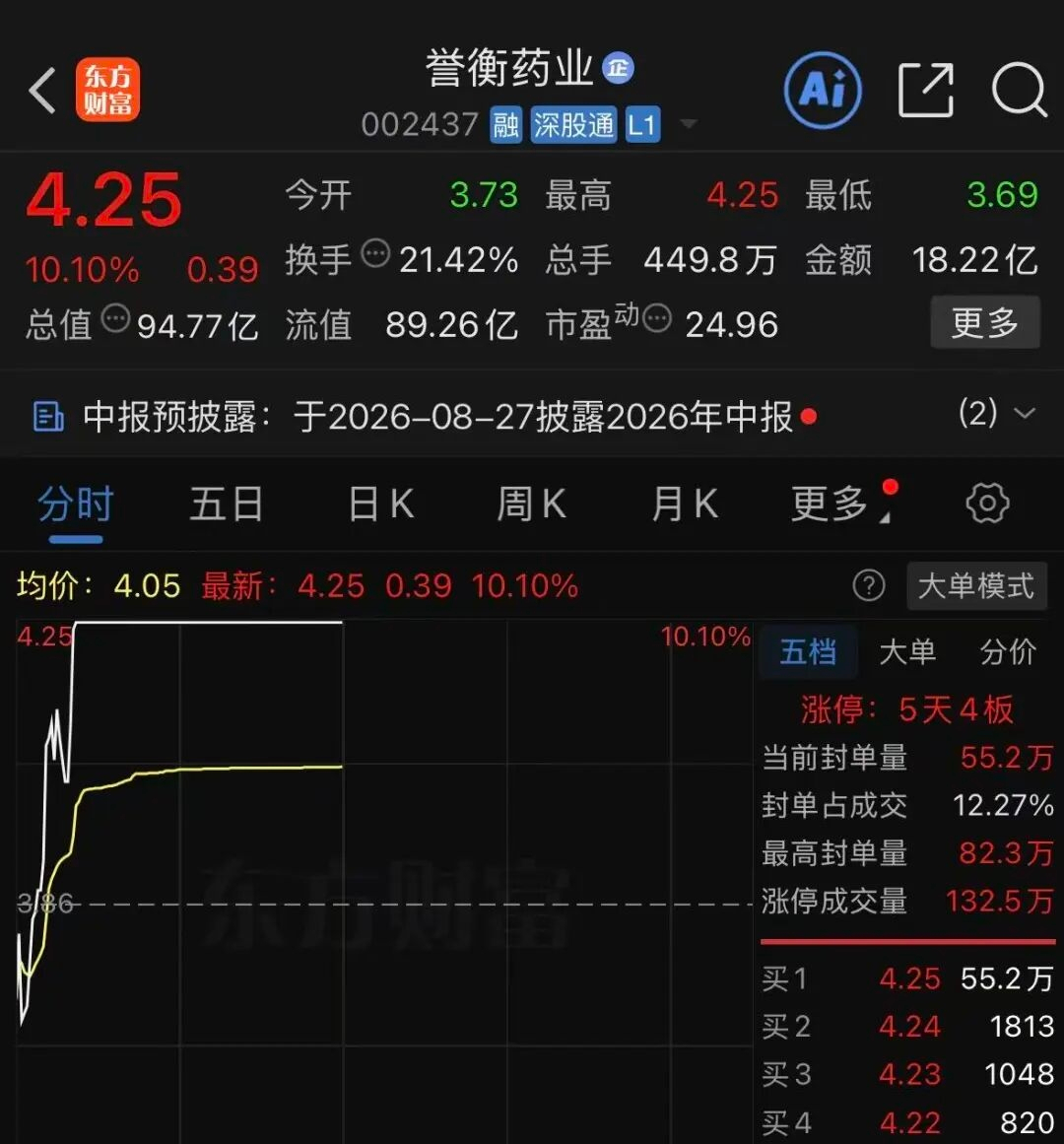
In the early session today, the concept of innovative drugs saw fluctuations followed by a rise. YuHeng Pharmaceutical achieved four consecutive daily boards within five trading days, while Kertu Biological, Bioperhaps, Realsight Biological, and Junshi Biosciences all followed suit.
On the news front, innovative drugs have resumed an upward trend, supported by multiple positive catalysts converging.
Haisco, Yiling Pharmaceutical, Hansoh Pharmaceutical, YuanDong Bio, Yuekang Pharmaceutical, and others have successively disclosed new clinical progress for innovative drugs. A number of self-developed products covering multiple technology types—including small molecules, peptides, biologics, siRNA, and PROTAC—have made phased breakthroughs, demonstrating a multi-point blooming trend in domestic innovative drug R&D.
On June 29, the National Healthcare Security Administration published the preliminary review lists for the 2026 National Reimbursement Drug List and the commercial insurance innovative drugs list. A total of 557 drugs passed the preliminary review for the 2026 basic medical insurance drug list, for an overall pass rate of 92%; 54 innovative drugs passed the preliminary review for the commercial insurance innovative drugs list. The news sparked strong market enthusiasm—on the day, the innovative-drug sector collectively strengthened, and the sector index rebounded quickly after bottoming out. The index rose 6.08% on the day.
On July 3, the NMPA again issued the (Announcement on Optimizing the Review and Approval of Cell and Gene Therapy Drugs—Draft for Public Comment), which includes qualifying cell and gene therapy drugs into a 30-day review pathway and encourages R&D innovation to improve the quality and efficiency of clinical research. The release of this draft for public comment once again provided momentum for the innovative-drug sector index to rise.
Pharmabok Fang database statistics: In the first half of 2026, Chinese innovative-drug companies disclosed 123 BD deals, up 24.24% year over year; total upfront payments exceeded USD 4.975 billion, up 71.65%. Under the National Medical Products Administration’s (NMPA) reporting scope, in the first half, 81 cooperation deals were reached for external licensing, with a total transaction value of about USD 110 billion, already accounting for 80% of the full-year total in 2025.
Since July, innovative-drug companies have released performance preannouncements for the first half in quick succession. Positive pre-increase news also boosted investor confidence. In the first half of this year, Zhao Yang New Drug’s net profit attributable to shareholders is expected to increase 884.9%–1377.4% year over year; Hansoh Pharma’s net profit attributable to shareholders increase is as high as 513.25%–575.35%; Medici’s net profit attributable to shareholders is expected to increase 425.62%–588.43% year over year, turning losses into profits. Companies including Betta Pharmaceuticals and Luoxin Pharmaceuticals (rights protection), as well as Hisun Pharmaceutical, and Nucleix Technology saw their net profit attributable to shareholders increase by more than 100%. Companies such as Huahai Pharmaceuticals, Hanbo, and Hansheng Pharma also saw net profit attributable to shareholders increase by more than 50%, while Rongchang Biotech, Sinopharm Jinfeng, and Lingkang Pharmaceuticals (rights protection) achieved a turnaround into profit.
CStone Pharmaceuticals and BeiGene released their 2026 interim reports. CStone Pharmaceuticals’ revenue and net profit attributable to shareholders increased 38.9% and 29.43% year over year, respectively, and the company raised its full-year guidance to RMB 58.5 billion–60.5 billion. BeiGene’s revenue and net profit attributable to shareholders increased 26.8% and 627.1%, respectively, and it also raised its full-year performance guidance to RMB 44.9 billion–46.2 billion.
(Comprehensive from Beijing News, Jiemian/China Securities Journal, and Securities Daily)