
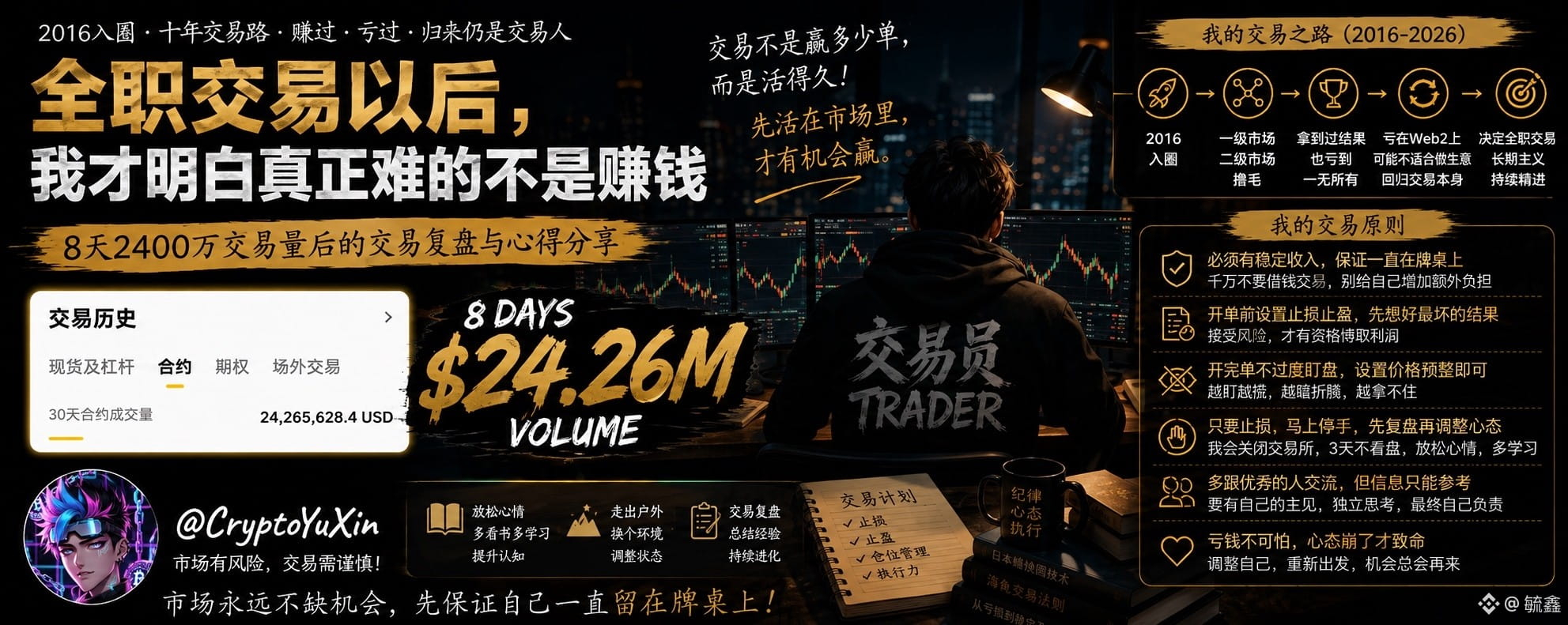

After 24 million in trading volume over 8 days, I want to seriously talk about the idea of full-time trading
Let me introduce myself briefly.
I entered the scene in 2016, and it’s been almost ten years now. In between, I wasn’t always trading; I messed around with a lot of things off and on.
I’ve played in the primary market, worked in the secondary market, and even scraped off some ‘furs’—back when the trend was good, I got some decent results; I’ve also experienced losing to the point where I basically had nothing left.
Looking back over the years, I actually managed to make some money in trading. What’s kind of funny, though, is that in the end, a lot of it was lost in doing business on Web2. 😂
Maybe I’m simply not cut out to do business.
After circling around for a long time, you finally discover that what you’re truly willing to spend long-term time studying—and what you’re relatively good at—is trading.
So next, I’m going to put more effort into full-time trading.
But first, here’s advice for friends who want to trade full-time:
Don’t quit your job on impulse just because you see others making money with trading, and then put all your assets on the table.
If you really want to go full-time, I’d actually recommend that you first prepare a stable income outside of trading, or a sufficiently long living reserve—at least make sure things like rent, meals, and household expenses won’t force you to make money from the market.
Why?
Because when your next month’s rent depends on this one trade, trading has already changed its taste.
For a trade that should have been stopped out, you’ll want to wait a little longer; for a trade that had no opportunity, you’ll force yourself to enter; after you lose a trade, you won’t be thinking about reviewing anymore—you’ll be thinking:
“I have to make it back today.”
In this kind of state, even great technical analysis is easy to get distorted.
So I’ve always felt that:
The first amount of capital for full-time trading isn’t your USDT in the account—it’s the time you can stay at the table without getting emotional.
And don’t borrow money to trade.
Trading itself already carries a huge psychological pressure. Then if you also take on interest, repayments, and other people’s money, what you’re facing isn’t just market volatility anymore.
You can lose within your trading budget, but don’t add leverage to today’s judgment by using your future life.
Losing money by itself isn’t scary.
After trading for so many years, I’m increasingly accepting one thing: as long as you’re still in the market, losses are part of the cost of trading.
What truly widens the gap between traders is what you do after you’ve finished losing.
This is also something I’ve felt especially deeply recently.
Over these 8 days, I basically threw myself fully into the market. I累计打了 close to 24 million in trading volume, and I made some money too.
But the biggest feeling isn’t how much you earned—it’s:
Trading with all your heart is really exhausting.
After doing it at high intensity, I’m increasingly sure that what determines whether a trader can survive long-term isn’t just technicals, strategies, or order-flow feel—it’s also the environment, discipline, and mindset.
First of all, full-time trading should ideally have an absolutely quiet environment, free from interruptions.
Especially for short-term trading, when the market moves violently, you may need to make a decision in a few seconds. Someone next to you says something, your phone suddenly rings, or even your attention gets interrupted—any of that can distort the trade you originally planned.
The hardest part of trading isn’t being wrong.
Instead, the trade was originally not wrong—yet due to external interference, you made it wrong.
Second, before opening a position, you must think through the stop-loss and take-profit.
Where to enter, where to exit if it goes wrong, where to see it and then act right, and under what conditions to reduce position size—ideally, you should have the answers before you press the open position button.
Because once you have a position, it’s hard for people to be completely objective.
When you’re floating in a loss, you can’t bear to cut; when you’re floating in profit, you’re afraid the gains will be given back—so in the end, it’s easy to shift from “executing your trading system” to “making decisions based on profit and loss numbers.”
So my habits are getting simpler and simpler:
First accept the worst outcome of this trade, then open the position.
One more thing I feel strongly about right now:
After you’ve placed the order, really don’t keep staring at the charts for no reason.
A trade that was originally supposed to take a few hours—if you watch the 1-minute candlestick chart, when the first bearish candle makes you doubt, after two bearish candles you start reducing your position. If it retraces a little, you’re even afraid the profit will disappear.
In the end, the direction was completely right, but the profit was盯ed away by yourself. 😂
Set your stop-loss and take-profit properly; hang price alerts at key levels, then do what you’re supposed to do.
What traders truly need to watch isn’t every single candlestick, but whether their own trading logic has been compromised.
Then there’s one discipline I’m particularly strict about:
As long as there’s a stop-loss, I stop.
I won’t immediately open the next trade thinking about flipping to get my losses back.
Because during the stop-loss just now, the real danger often wasn’t the market—it was your own emotions.
“I lost just now, the next trade must make it back.”
Once that sentence appears in your head, the trades that follow easily turn into revenge trading.
So my own approach is rather extreme:
As soon as my stop-loss gets hit, I close the trading platform immediately and don’t watch the charts for 3 days.
Don’t buy the bottom, don’t chase the rally, and don’t think about immediately earning back the loss.
Read books, learn something, go out for a walk—get yourself completely out of trading mode.
After your mindset has recovered, come back and review:
Why enter the trade?
Was it the direction wrong, or the entry location?
Did you execute the stop-loss according to your plan?
If you started over, would I open this trade again?
Think it through, then come back.
The market never lacks opportunities, but your capital and mindset can’t handle repeated getting carried away.
Let me say one more increasingly deeper takeaway from these years:
You must communicate more with excellent people, but never outsource your own brain to others.
I really enjoy chatting with different traders about the market, the logic, and the positions. Sometimes, a single sentence from someone else really can help you see what you didn’t notice.
But everyone’s information can only be used as a reference.
You can’t follow along just because some big shot shouts “buy.” If others shout “sell,” you immediately flip.
Even the best people can make mistakes.
The account is yours, the position size is yours—ultimately, it’s still you who bears the gains and losses.
You can listen to a hundred people’s opinions, but the moment you press the open position button, you must have your own reasons.
If you leave other people’s views and you don’t even know why you should open this trade yourself, then it never should have been yours in the first place.
After trading for so many years, I’m actually increasingly convinced that there isn’t that much fancy stuff to mature trading.
Have a life safety net; don’t trade with borrowed money;
Control position size and set stop-losses;
When it’s time to act, focus;
When you need to admit you’re wrong, cut the loss;
When it’s time to rest, leave the market;
Listen to other people’s views, but ultimately make the decision yourself.
The 24 million trading volume over these 8 days—rather than calling it an achievement, for me it’s more like a reminder.
Trading isn’t about who places more trades in a day, and it’s not about who will never lose.
What really matters is: after experiencing profit and loss again and again, can you still keep your own rhythm—and can you still stay at the table?
You can earn money back if you lose it.
If you miss the opportunity, it will come again.
What’s truly important is not to lose your capital, your mindset, and your life all together because of a stretch of market action.
Next, I also plan to seriously record my full-time trading life. When I make money, there will definitely also be times I get hit. 😂
And I’d also like to welcome all talented traders to exchange ideas and learn together.
Everyone’s information serves as a reference to each other, and opinions collide with each other—but in the end, it’s still the same line:
Your own trading is your call; your own account is your responsibility.