
橙子Joyce
217 Posts

橙子Joyce
 Square Verified+
价值投资者:以十年为单位投资美股及BTC.ETH.BNB.SOL.推特X:@Joyce88ai

BNB Holder
Frequent Trader
8.7 Years
735 Following
32.3K+ Followers
39.7K+ Liked
Posts
All
Quotes
Videos
Live

圣克斯Lucky1688
·
--
🧧🔥🧧🔥🧧🔥
Judging by the pricing actually provided by the Chicago Mercantile Exchange (CME) for federal funds futures, these concerns seem to be somewhat exaggerated. According to CME FedWatch data, the probability of a rate hike is 58%, which is far below the 90% or higher level that is usually considered “a sure thing.” Follow me—answer 1 and take away the $SOL red packet! 🧧🔥🧧🔥🧧🔥
Judging by the pricing actually provided by the Chicago Mercantile Exchange (CME) for federal funds futures, these concerns seem to be somewhat exaggerated. According to CME FedWatch data, the probability of a rate hike is 58%, which is far below the 90% or higher level that is usually considered “a sure thing.” Follow me—answer 1 and take away the $SOL red packet! 🧧🔥🧧🔥🧧🔥



oO小蝦米對抗大鯨魚Oo
·
--
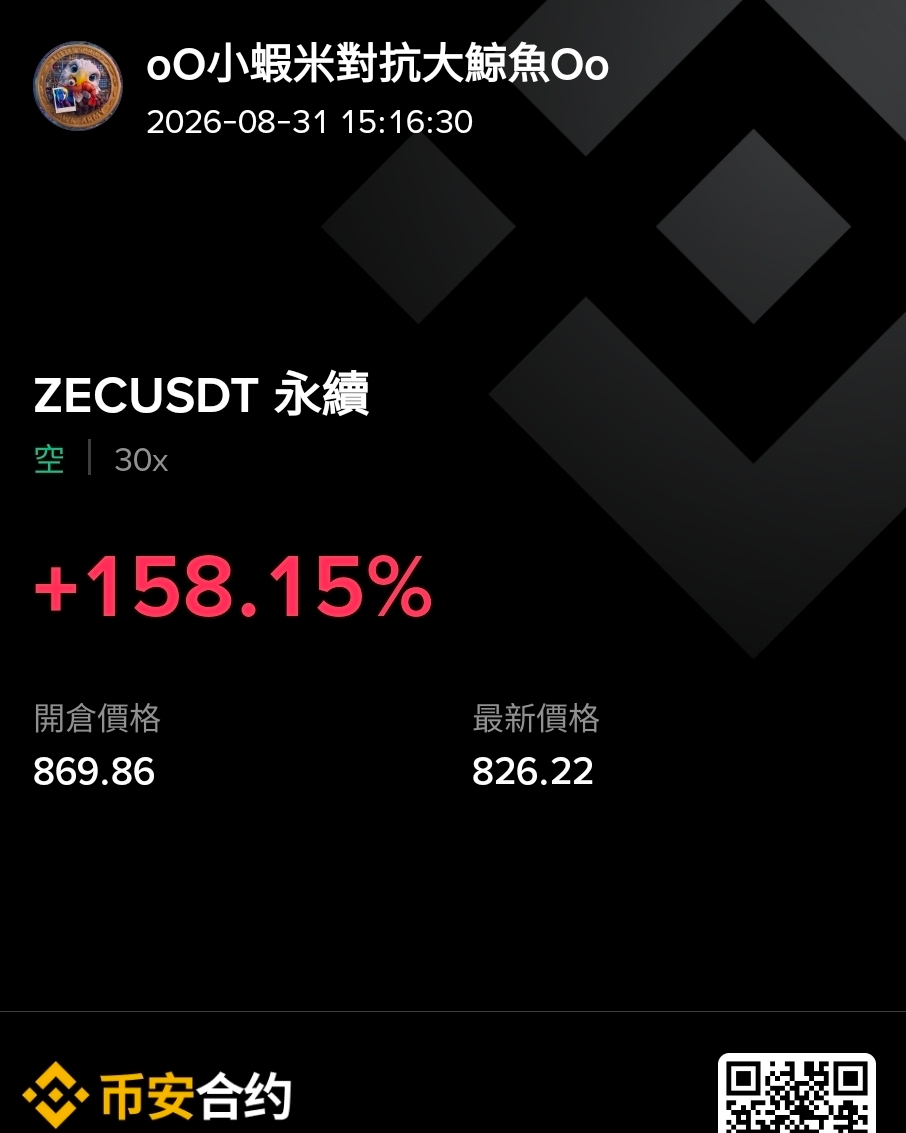
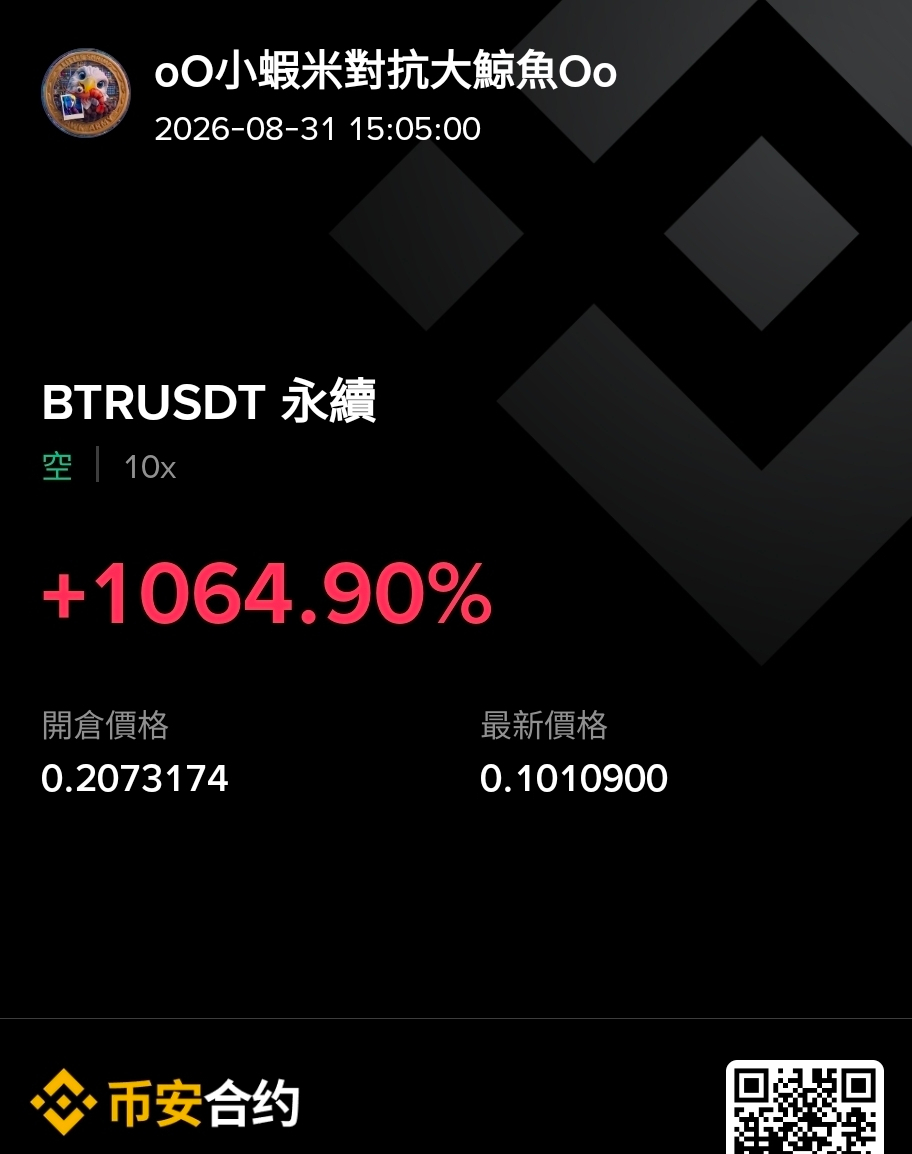
Little chive🥦 Notebook📔 $BTR
Thank you for your contribution, I’m grateful
#zec #BTR
Thank you for your contribution, I’m grateful
#zec #BTR


只会呐喊的尖刀手
·
--
The Ghost of Japan’s “100-Year Loan” Is Returning in China’s 40-Year Mortgages
On August 28, the Ministry of Housing and Urban-Rural Development, the People’s Bank of China, and the National Financial Regulatory Administration rolled out a package of measures: raise the pre-sale threshold to “principal capped at the main structure topping out,” prioritize existing homes, and tighten mortgages so that funds are only released after the completion and filing for record. Development loans for property developers will follow a main-bank model and operate under closed-loop management. Personal mortgage terms will be extended from 30 years to 40 years. After the news broke on Friday, real estate stocks surged collectively, but behind the excitement, what truly needs to be unpacked is that “40-year” line.
In the late 1980s, when the Tokyo asset bubble was at its wildest, the Bank of Japan once introduced a “100-year loan”—a repayment term of 100 years: grandfather borrows, father repays, and the grandson takes over to carry on. It was touted as “making it so that three generations can all afford to buy a home.” The slogan was almost word-for-word the same as what we hear today about “reducing monthly payments and smoothing the burden.” Then in 1991 the bubble burst. Tokyo property prices were cut in half, and then cut again. For those households that had taken out 100-year loans, the market value of their homes fell below the remaining principal, while the debt did not disappear across generations. Later, Japan’s Ministry of Land, Infrastructure, Transport and Tourism reported that the average age at which people fully repaid their mortgages had been pushed out to 73 years.
In the late 1980s, when the Tokyo asset bubble was at its wildest, the Bank of Japan once introduced a “100-year loan”—a repayment term of 100 years: grandfather borrows, father repays, and the grandson takes over to carry on. It was touted as “making it so that three generations can all afford to buy a home.” The slogan was almost word-for-word the same as what we hear today about “reducing monthly payments and smoothing the burden.” Then in 1991 the bubble burst. Tokyo property prices were cut in half, and then cut again. For those households that had taken out 100-year loans, the market value of their homes fell below the remaining principal, while the debt did not disappear across generations. Later, Japan’s Ministry of Land, Infrastructure, Transport and Tourism reported that the average age at which people fully repaid their mortgages had been pushed out to 73 years.

只会呐喊的尖刀手
·
--
The Ghost of Japan’s “100-Year Loan” Is Returning in China’s 40-Year Mortgages
On August 28, the Ministry of Housing and Urban-Rural Development, the People’s Bank of China, and the National Financial Regulatory Administration rolled out a package of measures: raise the pre-sale threshold to “principal capped at the main structure topping out,” prioritize existing homes, and tighten mortgages so that funds are only released after the completion and filing for record. Development loans for property developers will follow a main-bank model and operate under closed-loop management. Personal mortgage terms will be extended from 30 years to 40 years. After the news broke on Friday, real estate stocks surged collectively, but behind the excitement, what truly needs to be unpacked is that “40-year” line.
In the late 1980s, when the Tokyo asset bubble was at its wildest, the Bank of Japan once introduced a “100-year loan”—a repayment term of 100 years: grandfather borrows, father repays, and the grandson takes over to carry on. It was touted as “making it so that three generations can all afford to buy a home.” The slogan was almost word-for-word the same as what we hear today about “reducing monthly payments and smoothing the burden.” Then in 1991 the bubble burst. Tokyo property prices were cut in half, and then cut again. For those households that had taken out 100-year loans, the market value of their homes fell below the remaining principal, while the debt did not disappear across generations. Later, Japan’s Ministry of Land, Infrastructure, Transport and Tourism reported that the average age at which people fully repaid their mortgages had been pushed out to 73 years.
In the late 1980s, when the Tokyo asset bubble was at its wildest, the Bank of Japan once introduced a “100-year loan”—a repayment term of 100 years: grandfather borrows, father repays, and the grandson takes over to carry on. It was touted as “making it so that three generations can all afford to buy a home.” The slogan was almost word-for-word the same as what we hear today about “reducing monthly payments and smoothing the burden.” Then in 1991 the bubble burst. Tokyo property prices were cut in half, and then cut again. For those households that had taken out 100-year loans, the market value of their homes fell below the remaining principal, while the debt did not disappear across generations. Later, Japan’s Ministry of Land, Infrastructure, Transport and Tourism reported that the average age at which people fully repaid their mortgages had been pushed out to 73 years.

路人1688-luren
·
--
Closing the book and looking back at oneself—how can it not be like this? On the road of life, every fork is rewritten by a single choice. But no matter what, you must clench your teeth and keep moving forward with a smile, because this is your own unique life.$BNB




路飞社区糖宝Luffy
·
--
The weather is nice today, so you can go out and breathe some fresh air $SOL


花涧空
·
--
✨September Outlook Is Here
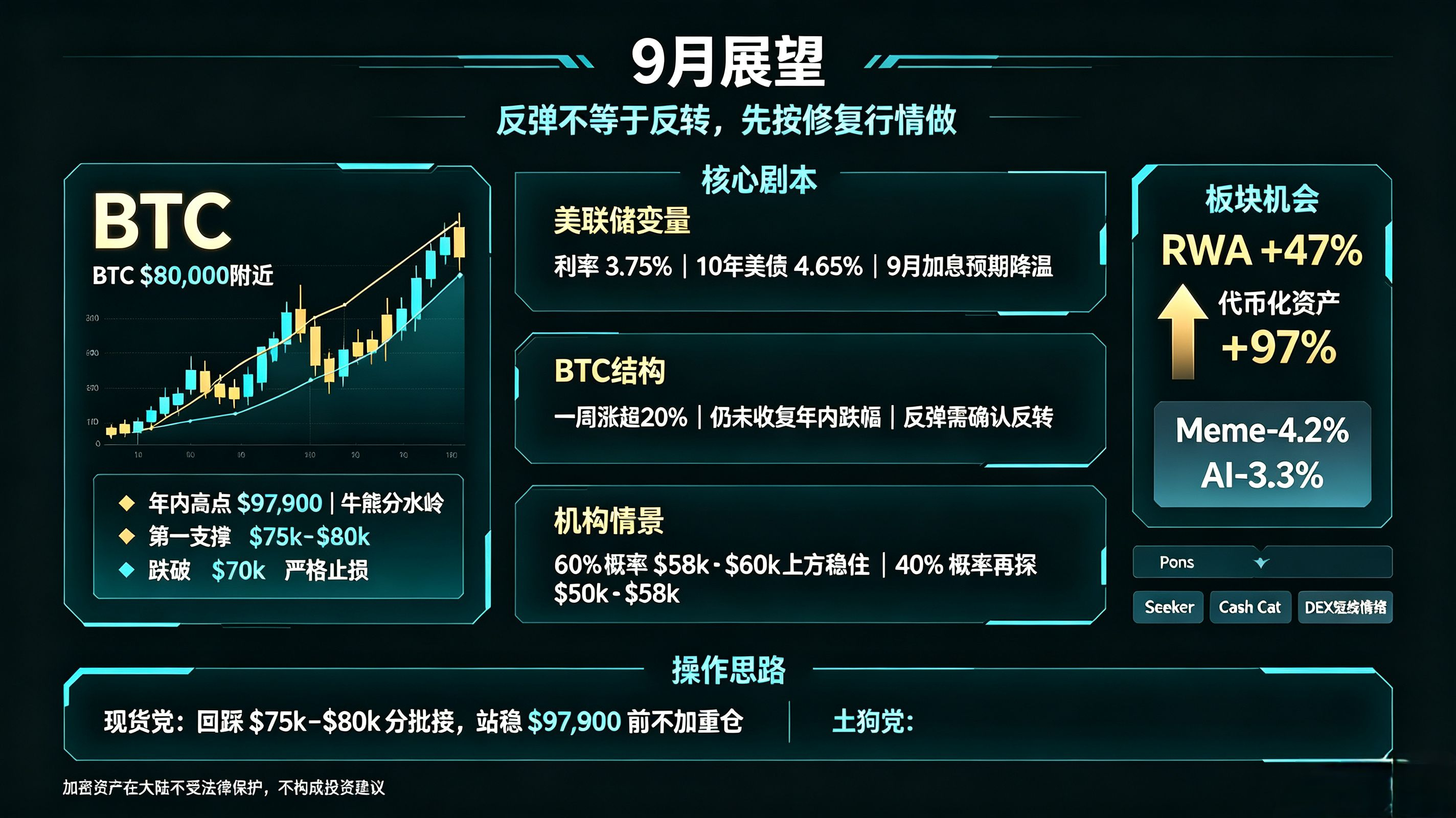
【Current Market Snapshot】
Total market cap is about $2.66 trillion, down 2.16% over the past 24 hours. BTC dominance is 59.2%, ETH is 11.2%. Overall, it’s a typical weak range-bound market, with capital clumping around BTC.
✨✨✨✨✨
【Key Scenarios for September】
1️⃣ The Fed is the biggest variable. Current federal funds rate is 3.75%, and the 10-year US Treasury yield is 4.65%—liquidity is still relatively tight. The good news: September rate-hike expectations are cooling down. Goldman Sachs even said the market is too hawkish, giving risk assets some breathing room.
2️⃣ BTC just violently rebounded from around $63,586 to near $80,000—up more than 20% in a week. But note: it hasn’t reclaimed this year’s losses yet. $97,900 (the year-to-date high) is the true bull vs. bear line.
3️⃣ Institutional script: 60% probability it holds above $58k–$60k, and 40% probability it retests $50k–$58k. A rebound doesn’t equal a reversal—trade the “market repair” first.
✨✨✨✨✨
【Sector Opportunities】
🔥 RWA surged +47% in 24h, and tokenized assets are up an eye-watering +97%! Capital is moving toward “on-chain compliant assets”—this is the brightest narrative for September.
❄️ Meme sector -4.2%, AI sector -3.3%. The hype is cooling off—don’t rush to chase big buys; let the bullets fly for a bit.
🔍 On the hot search list, new faces like Pons, Seeker, and Cash Cat have strong trading volumes. In short-term sentiment trades, everyone is crowding into DEXs to fight it out.
✨✨✨✨✨
【Trading Approach】
Spot crowd: If BTC dips back to $75k–$80k, scale in. Stop strictly if it breaks below $70k. Don’t increase position size before it stands firm above $97,900.
De-gens crowd: On BSC, be patient and wait for the new narrative to ignite—don’t catch the knife at the emotional low point. Money won’t disappoint smart babies, but de-gens will~
#比特币8月上涨23%跑赢黄金股市
Crypto assets are not legally protected on the Chinese mainland and do not constitute investment advice.
【Current Market Snapshot】
Total market cap is about $2.66 trillion, down 2.16% over the past 24 hours. BTC dominance is 59.2%, ETH is 11.2%. Overall, it’s a typical weak range-bound market, with capital clumping around BTC.
✨✨✨✨✨
【Key Scenarios for September】
1️⃣ The Fed is the biggest variable. Current federal funds rate is 3.75%, and the 10-year US Treasury yield is 4.65%—liquidity is still relatively tight. The good news: September rate-hike expectations are cooling down. Goldman Sachs even said the market is too hawkish, giving risk assets some breathing room.
2️⃣ BTC just violently rebounded from around $63,586 to near $80,000—up more than 20% in a week. But note: it hasn’t reclaimed this year’s losses yet. $97,900 (the year-to-date high) is the true bull vs. bear line.
3️⃣ Institutional script: 60% probability it holds above $58k–$60k, and 40% probability it retests $50k–$58k. A rebound doesn’t equal a reversal—trade the “market repair” first.
✨✨✨✨✨
【Sector Opportunities】
🔥 RWA surged +47% in 24h, and tokenized assets are up an eye-watering +97%! Capital is moving toward “on-chain compliant assets”—this is the brightest narrative for September.
❄️ Meme sector -4.2%, AI sector -3.3%. The hype is cooling off—don’t rush to chase big buys; let the bullets fly for a bit.
🔍 On the hot search list, new faces like Pons, Seeker, and Cash Cat have strong trading volumes. In short-term sentiment trades, everyone is crowding into DEXs to fight it out.
✨✨✨✨✨
【Trading Approach】
Spot crowd: If BTC dips back to $75k–$80k, scale in. Stop strictly if it breaks below $70k. Don’t increase position size before it stands firm above $97,900.
De-gens crowd: On BSC, be patient and wait for the new narrative to ignite—don’t catch the knife at the emotional low point. Money won’t disappoint smart babies, but de-gens will~
#比特币8月上涨23%跑赢黄金股市
Crypto assets are not legally protected on the Chinese mainland and do not constitute investment advice.

晚风Vesper_1688
·
--
☕Afternoon moments, in the hustle of the trading screen, keep a calm composure🍃
Market fluctuations are simply the norm📊.
There’s no need to let brief intraday rises and falls sway your emotions.
Trading tests not only your vision, but also your discipline and self-control🕯️.
If you can’t read the market, choose to observe—don’t rush to enter every time to fight the odds.
Clear away the noise from the outside world and stick to your own established trading rhythm✨.
Slow down, let your mind settle and think deeply—your opportunities will surely come in due time💎.
With fellow partners who walk this path, encourage each other🕊️
#交易心理
#比特币守稳78000美元上方
#1688家族family
Market fluctuations are simply the norm📊.
There’s no need to let brief intraday rises and falls sway your emotions.
Trading tests not only your vision, but also your discipline and self-control🕯️.
If you can’t read the market, choose to observe—don’t rush to enter every time to fight the odds.
Clear away the noise from the outside world and stick to your own established trading rhythm✨.
Slow down, let your mind settle and think deeply—your opportunities will surely come in due time💎.
With fellow partners who walk this path, encourage each other🕊️
#交易心理
#比特币守稳78000美元上方
#1688家族family





静心1688
·
--
💥 The Way: the universe’s origin, objective natural laws, existing without form, before all things
#美加贸易战加剧关税冲击就业 #中国房地产股大涨受房贷新规提振
#美加贸易战加剧关税冲击就业 #中国房地产股大涨受房贷新规提振


叮噹-Doraemon
·
--
What is ‘smart money’ buying? Tracking Cathie Wood: adds more than 450,000 shares to Block’s position, trimming some AI and genomics holdings
August 31, 2026 (Monday). The three major U.S. stock indexes closed lower across the board. The S&P 500 fell 0.33% to 7,686.14 points, the Nasdaq declined 0.12% to 26,370.89 points, and the Dow dropped the most by 0.70%, closing at 53,185.90 points. On the last trading day of the month, overall market sentiment was cautious, with capital rotating in a cyclical pattern.
On the day, Cathie Wood, known as “Jie,” increased exposure against the trend in areas such as financial technology, aerospace, and precision medicine. Meanwhile, she reduced positions in multiple AI applications and genomics-related targets. Overall, this reflected a strategic intention of “rotating holdings and adjusting the portfolio structure.”
Buying direction: focus on the long-term disruptive potential of financial technology, aerospace, and gene editing
On the day, Cathie Wood, known as “Jie,” increased exposure against the trend in areas such as financial technology, aerospace, and precision medicine. Meanwhile, she reduced positions in multiple AI applications and genomics-related targets. Overall, this reflected a strategic intention of “rotating holdings and adjusting the portfolio structure.”
Buying direction: focus on the long-term disruptive potential of financial technology, aerospace, and gene editing


竹竹 YGØZ²
·
--
September’s campus is bustling with energy! Even though the phoenix-flower season has already come around once during the summer break, it’s time to put away your beach clothes and mobile games and get ready for a new semester’s day-to-day routine of classes and battling.
Your classmate at the next table might be a brand-new face, and the breakfast shop aunt will be busy again for the new term.
A new semester brings a fresh atmosphere—take it easy and let’s go make friends at school together!
Your classmate at the next table might be a brand-new face, and the breakfast shop aunt will be busy again for the new term.
A new semester brings a fresh atmosphere—take it easy and let’s go make friends at school together!


Anna-汤圆
·
--
[Replay] 🎙️ We’re live! What will the US stock market do today?
02 h 09 m 24 s · 9.4k listens
·
--
🎙️ It’s live! What kind of market will the US stocks be like today?
End
02 h 09 m 24 s
9.1k
33
Verified
Federal Reserve Chair Powell Says the Global Economy Is Entering a Period of Investment Surge; Growth Potential May Be Underestimated
At the G20 finance leaders meeting, Federal Reserve Chair Powell said the world is seeing a wave of investment that will boost economic growth and reverse the situation in which excess savings flowed into low-yield instruments due to a lack of investment opportunities in the past.
He said at the G20 opening plenary session that he hopes to learn more about the growth outlook of member economies.
Powell said he is considering whether the growth rates of the United States and other G20 economies could exceed forecasts from traditional institutions such as the U.S. Congressional Budget Office—namely, that annual growth of about 1.8% is possible even when productivity growth is “sluggish.” * U.S. President Trump told reporters in the Oval Office that he greatly respects Federal Reserve Chair Powell and believes the latter “will do what he has to do” on the issue of interest rates.
$TSLA.US
At the G20 finance leaders meeting, Federal Reserve Chair Powell said the world is seeing a wave of investment that will boost economic growth and reverse the situation in which excess savings flowed into low-yield instruments due to a lack of investment opportunities in the past.
He said at the G20 opening plenary session that he hopes to learn more about the growth outlook of member economies.
Powell said he is considering whether the growth rates of the United States and other G20 economies could exceed forecasts from traditional institutions such as the U.S. Congressional Budget Office—namely, that annual growth of about 1.8% is possible even when productivity growth is “sluggish.” * U.S. President Trump told reporters in the Oval Office that he greatly respects Federal Reserve Chair Powell and believes the latter “will do what he has to do” on the issue of interest rates.
$TSLA.US

TSLAUS-2.70%
“The AI investment wave is far from over—will supply and demand only reach balance by 2028?
The staggering capital expenditure figures reported by major tech companies such as Alphabet, Meta, and Amazon are far from the end of the story, because the industry is racing to build artificial intelligence (AI) infrastructure.
The expected supply-demand balance for AI won’t be achieved until the first half of 2028. As a result, the imbalance is likely to persist for a long time. This means more capital spending and revenue growth are needed, but the supply chain is still constrained in many ways.
With the supply chain so tight, memory prices are rising. Chip prices are also higher than they were six months ago—even higher than they were twelve months ago. As a result, all input costs are increasing. In addition, data centers also face demand for acquiring land and building facilities— even for data center capacity that is currently vacant—because companies are trying to seize the lead so that when components are ready in two or three years, or even four years, they can be put into use immediately.
SpaceX is expected to invest $200 billion per year in the AI sector over the next two years.
And the most critical question now is whether the large-scale investments by big tech companies in AI have already been reflected in their stock prices. Many companies—such as Tesla—saw their share prices plunge in the last earnings season due to worries about spending.
I believe that large high-tech companies are shifting from focusing on the size of capital expenditures (regardless of whether they’re good or bad) to focusing on the visibility of capital expenditure returns. As this theme continues to dominate discussions among investors, attention to both absolute amounts and the visibility of returns will increase. This will lead to further expansion of the price-to-earnings ratio.
I continue to invest $SOL
$SPCX.US
The staggering capital expenditure figures reported by major tech companies such as Alphabet, Meta, and Amazon are far from the end of the story, because the industry is racing to build artificial intelligence (AI) infrastructure.
The expected supply-demand balance for AI won’t be achieved until the first half of 2028. As a result, the imbalance is likely to persist for a long time. This means more capital spending and revenue growth are needed, but the supply chain is still constrained in many ways.
With the supply chain so tight, memory prices are rising. Chip prices are also higher than they were six months ago—even higher than they were twelve months ago. As a result, all input costs are increasing. In addition, data centers also face demand for acquiring land and building facilities— even for data center capacity that is currently vacant—because companies are trying to seize the lead so that when components are ready in two or three years, or even four years, they can be put into use immediately.
SpaceX is expected to invest $200 billion per year in the AI sector over the next two years.
And the most critical question now is whether the large-scale investments by big tech companies in AI have already been reflected in their stock prices. Many companies—such as Tesla—saw their share prices plunge in the last earnings season due to worries about spending.
I believe that large high-tech companies are shifting from focusing on the size of capital expenditures (regardless of whether they’re good or bad) to focusing on the visibility of capital expenditure returns. As this theme continues to dominate discussions among investors, attention to both absolute amounts and the visibility of returns will increase. This will lead to further expansion of the price-to-earnings ratio.
I continue to invest $SOL
$SPCX.US
SOL-0.95%
SPCXUS+0.07%
Verified
Once Waller’s hawkish remarks hit the market, are forecasts now saying the Fed will hike once in September and once in December?
It is expected that the Federal Reserve will raise rates by 25 basis points in both September and December.
Waller’s speech was “clearly hawkish.” Although he still refused to provide explicit forward guidance, he effectively signaled further tightening of policy.
Market pricing has shifted accordingly. The CME FedWatch data shows that the probability of a September rate hike has risen to 60.4%, a clear increase from before Waller’s remarks. Interest-rate futures indicate that investors are re-pricing the Fed’s in-year hikes, and the policy meeting on September 16 will become the next key milestone.
During his first major speech in his current term at Jackson Hole last Friday, Waller did not directly lay out a September policy path, but his comments on inflation were clearly hawkish.
Even if monthly inflation data over the coming months may soften noticeably, longer-term inflation indicators could still be affected by adverse base effects, meaning the process of inflation cooling by year-end may not be smooth.
The issue is that Waller’s hawkish stance primarily addresses short-end interest rates and inflation expectations, but may not resolve the core pressure facing long-term U.S. Treasury yields.
U.S. government debt has already surpassed $40 trillion. Meanwhile, tech giants have been issuing large amounts of long-term corporate bonds for AI data center construction, also competing for capital that would otherwise flow into the Treasury market, further increasing long-term funding pressures.
Whether the market’s repricing after Waller’s speech can persist ultimately depends on economic data.
If subsequent economic data does not continue to move in a “hawkish” direction, the market action triggered by this speech could fade quickly. Especially if the next jobs report again shows weakness in the labor market, expectations for a September hike could cool down again.
The U.S. quarterly options expiration dates are the third Friday of March, June, September, and December. Similar to triple expiration is double expiration, where two of the three contracts expire simultaneously on the same date.
It is expected that the Federal Reserve will raise rates by 25 basis points in both September and December.
Waller’s speech was “clearly hawkish.” Although he still refused to provide explicit forward guidance, he effectively signaled further tightening of policy.
Market pricing has shifted accordingly. The CME FedWatch data shows that the probability of a September rate hike has risen to 60.4%, a clear increase from before Waller’s remarks. Interest-rate futures indicate that investors are re-pricing the Fed’s in-year hikes, and the policy meeting on September 16 will become the next key milestone.
During his first major speech in his current term at Jackson Hole last Friday, Waller did not directly lay out a September policy path, but his comments on inflation were clearly hawkish.
Even if monthly inflation data over the coming months may soften noticeably, longer-term inflation indicators could still be affected by adverse base effects, meaning the process of inflation cooling by year-end may not be smooth.
The issue is that Waller’s hawkish stance primarily addresses short-end interest rates and inflation expectations, but may not resolve the core pressure facing long-term U.S. Treasury yields.
U.S. government debt has already surpassed $40 trillion. Meanwhile, tech giants have been issuing large amounts of long-term corporate bonds for AI data center construction, also competing for capital that would otherwise flow into the Treasury market, further increasing long-term funding pressures.
Whether the market’s repricing after Waller’s speech can persist ultimately depends on economic data.
If subsequent economic data does not continue to move in a “hawkish” direction, the market action triggered by this speech could fade quickly. Especially if the next jobs report again shows weakness in the labor market, expectations for a September hike could cool down again.
The U.S. quarterly options expiration dates are the third Friday of March, June, September, and December. Similar to triple expiration is double expiration, where two of the three contracts expire simultaneously on the same date.

Log in to explore more content