
Anna-汤圆
5.1k Posts

Anna-汤圆
 Square Verified+
广场活跃创作者,永久返佣码:ANNA5199|每晚6:00-9:00直播,涨粉,web3工具分享,一级财富密码分享|推特X同名,每晚10点在X上space||广场&推特--KOL宣发&项目推广|AMA项目合作--币安广场直播打包宣发
Open Trade
High-Frequency Trader
5.5 Years
2.3K+ Following
84.9K+ Followers
61.3K+ Liked
Posts
Portfolio
All
Quotes
Videos
Live
·
--
🎙️ Sharing today’s topic: my trip meeting up with Hong Kong and CZ!
End
01 h 18 m 40 s
1.2k
2
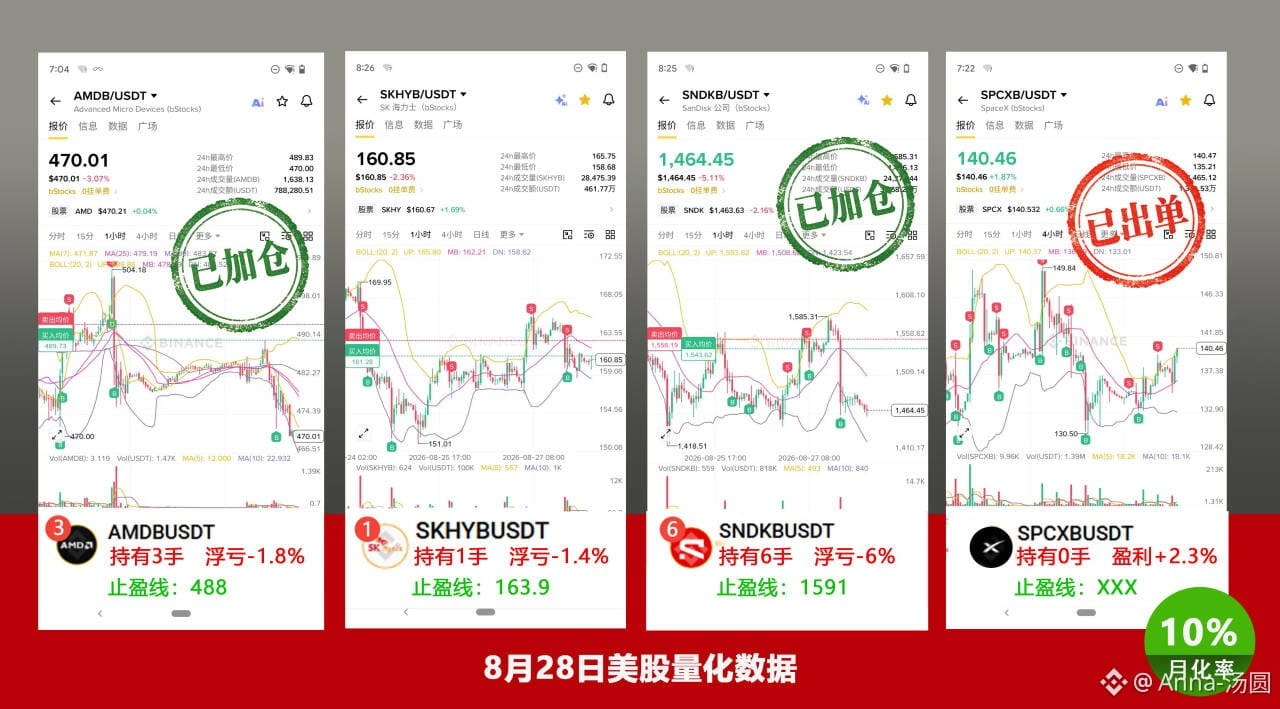
8.28 U.S. Stock Quantitative Trading Daily Brief is here.
The broad market: yesterday the Nasdaq rose 1.6%. Tech stocks took the lead, and Nvidia’s earnings were strong.
Position update:
$AMDB Added to the position; currently down 1.8% on 3 lots; take-profit at 488
$SKHYB Down 1.4% on 1 lot; take-profit at 163.9
$SNDKB Added 6 lots; currently down 6%; take-profit at 1591
$SPCXB The order has been closed; profit of 2.3%
Monthlyized 10% has been achieved. When the signal arrives, we act; when we reach the target, we close.
#美股量化 #代币化美股
Leave a comment in the comments section if you’re interested! Let’s play together!
The broad market: yesterday the Nasdaq rose 1.6%. Tech stocks took the lead, and Nvidia’s earnings were strong.
Position update:
$AMDB Added to the position; currently down 1.8% on 3 lots; take-profit at 488
$SKHYB Down 1.4% on 1 lot; take-profit at 163.9
$SNDKB Added 6 lots; currently down 6%; take-profit at 1591
$SPCXB The order has been closed; profit of 2.3%
Monthlyized 10% has been achieved. When the signal arrives, we act; when we reach the target, we close.
#美股量化 #代币化美股
Leave a comment in the comments section if you’re interested! Let’s play together!
·
--
🎙️ The index is surging again—are the bears just going to walk away like that?
End
02 h 48 m 54 s
10.2k
12
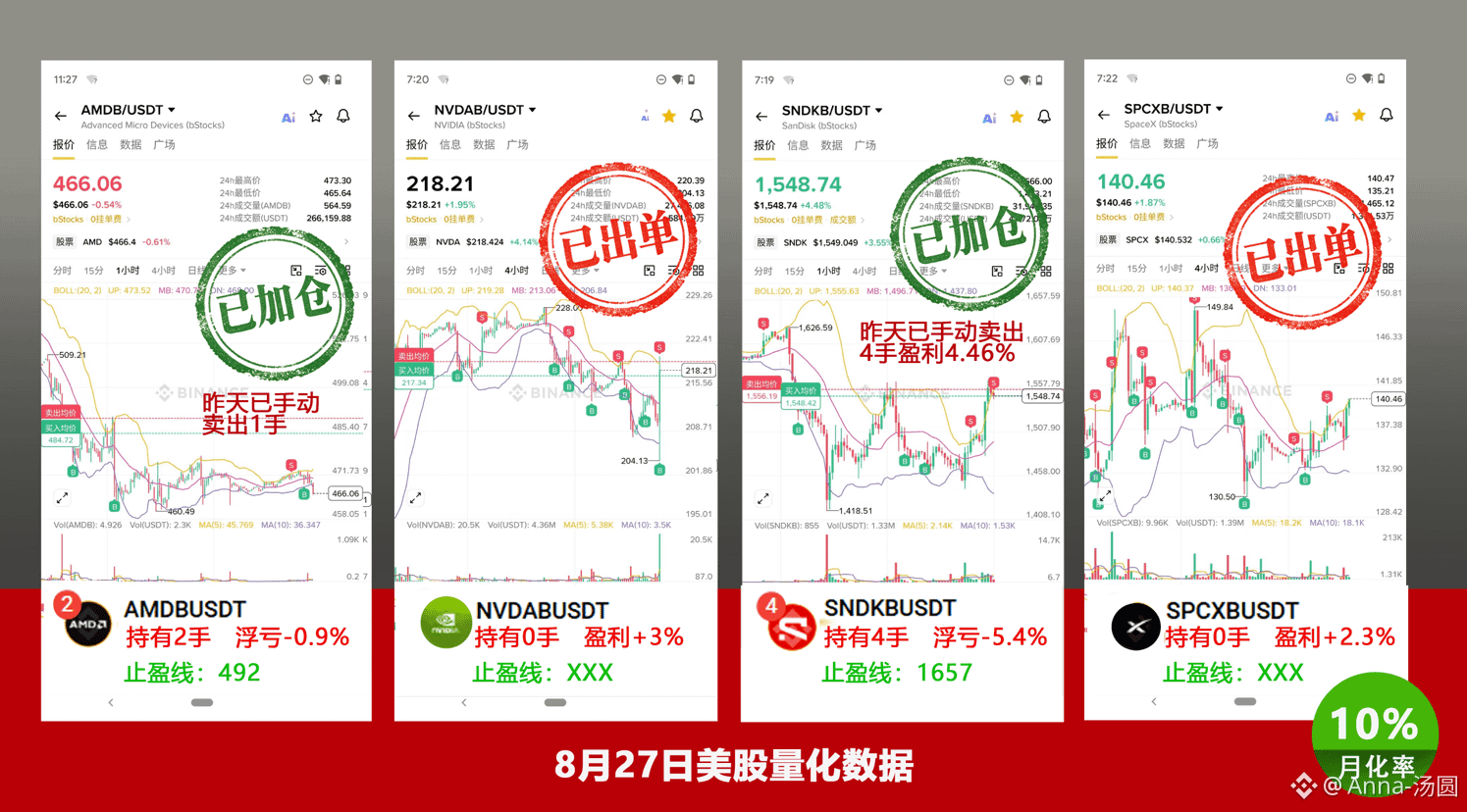
August 27 U.S. stock spot quantitative trading live update!
$AMDB added to the position by 2 lots, currently down -0.9%, take-profit raised to 492
$NVDAB has placed orders and locked in +3%
$SNDKB added 4 lots, currently down -5.4%, take-profit raised to 1657
$SPCXB has placed orders again and collected +2.3%
Yesterday, part of the positions were manually closed for profit; the overall annualized return for the month is staying steady above 10%. Pure spot trading with no leverage—our quantitative strategy continues to deliver a steady curve.
Daily live trading is made public. If you want to follow along or learn more about the strategy details, just follow directly! #美股量化 #现货量化 #crypto quant
$AMDB added to the position by 2 lots, currently down -0.9%, take-profit raised to 492
$NVDAB has placed orders and locked in +3%
$SNDKB added 4 lots, currently down -5.4%, take-profit raised to 1657
$SPCXB has placed orders again and collected +2.3%
Yesterday, part of the positions were manually closed for profit; the overall annualized return for the month is staying steady above 10%. Pure spot trading with no leverage—our quantitative strategy continues to deliver a steady curve.
Daily live trading is made public. If you want to follow along or learn more about the strategy details, just follow directly! #美股量化 #现货量化 #crypto quant
Partly True
I used to think that a privacy chain is about building for "more privacy," but later I realized I might have been looking in the wrong direction.
Over the past few days I’ve been watching Dusk’s updates, and it suddenly clicked: I’ve been asking the wrong question. I keep wondering, "Is the privacy on this chain hidden deep enough?" But what really bottlenecks the privacy network might not be that at all.
//
I understand that privacy is never free—every time you hide a state, verify an identity, or prove a transaction, the computation behind it has to be paid for in real terms. If there are only a few users, performance optimizations can help you handle the load. But once the user base grows, the points where proof generation, verification, and on-chain storage are handled will start to get strained. I think that going forward, what matters isn’t simply "who can build privacy." It’s: "the more users there are, the cheaper each privacy transaction becomes." That’s the real key to whether it can actually scale and run.
//
I looked into what Dusk is doing and found that the PlonKup proof system can already do recursive proofs—one proof can also verify another, and even multiple proofs can be verified in a single go. That means the amount of data that needs to be stored on-chain drops dramatically. Piecrust’s team also mentioned officially that the speed is at least ten times faster than the old version. I understand that if this direction keeps moving toward parallel processing and batch proving, then the goal isn’t just to push TPS higher—it’s to make sure privacy transactions can truly support a large-scale user base.
//
I also thought of a possibility that’s even a bit further out: maybe in the future users won’t even need to generate proofs themselves. Instead, specialized nodes or hardware clusters will handle the grunt work, and the network will mainly focus on verification and state maintenance. It would be like giving the privacy network a "compute market"—with dedicated participants performing the "proof generation" part.
//
So right now, I think what we should really watch isn’t how high Dusk’s TPS can go today, but whether once users grow from tens of thousands to a million-level scale, each privacy transaction can still stay cheap. If this can be achieved, then privacy will truly move from being a "nice-to-have" to something everyone can default to using.
One question: what determines whether a privacy network can truly run at massive scale?
#dusk $DUSK @Dusk
Over the past few days I’ve been watching Dusk’s updates, and it suddenly clicked: I’ve been asking the wrong question. I keep wondering, "Is the privacy on this chain hidden deep enough?" But what really bottlenecks the privacy network might not be that at all.
//
I understand that privacy is never free—every time you hide a state, verify an identity, or prove a transaction, the computation behind it has to be paid for in real terms. If there are only a few users, performance optimizations can help you handle the load. But once the user base grows, the points where proof generation, verification, and on-chain storage are handled will start to get strained. I think that going forward, what matters isn’t simply "who can build privacy." It’s: "the more users there are, the cheaper each privacy transaction becomes." That’s the real key to whether it can actually scale and run.
//
I looked into what Dusk is doing and found that the PlonKup proof system can already do recursive proofs—one proof can also verify another, and even multiple proofs can be verified in a single go. That means the amount of data that needs to be stored on-chain drops dramatically. Piecrust’s team also mentioned officially that the speed is at least ten times faster than the old version. I understand that if this direction keeps moving toward parallel processing and batch proving, then the goal isn’t just to push TPS higher—it’s to make sure privacy transactions can truly support a large-scale user base.
//
I also thought of a possibility that’s even a bit further out: maybe in the future users won’t even need to generate proofs themselves. Instead, specialized nodes or hardware clusters will handle the grunt work, and the network will mainly focus on verification and state maintenance. It would be like giving the privacy network a "compute market"—with dedicated participants performing the "proof generation" part.
//
So right now, I think what we should really watch isn’t how high Dusk’s TPS can go today, but whether once users grow from tens of thousands to a million-level scale, each privacy transaction can still stay cheap. If this can be achieved, then privacy will truly move from being a "nice-to-have" to something everyone can default to using.
One question: what determines whether a privacy network can truly run at massive scale?
#dusk $DUSK @Dusk
A. 用户越多单位成本能不能降下来
56%
B. 单笔交易速度多快
22%
C. 代币价格涨了多少
22%
9 votes • Voting closed
·
--
🎙️ In a choppy or falling market, how can U.S. stock spot quant investing easily earn 10% per month?
End
02 h 32 m 00 s
1.8k
1
·
--
🎙️ How much BNB do you invest in daily DCA every day?
End
02 h 50 m 22 s
12.3k
14
Besides transferring funds, I also found that Dusk can "quietly" transmit a contract
These days I’ve been thinking about something: when people talk about privacy chains, they mostly discuss how to hide money. But what if what’s stored on-chain isn’t money, but a file that only certain people can open? I hadn’t really considered that.
//
From what I understand, CITP basically creates a secure channel for "encrypted attachments" and "restricted data." It’s not just about throwing a file’s hash onto the chain to prove that "this thing existed." Instead, the data itself remains on-chain in ciphertext form, and only the explicitly authorized few can decrypt and read the contents. Even if others find their way to the chain, all they’ll see is a bunch of ciphertext they can’t make sense of.
//
My first reaction was: what’s the difference between this and encrypting a file and then sending it by email?
After thinking it through, the difference is real. With off-chain email transmission, the timeline is fragmented and can be altered. If later you want to prove that "this file definitely existed at some time point and hasn’t been tampered with," it’s hard to find a third party everyone trusts to verify it. But putting it on-chain changes everything: who wrote what in when, and who viewed it when—at least in theory—can all leave behind records that can’t be altered.
//
I think this approach is especially useful for documents like contracts and due diligence materials. Those documents inherently require two things at the same time: (1) they can’t be secretly modified (and if they are, it must be detectable), and (2) not just anyone can view them (access must be restricted to authorized parties). Before, it was difficult to satisfy both at once—if you go for transparency, you lose privacy; if you go for secrecy, you lose public credibility. What Dusk is trying to do is make it so you don’t have to choose one over the other.
//
A contract that can be both confidential and still leave a trace—that’s probably the clearest example of what I figured out these past few days: "on-chain is not just for transfers."
One question: for confidential data, what’s the biggest benefit of putting it on-chain compared to encrypting and transmitting it off-chain?
#dusk $DUSK @Dusk
These days I’ve been thinking about something: when people talk about privacy chains, they mostly discuss how to hide money. But what if what’s stored on-chain isn’t money, but a file that only certain people can open? I hadn’t really considered that.
//
From what I understand, CITP basically creates a secure channel for "encrypted attachments" and "restricted data." It’s not just about throwing a file’s hash onto the chain to prove that "this thing existed." Instead, the data itself remains on-chain in ciphertext form, and only the explicitly authorized few can decrypt and read the contents. Even if others find their way to the chain, all they’ll see is a bunch of ciphertext they can’t make sense of.
//
My first reaction was: what’s the difference between this and encrypting a file and then sending it by email?
After thinking it through, the difference is real. With off-chain email transmission, the timeline is fragmented and can be altered. If later you want to prove that "this file definitely existed at some time point and hasn’t been tampered with," it’s hard to find a third party everyone trusts to verify it. But putting it on-chain changes everything: who wrote what in when, and who viewed it when—at least in theory—can all leave behind records that can’t be altered.
//
I think this approach is especially useful for documents like contracts and due diligence materials. Those documents inherently require two things at the same time: (1) they can’t be secretly modified (and if they are, it must be detectable), and (2) not just anyone can view them (access must be restricted to authorized parties). Before, it was difficult to satisfy both at once—if you go for transparency, you lose privacy; if you go for secrecy, you lose public credibility. What Dusk is trying to do is make it so you don’t have to choose one over the other.
//
A contract that can be both confidential and still leave a trace—that’s probably the clearest example of what I figured out these past few days: "on-chain is not just for transfers."
One question: for confidential data, what’s the biggest benefit of putting it on-chain compared to encrypting and transmitting it off-chain?
#dusk $DUSK @Dusk
A. 不可篡改的时序和可追溯性
64%
B. 传输速度更快
18%
C. 完全免费
18%
11 votes • Voting closed
·
--
🎙️ Bosses, are we continuing orders today—dusk, more or less?
End
02 h 45 m 19 s
11.6k
13
Verified
I gave Dusk a “technical court trial” (i.e., not a mindless hype piece). The more I study Dusk these past few days, the less I want to just write about what it does well—I’d rather be more rigorous once: does this whole setup really hold up?
//
I counted the cards it has: privacy is natively designed into the protocol rather than added as an afterthought; public and private transaction models coexist; native ZK + WASM execution; it also remains compatible with the EVM ecosystem; settlement is deterministic; it supports selective disclosure; and the entire design is aimed at regulated assets.
One by one, none of these are particularly rare. But what’s truly valuable is that these capabilities are braided into a system tailored for financial workflows—not a pile of scattered features.
//
But I don’t want to say only the flattering things. I also have to lay out the risks.
First, the more modules there are, the more complex the coupling across consensus, the VM, ZK, identity, EVM, and settlement becomes. If any one part goes wrong, it could ripple through the entire system.
Second, just because the technology can do it doesn’t mean financial institutions will actually adopt it. Regulation, liquidity, custody, issuers, trading venues, and the legal framework—these are the real variables that determine adoption. Technology alone isn’t enough.
Third, Dusk currently holds both DuskVM and DuskEVM. In the long run, which path becomes the main carrying layer is a question worth monitoring continuously. Reaching a conclusion right now is still too early.
//
My take: Dusk’s cards aren’t bad, but having good cards doesn’t automatically mean you can win. How this road will unfold—I’ll keep following it.
One question: what do you think is Dusk’s biggest uncertainty?
#dusk $DUSK @Dusk
//
I counted the cards it has: privacy is natively designed into the protocol rather than added as an afterthought; public and private transaction models coexist; native ZK + WASM execution; it also remains compatible with the EVM ecosystem; settlement is deterministic; it supports selective disclosure; and the entire design is aimed at regulated assets.
One by one, none of these are particularly rare. But what’s truly valuable is that these capabilities are braided into a system tailored for financial workflows—not a pile of scattered features.
//
But I don’t want to say only the flattering things. I also have to lay out the risks.
First, the more modules there are, the more complex the coupling across consensus, the VM, ZK, identity, EVM, and settlement becomes. If any one part goes wrong, it could ripple through the entire system.
Second, just because the technology can do it doesn’t mean financial institutions will actually adopt it. Regulation, liquidity, custody, issuers, trading venues, and the legal framework—these are the real variables that determine adoption. Technology alone isn’t enough.
Third, Dusk currently holds both DuskVM and DuskEVM. In the long run, which path becomes the main carrying layer is a question worth monitoring continuously. Reaching a conclusion right now is still too early.
//
My take: Dusk’s cards aren’t bad, but having good cards doesn’t automatically mean you can win. How this road will unfold—I’ll keep following it.
One question: what do you think is Dusk’s biggest uncertainty?
#dusk $DUSK @Dusk
A. EVM和Native路线长期怎么平衡
77%
B. 团队技术实力不够
15%
C. 完全没有护城河
8%
13 votes • Voting closed
·
--
🎙️ How to Pair Currencies and US Stocks to Maximize Profit
End
02 h 01 m 19 s
1.7k
1
Verified
The market is soaring like crazy, and I can’t help thinking: in the future, who will have the right to see your positions?
These days, the market rally has been genuinely insane—everywhere in my朋友圈 people are posting things like “we’re taking off” and “a bull market is here.”
But lately, as I’ve been researching Dusk again, I’ve kept coming back to a very practical question:
If, in the future, stocks, bonds, and RWA are truly moved onto the chain in large quantities, will my holdings, trading amounts, and trading counterparties also need to be exposed to the whole world—just like many current public chains do?
I don’t think financial institutions would accept that.
So when I revisited Dusk, what really caught my eye wasn’t simply “it uses ZK.”
Dusk’s Phoenix uses a privacy transaction model, using zero-knowledge proofs so the network can verify that transactions are valid—while minimizing the exposure of sensitive trading information.
Under the hood, it’s really a package deal: JubJub, Poseidon, Merkle structures, plus the PLONK proving system. It’s not merely about “hiding data.” Instead, it tackles this:
If the data isn’t public, can I still prove that you’re authorized to spend this money, that this transaction didn’t cheat, and that the state transition is valid?
Also, Dusk doesn’t turn privacy into “nobody can ever see anything.”
When regulators, auditors, or authorized institutions need to verify, selective disclosure is possible through a viewing key.
I think this is the kind of privacy that finance truly needs:
not hiding away, but letting you decide when, and to whom, you prove what.
What’s even more interesting is that this year, Dusk’s Aegis upgrade has already enabled PLONK V3 verification—so
this isn’t just something from a whitepaper concept. It’s continuing to get implemented at the protocol layer.
If RWA really needs to be moved on-chain at large scale in the future, I actually think this “verifiable but not doxxing” approach is worth long-term observation.
When you think about putting financial assets on-chain, which privacy model is more reasonable?
#dusk $DUSK @Dusk
These days, the market rally has been genuinely insane—everywhere in my朋友圈 people are posting things like “we’re taking off” and “a bull market is here.”
But lately, as I’ve been researching Dusk again, I’ve kept coming back to a very practical question:
If, in the future, stocks, bonds, and RWA are truly moved onto the chain in large quantities, will my holdings, trading amounts, and trading counterparties also need to be exposed to the whole world—just like many current public chains do?
I don’t think financial institutions would accept that.
So when I revisited Dusk, what really caught my eye wasn’t simply “it uses ZK.”
Dusk’s Phoenix uses a privacy transaction model, using zero-knowledge proofs so the network can verify that transactions are valid—while minimizing the exposure of sensitive trading information.
Under the hood, it’s really a package deal: JubJub, Poseidon, Merkle structures, plus the PLONK proving system. It’s not merely about “hiding data.” Instead, it tackles this:
If the data isn’t public, can I still prove that you’re authorized to spend this money, that this transaction didn’t cheat, and that the state transition is valid?
Also, Dusk doesn’t turn privacy into “nobody can ever see anything.”
When regulators, auditors, or authorized institutions need to verify, selective disclosure is possible through a viewing key.
I think this is the kind of privacy that finance truly needs:
not hiding away, but letting you decide when, and to whom, you prove what.
What’s even more interesting is that this year, Dusk’s Aegis upgrade has already enabled PLONK V3 verification—so
this isn’t just something from a whitepaper concept. It’s continuing to get implemented at the protocol layer.
If RWA really needs to be moved on-chain at large scale in the future, I actually think this “verifiable but not doxxing” approach is worth long-term observation.
When you think about putting financial assets on-chain, which privacy model is more reasonable?
#dusk $DUSK @Dusk
A️,全透明,链上数据全部公开
67%
B️,全匿名,谁都不能查
20%
C️,隐私优先,但支持合规选择性披露
13%
15 votes • Voting closed
🐝 Little Honeybee — Fair Meme Launch
Most people play Meme—what are they afraid of?
Afraid the insiders control the supply, afraid of dumps, afraid of being the last one holding the bag.
The Little Honeybee solution: lock 80% of the tokens in escrow, and let everyone buy directly from the pool.
You can’t buy the presale, and I can’t either.
Fairness—just that simple.
📌 Three foundational logics
① Third-party launcher launches
The liquidity pool stays safe; the project team can’t touch it, and no one can tamper with anything
② 300+ community members jointly initiate; 80% of tokens locked
All community participation buys fairly from the pool
No allocations reserved, no backdoors, no “team allocation”
③ Community model acquires 80% of the tokens
Fair and transparent—earned through participation, not connections
⚡ Genesis Node · Limited to 1000 seats
Price: $300 per share
Seats: 1000 total—first come, first served
Core advantage: buy earlier to get more
Node benefits:
1. Node computing power: 3x (1.2x more than the main launch)
2. Trading slippage: 2% permanent dividend
3. Share 20 nodes → advance into the big community (up to 50 seats,享受 2% slippage dividend)
💰 Community model: don’t fear dips—profit more when it rises
▸ Entry: starting from $100
▸ Release: 3% per day, fully vested in 60 days at 1.8x Little Honeybee
▸ Core: gold-standard—no need to look at the coin price’s face
Dipped? Still release—hold with confidence.
Risen? Computing rewards fly along with it.
No matter which way it goes, there’s a path—this is the model people can actually hold onto.
🔄 Deflation engine: the more you trade, the fewer coins remain
Trading slippage: buy 3% + sell 3% = total 6%
→ 4% goes to nodes and the community
→ 2% burned endlessly
Every trade reduces circulating supply.
Judge for yourself.
While others are just selling dreams, Little Honeybee locks the cake in place.
🐝 Genesis node countdown—please pay attention ➡️ @Seven七七 @小蜜蜂官方
Most people play Meme—what are they afraid of?
Afraid the insiders control the supply, afraid of dumps, afraid of being the last one holding the bag.
The Little Honeybee solution: lock 80% of the tokens in escrow, and let everyone buy directly from the pool.
You can’t buy the presale, and I can’t either.
Fairness—just that simple.
📌 Three foundational logics
① Third-party launcher launches
The liquidity pool stays safe; the project team can’t touch it, and no one can tamper with anything
② 300+ community members jointly initiate; 80% of tokens locked
All community participation buys fairly from the pool
No allocations reserved, no backdoors, no “team allocation”
③ Community model acquires 80% of the tokens
Fair and transparent—earned through participation, not connections
⚡ Genesis Node · Limited to 1000 seats
Price: $300 per share
Seats: 1000 total—first come, first served
Core advantage: buy earlier to get more
Node benefits:
1. Node computing power: 3x (1.2x more than the main launch)
2. Trading slippage: 2% permanent dividend
3. Share 20 nodes → advance into the big community (up to 50 seats,享受 2% slippage dividend)
💰 Community model: don’t fear dips—profit more when it rises
▸ Entry: starting from $100
▸ Release: 3% per day, fully vested in 60 days at 1.8x Little Honeybee
▸ Core: gold-standard—no need to look at the coin price’s face
Dipped? Still release—hold with confidence.
Risen? Computing rewards fly along with it.
No matter which way it goes, there’s a path—this is the model people can actually hold onto.
🔄 Deflation engine: the more you trade, the fewer coins remain
Trading slippage: buy 3% + sell 3% = total 6%
→ 4% goes to nodes and the community
→ 2% burned endlessly
Every trade reduces circulating supply.
Judge for yourself.
While others are just selling dreams, Little Honeybee locks the cake in place.
🐝 Genesis node countdown—please pay attention ➡️ @Seven七七 @小蜜蜂官方

Verified
If after financial assets are put on-chain, everyone can see them, would you still buy RWA?
After joining this Binance Creator program, I recently went back to read Dusk’s whitepaper and technical architecture seriously again—and I actually find the most interesting part is not the three words “privacy chain.”
Instead, it doesn’t understand privacy as “hiding everything.”
Dusk’s design is very realistic: Moonlight handles public trading, while Phoenix handles private trading. Phoenix uses ZK proofs to show that a transaction is valid, but it doesn’t lay out sensitive information directly to everyone—such as the amounts or the transaction counterparties. And if regulators, auditors, or specific institutions need it, selective disclosure is still possible through a viewing key.
This is actually very much like the real financial world.
Banks won’t post your account balance on the street, but they also can’t refuse to be checked by regulators.
So I think what Dusk truly wants to solve isn’t “how to make blockchains more anonymous,” but a more practical problem:
How can assets be put on-chain with both privacy and compliance?
And that’s probably the hurdle RWA can’t really bypass when it comes to being implemented.
If it were you, which would you bet on more?
#dusk $DUSK @Dusk
After joining this Binance Creator program, I recently went back to read Dusk’s whitepaper and technical architecture seriously again—and I actually find the most interesting part is not the three words “privacy chain.”
Instead, it doesn’t understand privacy as “hiding everything.”
Dusk’s design is very realistic: Moonlight handles public trading, while Phoenix handles private trading. Phoenix uses ZK proofs to show that a transaction is valid, but it doesn’t lay out sensitive information directly to everyone—such as the amounts or the transaction counterparties. And if regulators, auditors, or specific institutions need it, selective disclosure is still possible through a viewing key.
This is actually very much like the real financial world.
Banks won’t post your account balance on the street, but they also can’t refuse to be checked by regulators.
So I think what Dusk truly wants to solve isn’t “how to make blockchains more anonymous,” but a more practical problem:
How can assets be put on-chain with both privacy and compliance?
And that’s probably the hurdle RWA can’t really bypass when it comes to being implemented.
If it were you, which would you bet on more?
#dusk $DUSK @Dusk
A,全透明
70%
B,全隐私
26%
C,全隐私
4%
23 votes • Voting closed
Verified
I recently went through Dusk’s technical documentation, and there’s a detail I can’t stop thinking about:
In Rusk’s reference implementation, why is it entirely built around Rust?
When many people see Rust, their first reaction is “high performance” and “memory safety.”
But I suspect the real priority for Dusk may not be those two words themselves.
Because Rusk isn’t just a regular application—it runs consensus, cryptography, and concurrency logic all at once.
What do these things fear the most?
Not being slow, but a basic memory error that ultimately turns into a system-wide security issue.
Rust’s Ownership and the Borrow Checker can catch a large class of memory-safety vulnerabilities at compile time.
But note this:
Memory safety ≠ cryptographic security.
Rust won’t prove your algorithms are necessarily correct, and it won’t automatically eliminate logical flaws in your cryptographic implementations.
What it truly provides is a deeper layer of safety guardrails:
at least keeping developers from falling into an entire category of pitfalls.
I find this especially interesting for Dusk.
Because what it wants to build isn’t just a chain that looks “secure,” but one tailored for financial use cases—bringing privacy, compliance, and on-chain execution together.
In that context, whether the code itself can be audited, whether dependencies can be traced, and whether the underlying implementation can be maintained long-term—all end up becoming part of the product.
So now I’m increasingly convinced that:
For Dusk, Rust isn’t just a technical aesthetic—it’s a security strategy.
Of course, Rust isn’t an invincible golden ticket.
Whether Rusk is secure is ultimately determined by the code, cryptographic design, audits, and real-world execution.
But at least from an architectural perspective, Dusk is taking a path I personally agree with:
eliminate problems as much as possible at compile time—before they ever make it to runtime.
If you’re developing a financial system, which would you care about more?
#dusk $DUSK @Dusk
In Rusk’s reference implementation, why is it entirely built around Rust?
When many people see Rust, their first reaction is “high performance” and “memory safety.”
But I suspect the real priority for Dusk may not be those two words themselves.
Because Rusk isn’t just a regular application—it runs consensus, cryptography, and concurrency logic all at once.
What do these things fear the most?
Not being slow, but a basic memory error that ultimately turns into a system-wide security issue.
Rust’s Ownership and the Borrow Checker can catch a large class of memory-safety vulnerabilities at compile time.
But note this:
Memory safety ≠ cryptographic security.
Rust won’t prove your algorithms are necessarily correct, and it won’t automatically eliminate logical flaws in your cryptographic implementations.
What it truly provides is a deeper layer of safety guardrails:
at least keeping developers from falling into an entire category of pitfalls.
I find this especially interesting for Dusk.
Because what it wants to build isn’t just a chain that looks “secure,” but one tailored for financial use cases—bringing privacy, compliance, and on-chain execution together.
In that context, whether the code itself can be audited, whether dependencies can be traced, and whether the underlying implementation can be maintained long-term—all end up becoming part of the product.
So now I’m increasingly convinced that:
For Dusk, Rust isn’t just a technical aesthetic—it’s a security strategy.
Of course, Rust isn’t an invincible golden ticket.
Whether Rusk is secure is ultimately determined by the code, cryptographic design, audits, and real-world execution.
But at least from an architectural perspective, Dusk is taking a path I personally agree with:
eliminate problems as much as possible at compile time—before they ever make it to runtime.
If you’re developing a financial system, which would you care about more?
#dusk $DUSK @Dusk
A️,内存安全
71%
B️,密码学设计
6%
C️,可审计、可验证的完整代码体系
23%
17 votes • Voting closed
Verified
I’ve been looking at TermMax V2 recently, and there’s a feeling that’s becoming more and more obvious:
It may no longer look much like a traditional Lending Protocol.
In DeFi, when I was looking for fixed-rate yields, the most annoying part wasn’t that I couldn’t borrow—it was that I had to find things myself. @TermMax
What interest rate is available in this market?
What about on another chain?
Are Curator’s order values worth it?
Do Limit Orders offer a better price?
Information is scattered across different markets, and in the end the user becomes an “artificial router.”
What TermMax V2 is doing, I think, is precisely addressing this pain point.
It unifies different orders—Curator Range Orders, Limit Orders, and so on—into the execution layer, so users don’t see a pile of orders, but a single Quote.
And it also puts multi-chain markets together for comparison.
So what does that mean?
Before, I found the liquidity myself; now the protocol helps me find it.
That’s also what I find most interesting about TermMax.
What it truly wants to do might not be to “create another lending pool,” but to move toward a Liquidity Router in the fixed-rate lane.
And its original fixed-rate and fixed-term design conveniently provides a strong foundation for this routing approach: rates can be compared directly, and funding costs can be locked in ahead of time.
When I participate in products like this, what I care about the most is never how pretty the page is—it’s whether it truly helps users take one less step. #TermMax
On this point, I think V2 has done it.
So I’d actually like to ask everyone:
If, in the future, on-chain fixed rates really turn into a “rate supermarket,” what issue would you most want the protocol to solve for you?
It may no longer look much like a traditional Lending Protocol.
In DeFi, when I was looking for fixed-rate yields, the most annoying part wasn’t that I couldn’t borrow—it was that I had to find things myself. @TermMax
What interest rate is available in this market?
What about on another chain?
Are Curator’s order values worth it?
Do Limit Orders offer a better price?
Information is scattered across different markets, and in the end the user becomes an “artificial router.”
What TermMax V2 is doing, I think, is precisely addressing this pain point.
It unifies different orders—Curator Range Orders, Limit Orders, and so on—into the execution layer, so users don’t see a pile of orders, but a single Quote.
And it also puts multi-chain markets together for comparison.
So what does that mean?
Before, I found the liquidity myself; now the protocol helps me find it.
That’s also what I find most interesting about TermMax.
What it truly wants to do might not be to “create another lending pool,” but to move toward a Liquidity Router in the fixed-rate lane.
And its original fixed-rate and fixed-term design conveniently provides a strong foundation for this routing approach: rates can be compared directly, and funding costs can be locked in ahead of time.
When I participate in products like this, what I care about the most is never how pretty the page is—it’s whether it truly helps users take one less step. #TermMax
On this point, I think V2 has done it.
So I’d actually like to ask everyone:
If, in the future, on-chain fixed rates really turn into a “rate supermarket,” what issue would you most want the protocol to solve for you?
A️,自动找最高收益
60%
B️,自动找最低借款成本
27%
C️,跨链直接找最优报价
13%
15 votes • Voting closed
·
--
🎙️ What strategy should be used with different first-order proportions to maximize profit (Strategy Practical Guide)
End
02 h 48 m 06 s
2.4k
1
Log in to explore more content