
Many people’s understanding of trading always stays on the surface of “probability games”: they believe the costs of trading are merely the losing principal, commissions, and slippage. The vast majority of traders spend their entire lives studying candlestick patterns, trading strategies, and entry/exit levels, trying to beat the market with higher win rates and more precise risk control.
But very few people truly see through it: the biggest losses in trading have never been the unrealized gains and losses in your account, but the time, emotions, health, and agency in life that trading steals from you.
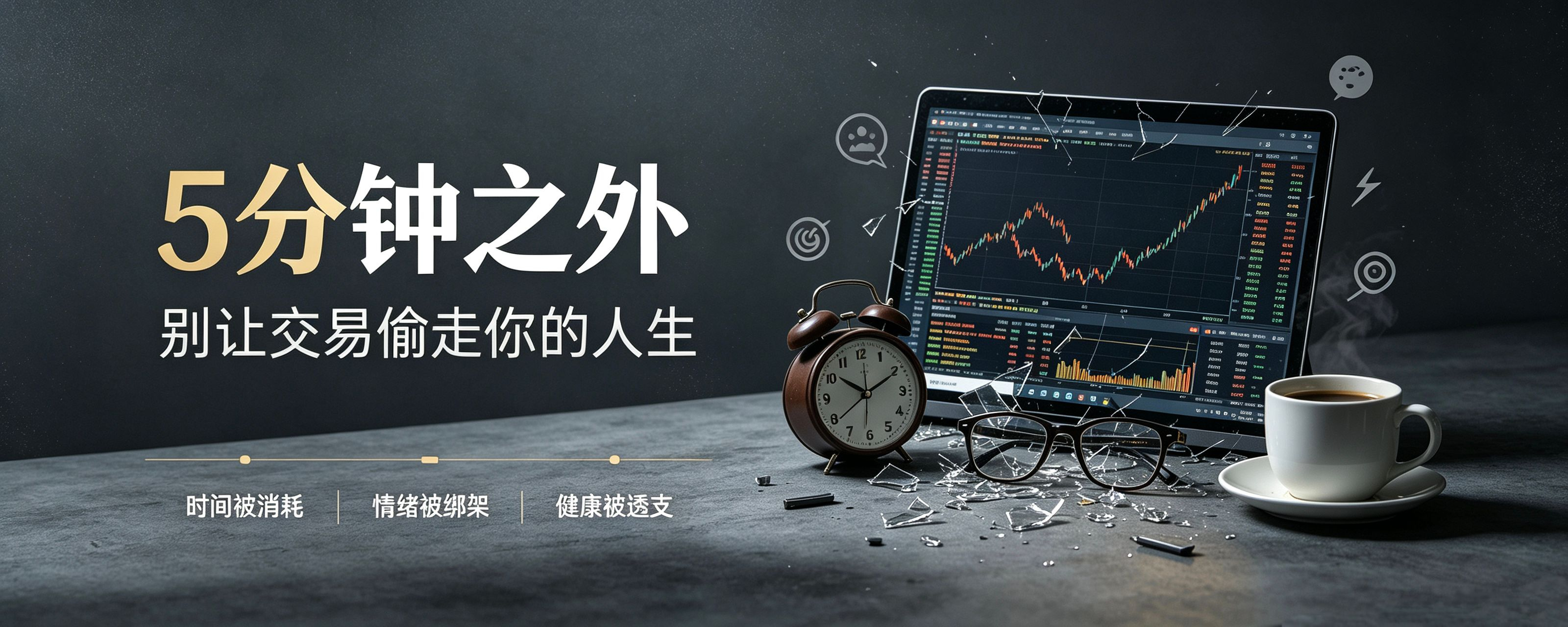
There is a cruel and true conclusion: if your daily trading takes longer than just five minutes, you’ve already become a slave to trading.
Real maturity in trading is never about staring at the screen, frequent actions, or endlessly agonizing. It is a set of exquisitely simplified rule execution: wait for certainty-based opportunities, mechanically enter and exit positions, and take profit and cut loss unconditionally—through the entire process with no emotional drain and no waste of mental energy. In five minutes, you can complete all daily trading planning and execution.
And those who spend hours every day watching the charts, reviewing afterward, and refreshing market data—seemingly working hard to make money, but in reality quietly mortgaging their lives away. They’re running a contest that, in the long run, is absolutely not worth it.
We must first recognize a deep underlying logic: the essence of the market is a harvesting ground that preys on human nature. It specifically exploits people’s greed and fear, manufacturing endless waves of emotion. When you immerse yourself for a long time in the rise and fall of the market, your mindset will inevitably be manipulated: when you’re profitable, greed and luck make you want to chase more returns; when you’re losing, anxiety and unwillingness lead you to add positions to “get back to even,” or to stubbornly hold against the trend.
Day after day of chart-watching never brings an improvement in trading ability—it only creates ongoing mental drain. Many traders fall into it: during the day, they fixate on the screen, restless and uneasy; after the market closes, they endlessly review and self-undermine; late at night, they stay up to watch overseas markets, agonizing over tomorrow’s direction. Long-term exposure to this state leads inevitably to anxiety, insomnia, irritability, and a collapse in focus.
These hidden physical and mental costs are the most expensive and least reversible parts of all trading losses.
If you lose principal, there’s still a chance to recover it; if your strategy is flawed, there’s still an opportunity to correct it. But health drained by trading, energy consumed, and time wasted can never be replayed. Human depletion is compounded. Long-term staying up late, emotional suppression, and mental tightness won’t “charge you” immediately in the form of a price tag—but they will erupt in a concentrated way years later: declining immunity, endocrine disorders, a restless and irritable mindset, and the loss of patience to calmly and steadily do things.
In the end, traders will discover a painful truth: the meager gains earned from short-term contests are far from enough to cover the later costs of self-care and restoring the body and mind. To use your precious health and stable emotions to gamble for uncertain market returns is, from a long-term life perspective, fundamentally a losing purchase—an utterly bad deal.
More tragic is that most people misunderstand the core of trading. Many think, “The more time you spend trading, the more money you make.” In fact, it’s exactly the opposite. The key to making money in trading is restraint, not diligence.
The market is never short of opportunities; what it lacks is patience for waiting. Constantly staring at the charts only magnifies human weaknesses, making people feel compelled to trade frequently, add positions impulsively, and break risk controls. The more time-consuming, laborious, and unwilling to let go it is, the easier it becomes to be led around by the market—turning from “active trading” into a “passive contest,” ultimately becoming a slave to the market.
Many traders fall into a vicious cycle: wasting large amounts of time, overspending their body, mind, and emotions, and gambling in a contest that risks going back to zero capital. In the end, they will most likely make small wins and big losses, overall ending in loss. They don’t make money, their body breaks down, their mindset collapses, and their time is wasted.
Looking at true top-tier traders, none are anything but minimalists. Each day, they spend only a few minutes: form a trading plan, filter trading opportunities, and execute take-profits and stop-losses. The rest of their time is devoted entirely to life, learning, reflection, and deepening their own value.
They understand a fundamental truth: trading is only a tool in life, never the whole of life. The ultimate境界 of trading is not endless study and obsessively watching the screen, but low time cost, low mental strain, and low emotion—seeking certain returns with the least cost.
The most fatal misconception for ordinary people is treating trading as a “full-time, go-for-it career.” They burn huge sunk costs, risking principal, emotions, and health, to participate in a zero-sum contest with a very low chance of winning and uncertain returns.
The most precious capital in life is never the money in your account, but rather non-renewable time, a stable mindset, and a healthy body.
Any trading that takes more than five minutes, in essence, is self-consumption. Once you start worrying about price action, losing sleep over profit and loss, and wasting your life on trading, you’ve already lost.
True smart trading is light positions, extreme simplicity, and low cost. True clarity in life is not being driven around by contests and not being drained by profit and loss.
Put down endless chart-watching. Quit emotional trading. Reclaim your attention that has been held hostage by the market. Give time back to life, give health back to yourself, and return agency to your life.
Trade to empower your life—never let your life be sacrificed to trading.