

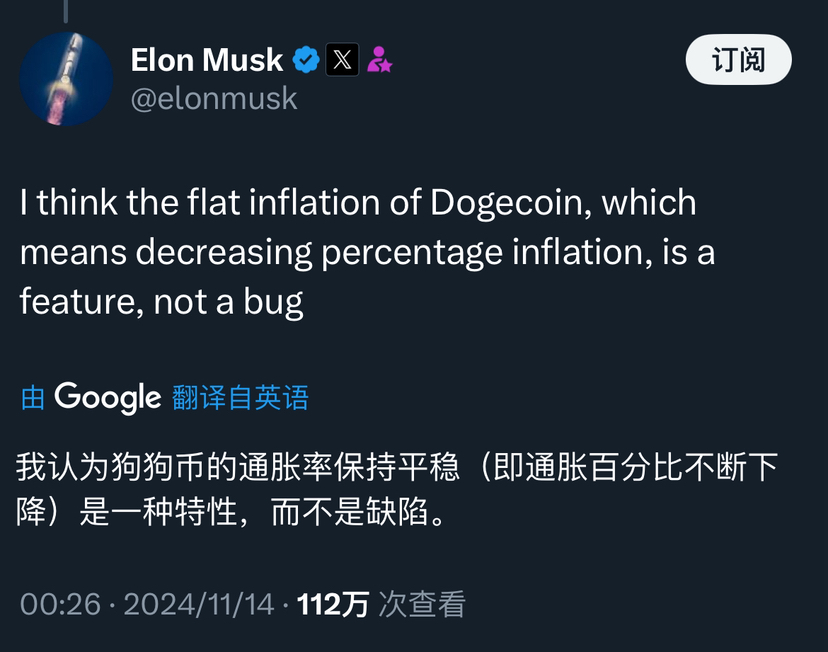
Dogecoin (DOGE) currently has a fixed issuance mechanism of about 5 billion new coins per year (fixed block reward of 10,000 DOGE per block, one block every minute), with no total supply cap and no halving mechanism. This leads to a continuous increase in circulation, but the percentage inflation rate declines year by year (around 3.3%–3.8% in 2025-2026, and will continue to slowly decrease to below 2% in the future). Many people see this mechanism as a 'flaw', but in fact, the Dogecoin officials and many supporters (including Elon Musk) have consistently emphasized that this is a 'feature, not a bug.'
The following lists some unexpected and counterintuitive benefits that are often overlooked by Bitcoin maximalists, yet are crucial for Dogecoin's positioning and long-term survival:
Permanently incentivizes miners, making network security more sustainable
After Bitcoin's halving, if transaction fees are insufficient to cover costs, miners' revenues will drop significantly, potentially leading to a drop in computing power and a weakened network. Dogecoin, through fixed block rewards, always provides miners with stable income, avoiding the risk of 'miner exodus.' This is actually a millennial-level security guarantee in PoW chains, and many analysts believe this is one of the core reasons why Dogecoin can 'last longer than expected.'
Deliberately suppresses 'hoarding culture' and encourages genuine circulation as currency
Deflationary assets (like Bitcoin) easily lead people to 'become more reluctant to spend as prices rise,' ultimately transforming into 'digital gold' instead of a daily currency. Dogecoin's mild inflation creates a slight psychological expectation for holders that 'spending is more cost-effective than holding,' thus promoting native scenarios such as tipping, rewards, micro-payments, and charitable donations.
This is also why the Dogecoin community's activity level and actual usage frequency have consistently far exceeded many 'scarcer' coins—it is truly being spent, rather than locked in cold wallets.
The inflation rate naturally 'self-decelerates,' tending towards extremely low inflation rather than malignant inflation
Many people mistakenly believe 'unlimited issuance = malignant inflation,' but because the annual increase is fixed, the percentage inflation rate will automatically decrease (similar to the 2% target pursued by many central banks in the real world). After 2030, it may stabilize long-term below 2%–3%, which is lower and more predictable than the actual inflation of many fiat currencies, giving it a 'mildly controllable currency' attribute.
Prevents excessive centralization of computing power, maintaining a relatively healthy decentralization
Fixed rewards ensure that small and medium miners consistently have reasonable returns, making it difficult for large institutions or super investors to completely squeeze them out of the market during the 'low-fee era after halving.' This is especially evident in merged mining (sharing computing power with Litecoin), indirectly enhancing the network's resistance to censorship and attacks.
Has a natural hedging effect against 'lost coins'
Every year, situations like lost private keys and dead wallets lead to coins permanently exiting circulation. Fixed issuance perfectly hedges against these losses, ensuring that the actual circulating supply does not experience severe deflation due to losses, thus maintaining the currency's usability and liquidity. In the long term, this actually stabilizes Dogecoin's 'effective supply.'
In summary: the issuance mechanism of Dogecoin is essentially designed for 'use as currency,' rather than for 'hoarding as digital gold.' Therefore, the 'unexpected benefits' revolve mainly around practicality, sustainability, and liquidity, rather than short-term price surges. Of course, this mechanism does limit its potential to become a 'super scarce asset,' with long-term prices relying more on community vitality, real adoption, and narrative-driven factors. If you treat Dogecoin as an investment, its risks are completely different from Bitcoin; but if you see it as 'internet tipping/reward currency' or 'meme culture carrier,' this mechanism is one of the greatest moats that allow it to survive and possibly thrive in the future.
