
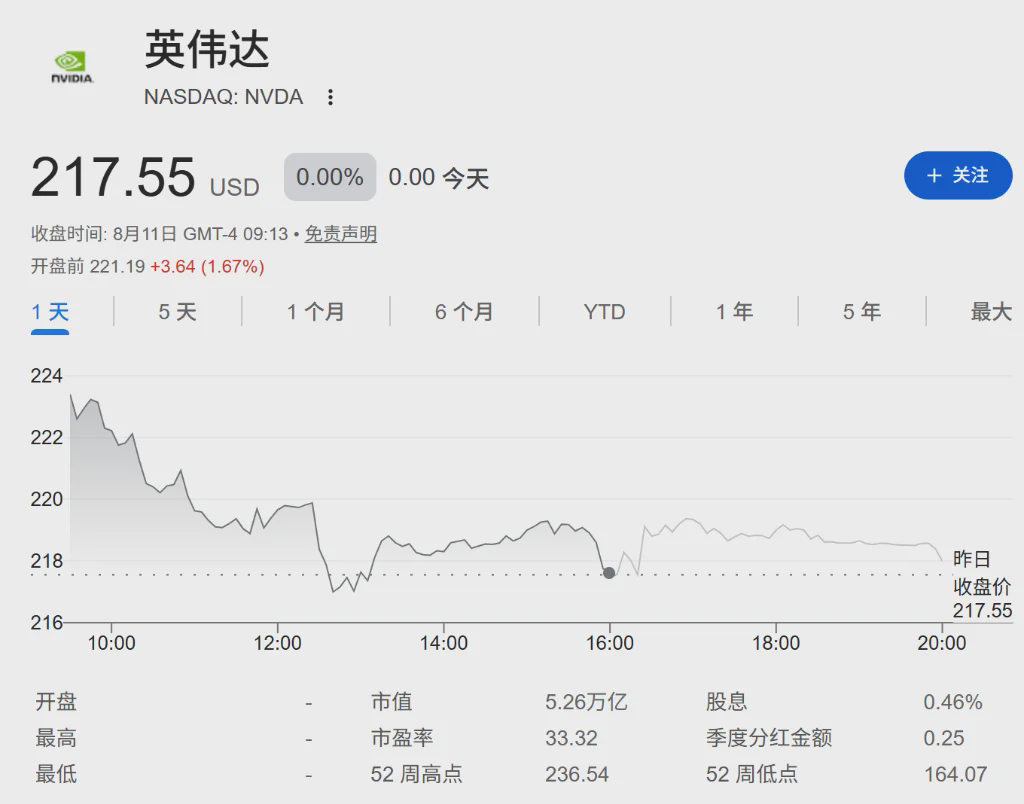
NVIDIA is fully committed to developing an open-source model, Nemotron 4, with at least 100 trillion parameters, aiming to reduce reliance on leading customers such as OpenAI and on cloud giants. The company has not only substantially increased its cloud service compute commitments to $28 billion through a server leaseback program, but has also formed the “Nemotron Alliance,” an ecosystem co-building effort that includes Mistral, Cursor, and others. NVIDIA shares rose nearly 2% in premarket trading.
NVIDIA is heavily betting on its own in-house open-source artificial intelligence model, trying to grow demand for its GPUs—even as this strategy places it in a delicate position of directly competing with its own customers and investment targets.
The Information reported on the 11th that Nvidia’s goal is to bring the performance of the largest version of Nemotron 4 to a level comparable to the world’s top open-source models. Multiple employees said the model’s parameter count is expected to be at least 1 trillion—about twice that of its current largest model, Nemotron 3 Ultra. In an email, Nvidia’s vice president of generative AI, Kari Briski, said, “Nvidia invests in Nemotron because we believe every company and every country needs accessible cutting-edge open-source models.”
Nvidia’s current chip demand is highly concentrated among a small number of cutting-edge labs and cloud service providers such as OpenAI and Microsoft and SpaceX, and these organizations are increasingly moving toward designing their own AI chips. The push for Nemotron 4 aims to broaden the base of demand to include a wider range of enterprise users, thereby reducing Nvidia’s reliance on its top customers. Anastasios Angelopoulos, CEO of AI model evaluation firm Arena, said, “No matter which company creates an excellent open-source model, Nvidia is the winner.”
Nvidia’s shares rose nearly 2% before the market opened in the U.S. today.
A goal of a trillion parameters, with compute investment tripling
According to multiple employees involved in the Nemotron project, the largest-scale Nemotron 4 model Nvidia plans to develop is expected to have at least 1 trillion parameters—about twice the size of its current largest model, Nemotron 3 Ultra, released in June this year. The parameter scale will still be far below China’s leading open-source models, but Nvidia also emphasizes that its compression technology can enable a smaller model to deliver standout performance.
In terms of compute power investment, Nvidia’s resolve is reflected in a significant expansion of its funding commitments. It is reported that the company obtains compute power by leasing AI servers back from cloud service providers that purchase its chips. As of April this year, the total value of Nvidia’s multi-year cloud service commitments had risen to $28 billion by early 2031, about three times the amount disclosed a year earlier. Spending for the current fiscal year (through January 2028) is about $7 billion—far lower than the scale of investment by OpenAI and Anthropic, but already exceeding the total historical financing amounts of the vast majority of leading open-source labs in the U.S. and China.
In terms of the size of its R&D workforce, the Nemotron project continues to expand as well. The author list on the research paper for Nvidia’s previous major model includes as many as 570 people, and multiple employees said the number of participants in Nemotron 4 will be even greater. “Everyone wants to jump in now,” one former employee said.
Forming the “Nemotron Alliance” and welcoming open-source ecosystem partners
To accelerate Nemotron 4’s R&D, Nvidia has built a collaborative network called the “Nemotron Alliance.” Members include open-source developers such as Reflection, Cursor, Thinking Machines, and Mistral. While advancing their own model projects, all parties also contribute training data, evaluation support, and model design proposals to Nemotron 4.
In addition, a person directly involved in the collaboration disclosed that Prime Intellect, an AI model training startup, contributed 300,000 simulated environments to the project to help train the models. Cognition, an AI programming tool startup, is also among the alliance members. According to insiders, the company has discussed with Nvidia providing code training data, but no related cooperation has been officially disclosed to the public yet.
The members’ motivations for participating vary. Some companies hope to expand their market share by leveraging Nvidia’s push for an open-source ecosystem; others expect to influence the development direction of a high-quality model they can use at a lower cost, thereby avoiding the pressure of having to bear the training compute costs themselves. Prime Intellect CEO Vincent Weisser frames this alliance as a collective action to counter a monopoly by a single “god-level” model, rather than a zero-sum game over who gets the title of the best open-source model.
The boundaries between customers and competitors are becoming blurry
Nemotron 4’s push puts Nvidia in a delicate kind of structural tension. On the one hand, OpenAI has long been a major driver of demand for Nvidia chips, and Nvidia has invested $30 billion in it; on the other hand, Nemotron 4 is precisely positioned to offer enterprises a lower-cost alternative, competing with the business models of cutting-edge labs such as OpenAI. At the same time, companies included in the alliance, such as Reflection AI and Thinking Machines, are open-source startups that Nvidia has already funded.
However, for Nvidia, this competitive logic is not necessarily a zero-sum game. Anastasios Angelopoulos, CEO of AI model evaluation firm Arena, said: “No matter which company creates an excellent open-source model, Nvidia is the winner.” Nvidia’s core logic is that the more vibrant the open-source ecosystem and the more diverse the participants, the stronger overall demand for GPUs becomes.
At present, Nemotron series models have gained some market adoption. Palantir announced in June that it is collaborating with Nvidia to use Nemotron models for U.S. government customers. But according to benchmark test data from firms such as Arena and Artificial Analysis, Nvidia’s current largest model, Nemotron 3 Ultra, ranks only second among U.S. open-source models, coming after Thinking Machines’ newly released Inkling model. In the overall global ranking, it is also outside the top 40 models.
The release timeline remains unclear
Despite the project’s large scale, there is still significant uncertainty around the release timeline for Nemotron 4. Multiple employees said Nvidia has made several decisions regarding pretraining data and the architecture, but has not finalized the exact specifications and release date. The final training stage has not yet started and is expected to take several months. Two employees believe the model could be released by late autumn this year, while another employee thinks it may come later.
Meanwhile, Nvidia this week released a smaller version of the Nemotron series—Nemotron 3.5 Lightning. The model focuses on running AI agent tasks as quickly and efficiently as possible. Nvidia also simultaneously released free model-routing software to help enterprises more conveniently build custom model-routing tools, automatically assigning specific AI tasks to the best and most economical models for processing.
In a podcast this January, Bryan Catanzaro, Nvidia’s vice president for deep learning research, said that investing in Nemotron “is crucial to the future of our company.” Nvidia CEO Jensen Huang also publicly stated his support for open source in an email last month, saying open-source models “promote safety, cybersecurity, scientific progress, and national security.”
