

Let’s use a simple example with LAB.
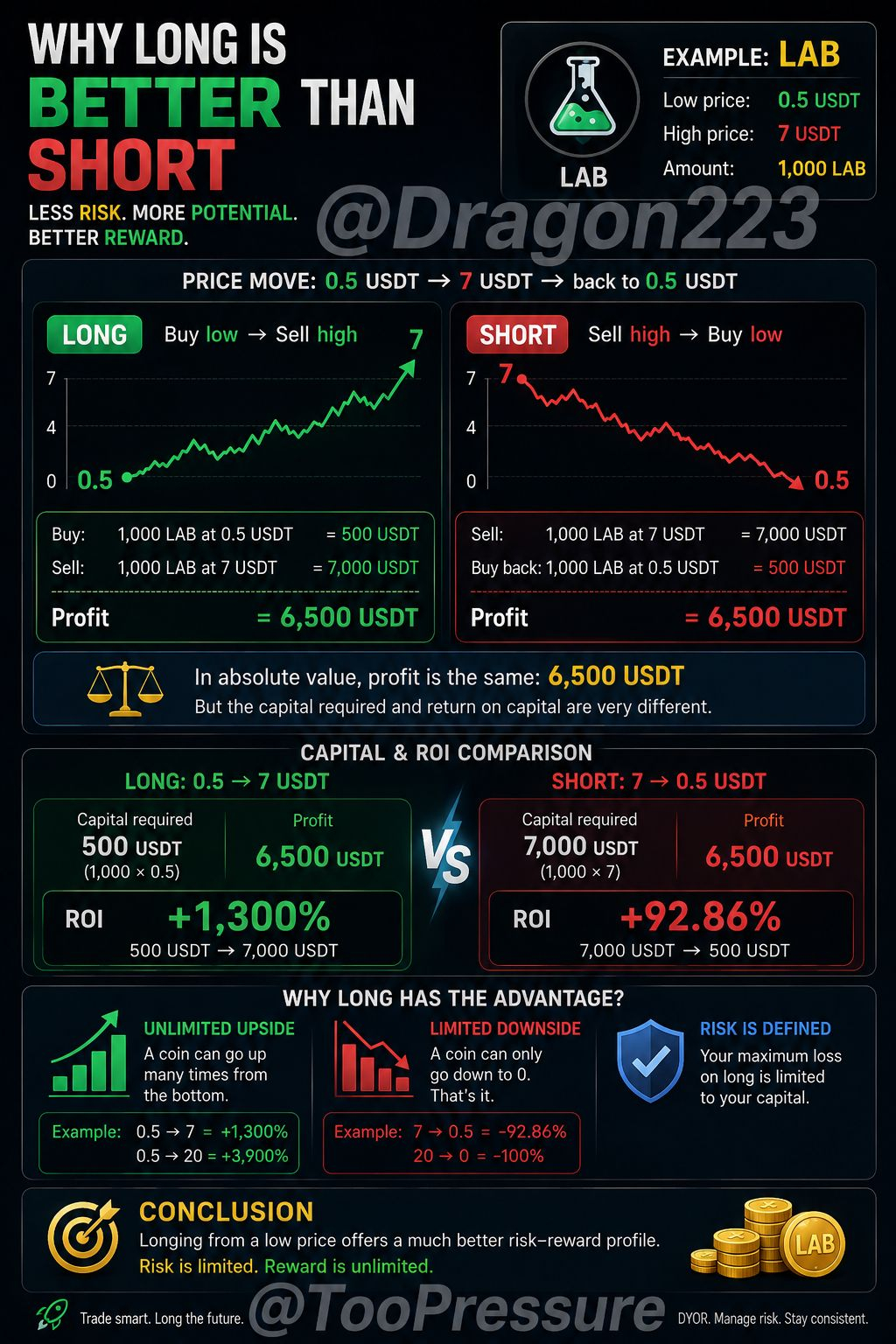
Imagine LAB moves from 0.50 USDT → 7.00 USDT.
Suppose we trade exactly 1,000 LAB.
🟢 LONG: 0.50 → 7.00
Entry: 0.50 USDT
Exit: 7.00 USDT
Position size: 1,000 LAB
Initial capital required:
1,000 × 0.50 = 500 USDT
Value at 7.00:
1,000 × 7 = 7,000 USDT
Profit = 6,500 USDT
That means:
500 USDT → 7,000 USDT
🔥 +1,300% return
---
🔴 SHORT: 7.00 → 0.50
Now imagine shorting 1,000 LAB at 7.00 and covering at 0.50.
Short position value:
1,000 × 7 = 7,000 USDT
Cost to buy back:
1,000 × 0.50 = 500 USDT
Profit = 6,500 USDT
The absolute profit is the same.
But without leverage:
- LONG: 500 USDT capital → 6,500 USDT profit = +1,300%
- SHORT: 7,000 USDT position → 6,500 USDT profit = +92.86%
The key difference
A coin can potentially go:
0.50 → 1 → 2 → 4 → 7 → 10 → 20...
There is theoretically no upper limit to how high the price can go.
But on the downside:
7 → 3 → 1 → 0.50 → 0
The maximum decline is 100%.
That asymmetry is one reason Traders prefer looking for high-quality LONG opportunities near undervalued or depressed prices, rather than constantly trying to SHORT every pump.
Of course, this does not mean every low-priced coin should be bought.
The key is finding the right combination of:
📌 Strong fundamentals
📌 Accumulation / market structure
📌 Volume
📌 Liquidity
📌 Risk management
📌 A clear invalidation level
The goal isn't to predict every move.
The goal is to find situations where the upside potential is significantly larger than the downside risk.
What do you prefer?
🟢 LONG the bottom → ride the upside
or
🔴 SHORT the top → ride the downside
#Crypto #BinanceSquare #Trading #Long #Short #LAB #RiskManagement
