

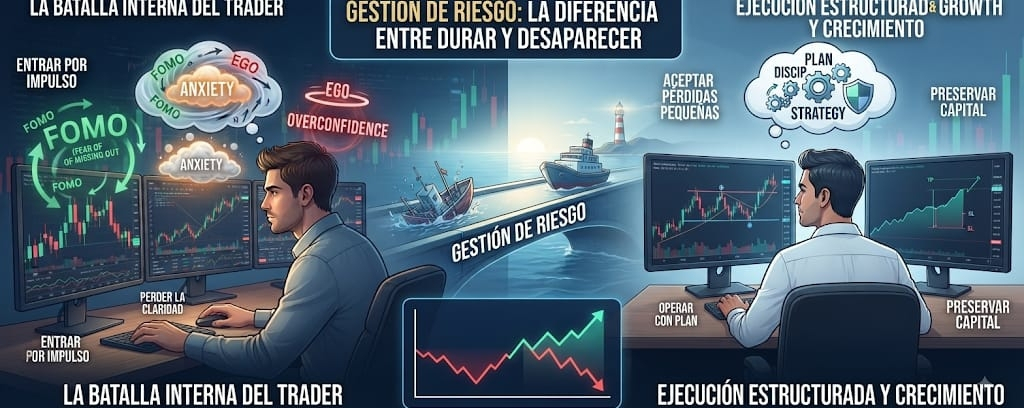

📉 Many people enter trading believing that everything depends on finding the perfect entry, the correct indicator, or the coin of the moment. But over time, the market teaches a lesson that’s far more important: it’s not the one who’s right the most who survives, but the one who best protects their capital.
In trading, winning one operation can give you confidence. But mismanaging risk can take you out of the game entirely. And that’s the big difference between trading with emotion and trading with structure.
What is risk management really?
Risk management is the set of rules you use to limit damage when the market doesn’t move as you expected. It’s not about avoiding losses, because losses are part of trading. It’s about preventing a bad decision, an impulsive entry, or an emotional reaction from destroying your account.
Put simply: your goal is not to win every time, but to stay in the game long enough for a disciplined strategy to make sense.
The real problem isn’t always the market
Many traders know how to read support, resistance, trend, and volume. Still, they lose. Why? Because understanding the chart is one thing, and executing well under pressure is a completely different thing.
When FOMO, anxiety, ego, or the need to get back quickly show up, the most expensive mistakes start:
entering late out of fear of missing out
increasing exposure without structure
changing the plan mid-trade
holding a bad entry for too long
getting back in impulsively after losing
trading more out of anxiety than opportunity
📌 Most of the time, the account doesn’t break from a single trade. It breaks from a chain of poorly controlled bad decisions.
Protecting capital is also protecting your mind
In trading, you shouldn’t only take care of the money. You also need to protect your mental clarity.
Because a bad streak can make you doubt, force entries, break your rules, and trade from frustration. That’s why managing risk also means knowing when to stop, when to lower intensity, and when to accept that today isn’t a day to trade.
💬 An account can be recovered. A disordered mind in front of the market costs much more.
Basic keys to good risk management
1. Trade with a plan, not on impulse
Before opening a trade, you should be clear about why you’re entering, what invalidates the idea, and at what point that trade no longer makes sense. Without structure, any emotion ends up taking control.
2. Accept small losses
Many traders don’t fail because they lose. They fail because they don’t accept small losses in time. They try to recover immediately, force entries, and end up increasing the damage. Sometimes, a small well-managed loss prevents a major emotional and financial one.
3. Don’t confuse activity with progress
Trading all the time doesn’t mean you’re moving forward. Sometimes, doing nothing is also an intelligent decision. The market doesn’t pay you for being present; it pays for executing well.
4. Ego also destroys accounts
When a trade stops being analysis and turns into a need to be right, management weakens. Ego makes many traders hold onto broken ideas for too long just to avoid admitting the mistake.
5. Overconfidence is also dangerous
After several good trades, some traders let their guard down. They feel invincible, increase exposure, and stop respecting their rules. The problem is that the market doesn’t forgive arrogance.
Discipline matters more than emotion
Risk management doesn’t work only as a nice theory. It has to show up in real habits: waiting, filtering, pausing, respecting criteria, and avoiding trading on impulse.
📍 In trading, surviving matters more than looking brilliant.
📍 Preserving capital matters more than chasing every move.
📍 Keeping clarity matters more than entering out of anxiety.
Conclusion
Most people don’t lose because they lack tools. They lose because they lack control. The market doesn’t demand perfection, but it punishes improvisation, ego, and the absence of structure hard.
Learning risk management doesn’t guarantee profits, but it can help you avoid the mistakes that destroy the most accounts. And in this business, that alone is a huge advantage.
🔥 Because in trading, in the long run, it’s not the one who guesses the most who wins… it’s the one who knows how to stand your ground.
❓Question for the community:
What do you think is the risk management mistake that destroys accounts the most: FOMO, ego, or overconfidence?
“In trading, surviving is more important than impressing.”
#Trading #GestionDeRiesgo #RiskManagement #CryptoTrading #BİNANCESQUARE #Discipline #PsicologiaDelTrading #FOMO #KoreaApprovesTighterCryptoExchangeRules #FinancialEducation #BTC #ETH 📊🚨💰$BTC $ETH

