


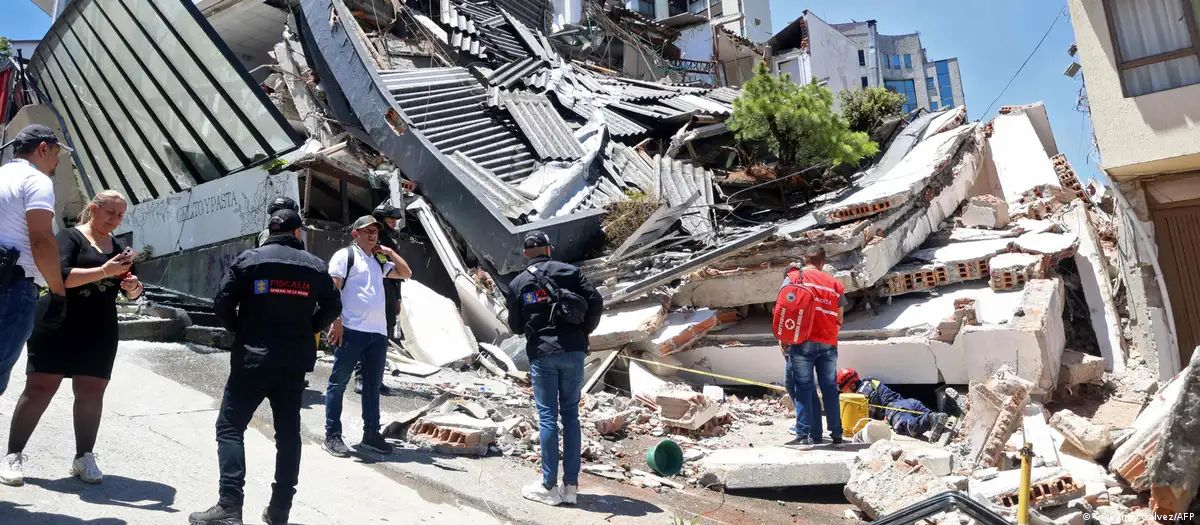
Colombia President Abelardo de la Espriella declared a nationwide state of emergency after a strong earthquake with a magnitude of 7.4. De la Espriella said this on Monday, August 10, three days after taking office.
"All institutional resources will be mobilized to respond adequately to the disaster," the agency dpa quoted him. "First of all, it is necessary to save people who are trapped under the rubble."
According to the Colombian Association of Regional Centers, at least 132 people died and 570 were injured as a result of the disaster.
More than 1,500 residential buildings suffered serious damage in several cities, including Pereira, Cali, and Manizales. About 60 buildings completely collapsed. Damage was done to 18 hospitals and 52 schools. There are concerns that the number of deaths may rise further.
"The strongest earthquake in Colombia in the 21st century"
The earthquake occurred on August 10 at 07:34 local time (15:34 Moscow time). According to Colombia's Geological Service (SGC), the epicenter was located at a depth of about 103 kilometers near the city of San José del Palmar in the west of the country. Numerous aftershocks were recorded. "This is the strongest earthquake registered in Colombia in the 21st century," SGC said.
The U.S. State Department on August 10 announced that it would allocate an emergency assistance package to Colombia worth $15.5 million (€13.4 million). "We are united in prayer with the Colombian people and are ready to support President Abelardo de la Espriella," the U.S. foreign policy agency said, referring to the leader who is favored in Washington.
Abelardo de la Espriella won the election in June
In June, Abelar do de la Espriella won the runoff of the Colombian presidential election over the left-wing candidate Ivan Cepeda and replaced the left-wing president, Gustavo Petro, who could not run for a second term.
De la Espriella said that he intended to fight armed groups involved in drug trafficking with the help of military force and that he would rely on deregulation in the economy. As part of the fight against crime, the politician planned to build huge prisons—after the example of Salvador.
"The Trump administration expects close cooperation with your future administration to strengthen regional security cooperation, curb illegal immigration to the United States, and strengthen our economic ties," U.S. Secretary of State Marco Rubio wrote on the social media platform X shortly after the election of the new Colombian leader.