It wasn’t the miners dumping it either.
It wasn’t the futures that caused the drop.
It was BlackRock who dumped it.
BlackRock’s 750,000 Bitcoins— all someone else’s money. Who’s holding it, and when will they cut their losses?
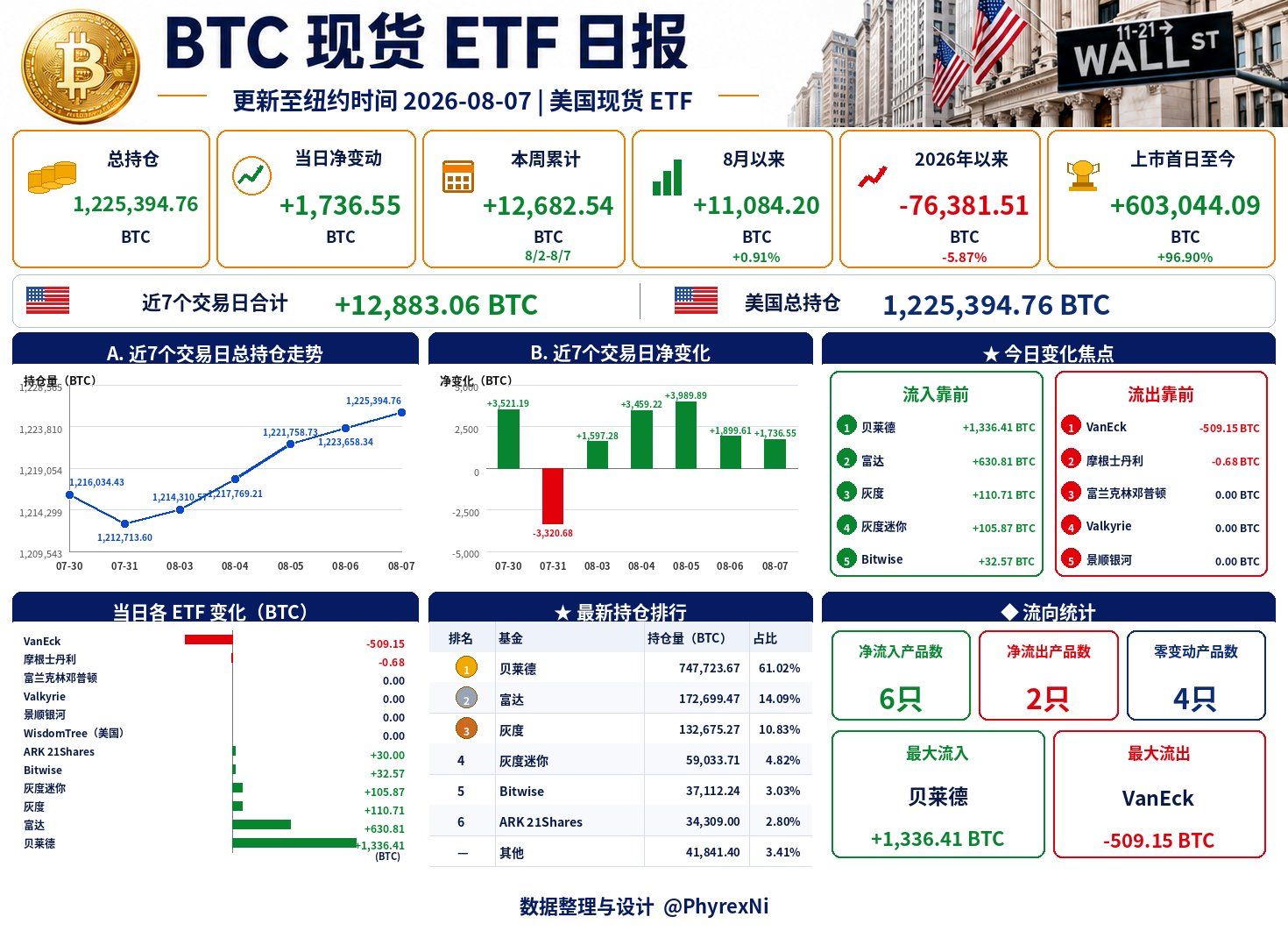
Since 2026, US spot Bitcoin ETFs have seen net outflows of 76,381 BTC (-5.87%).
76,000 Bitcoins redeemed from ETFs and dumped onto the market.
Who has the biggest ETF? BlackRock’s IBIT.
So for that “why BTC keeps drifting down” question, half of the answer is already in the ETF redemption data.
The other half? Look at when BlackRock’s customers get done selling.
Global holdings ranking: BlackRock isn’t number one, but it is the biggest conduit.
The institution holding the most Bitcoin is Strategy—840,447 units, 840 thousand.
BlackRock IBIT second: 747,724 units, about 750k.
But BlackRock is the role worth watching more: the total holdings of all US spot ETFs are 1,225,395 units, and IBIT alone accounts for 61%.
When retail investors buy and sell Bitcoin, more than half of the orders route through its ledger.
Strategy’s 840k units are “dead inventory.”
BlackRock’s 750k coins are “live inventory”—each coin represents a customer who may press the redemption button at any moment.
The true source of selling is clear at a glance.
ETF redemptions are effectively selling
And BlackRock’s IBIT is the largest ETF—during redemption waves, it’s the thickest pipe.
The most interesting contrast is here: last week IBIT still had net inflows of $850 million (retail is bottom-fishing), but YTD is net outflows of 76k coins (big players are pulling out).
Retail investors bottom-fishing pick up the goods from the big guys.
This script is exactly the same as the 2025 top—only the direction is reversed.
BlackRock’s 750k coins—whose money is it?
BlackRock itself never sells—it only collects a 0.25% management fee.
The ones who sell are its customers.
Arbitrage machine (largest position share, zero belief)
Jane Street, Cumberland, Millennium. Market makers—capture discounts and premiums—and sell volatility. The more BTC falls, the better their business is to run.
Their selling isn’t a decision—it’s an algorithm. The bigger the discount widens, the more they redeem, millisecond by millisecond. In the redemption data, each abnormal fluctuation trade—about half of them—are theirs.
Middle-class 401(k) holders (largest in number)
Dollar-cost averaging monthly: 1%-5% position size, entering in 2024-2025, cost 80-100k (estimate). Now they’re down 25%-35%.
They don’t watch the screen. The trigger for what they sell is life: unemployment, a mortgage, tuition. When money needs to leave the account, the first thing sold is “Bitcoin they don’t understand.”
Pension plan trial-takers (fastest movers)
Wisconsin 160 million, Michigan 25 million—about 0.1% of their assets <0.1%.
Their selling is a political event: hearings, the SEC’s leadership change, custody problems. No announcements, no explanations—quietly disappears in the next quarter’s 13F.
Retail FOMO crowd (most steadfast, deepest floating loss)
Entering from late 2024 to the 2025 peak, cost 100-120k, floating loss 40%-50%. Still buying—last week’s $850 million inflow is them.
The trigger for what they sell is emotion: the moment they break even.
Under what conditions would they sell? Four triggers.
Trigger 1: it’s already selling (YTD -76,381 units)
This isn’t a prediction—it’s the current situation.
From January to August 2026, the ETF has net outflows of 76k coins (6-7 billion USD).
The first domino has already fallen—falling 49% is the result.
Trigger 2: sell on rebound (the biggest sell pressure is hidden at the break-even line)
The psychological price for trapped supply is break-even. IBIT’s overall cost estimate is 85k-95k; retail’s cost is 100k-120k.
BTC rebounds to 900k-1.0M, and the three-year trapped supply collectively breaks even and dumps—those sell pressures will be an order of magnitude larger than the panic sell pressure around 60k.
Every time the rebound reaches the previous high on huge volume, it’s the breakout/breakeven holders unloading.
Trigger 3: break the level and sell
- Breaks below 50,000: compliance risk controls in wealth management channels trigger—model portfolios are forced to liquidate—redemption waves accelerate: continuous net outflows from the ETF will turn into weekly net outflows
- Break below 30,000: the pre-2022 all-time-high platform zone—believers’ final line of defense—chain liquidations
- Break below the prior low: trend-following funds all exit—ETF redemptions + futures forced liquidations + miner sell-offs deliver the triple kill.
Reference 2022: 30k to 15k took only 6 months
Trigger 4: events trigger selling
- US stock crashes (the easiest one to happen): when margin accounts are called for additional funds, leveraged investors’ first thing to sell is the most liquid asset—BTC.
The March 2020 COVID crash: BTC dropped 50% in two days. This wasn’t crypto having any bad news—it was leveraged positions selling everything they could to cover margin.
The more the US stocks crash at the level of an “AI bubble,” the more BTC gets cut first.
How do you short?
Short at the current price 63,900-64,500 (first tranche 30%) → stop-loss 66,200 / 66,800
Add on the rebound 1: 65,500-66,500 (+30%) → after adding, unify stop-loss at 68,000
Add on the rebound 2: 69,000-70,500 (+25%, MA200 main resistance) → stop-loss unified at 71,500
Add on the rebound 3: 72,500-73,500 (+15%, Fib 0.786) → total hard stop-loss 75,500
Profit-taking ladder: 62,000 → 57,800 → 50,000 → 30,000
Discipline: total position capped, reduced step by step, total risk ≤2%; after the stop-loss is swept at 69,000+, re-short by re-posting the order without chasing.
30k isn’t the end point—it’s the next stop
750k floating supply—each coin has an owner, and each owner has a price.
When the price is there, the coins get rotated.
Below 50,000, the risk-control book forces them out.
Below 40k, the believers’ positions start collapsing.
Then what? Reference 2022: from 30k to 15k—used only 6 months.
The buyers who take the bag are always the next people lured in by “institutions entering,” “digital gold,” “this time is different.”