
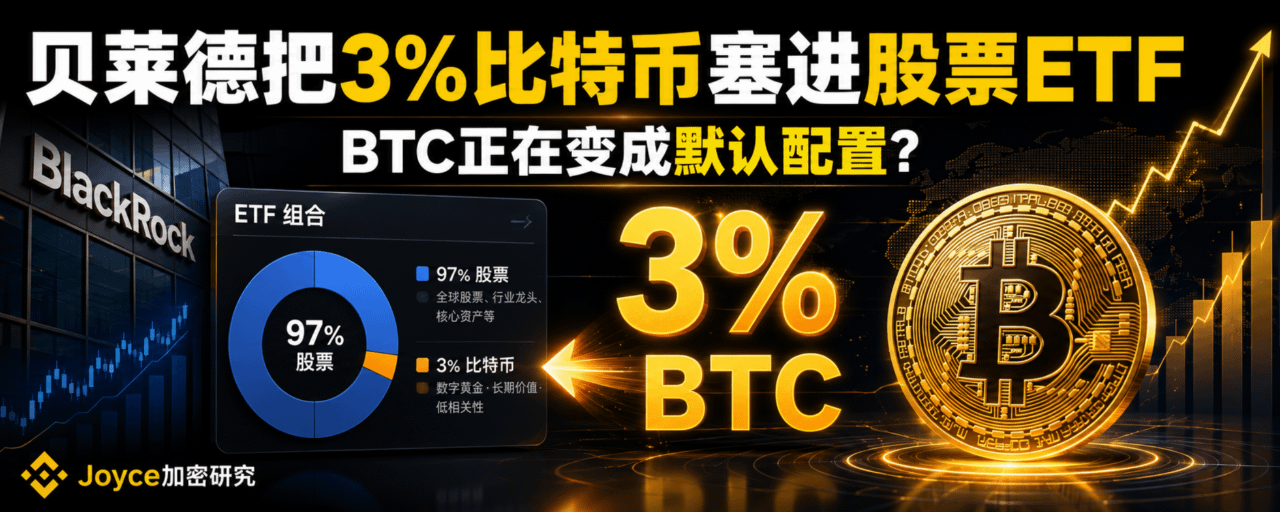
BlackRock puts 3% Bitcoin into a traditional stock ETF: is BTC becoming a “default setting”?
When many people see this message, their first reaction might be:
“BlackRock has released another Bitcoin ETF?”
Actually, it’s not that simple.
BlackRock Canada’s latest IBQT isn’t a pure BTC ETF; it’s a “stocks + Bitcoin” combined ETF:
97% allocated to global stocks, 3% allocated to Bitcoin.
And it’s already trading on the Toronto Stock Exchange, with a management fee of only 0.22%. BlackRock’s official positioning for this product is also very direct: get global stock exposure and Bitcoin exposure through a single ETF.
I think the real thing worth watching here is the 3% figure.
3% looks small.
But it represents a completely different logic:
In the past, investors had to actively decide: “Should I buy BTC?”
It’s starting to become:
“In my traditional investment portfolio, should I by default keep a little bit of BTC?”
The difference between the two is huge.
Because when BTC truly goes mainstream, it doesn’t necessarily happen just because everyone suddenly turns into Bitcoin believers.
More likely, asset managers will slowly turn it into:
A small standard allocation outside of stocks.
That’s also why I think IBQT is more meaningful than simply issuing another BTC ETF.
It doesn’t ask you to bet 100% on BTC.
Instead, it tells traditional investors:
97% keep buying the stocks you know. The remaining 3%—put it into Bitcoin.
If more and more products like this show up in the future, BTC’s role may gradually shift from a “high-risk alternative asset” to a “satellite position in a traditional portfolio.”
But don’t get overly excited about it either.
This fund is still very small in size. As of August 10, its net assets are only about CAD 1 million—nowhere near the level of “a massive influx of capital.”
So this news won’t directly push BTC up in the short term.
BTC is currently around the 64K range and still under pressure intraday.
What I care more about is the long-term trend:
It used to be: Crypto convincing traditional finance to accept BTC.
It’s starting to become that: traditional finance actively puts BTC into its own products.
Scenario A:
If “stock + a 1%-5% BTC” type of combination ETF becomes more and more common, BTC’s future incremental capital may come not only from Crypto users, but from pension funds, wealth-management accounts, and everyday ETF investors.
Scenario B:
If this kind of product can’t build a long-term scale, it means the story of “default allocation to BTC” is still just product innovation—and hasn’t truly become a capital trend.
3% isn’t much by itself. But direction matters.
What’s really worth paying attention to isn’t how many BTC BlackRock buys today.
Instead, will more and more traditional portfolios by default leave a spot for Bitcoin?
#blackRock #BTC #BitcoinETF $BTC