I opened the chart $SPCXB at 23:40 on Tuesday — $133.27. I look at the candle and think: how much time per week is this token traded when Nasdaq is physically operating?
I calculated on paper:
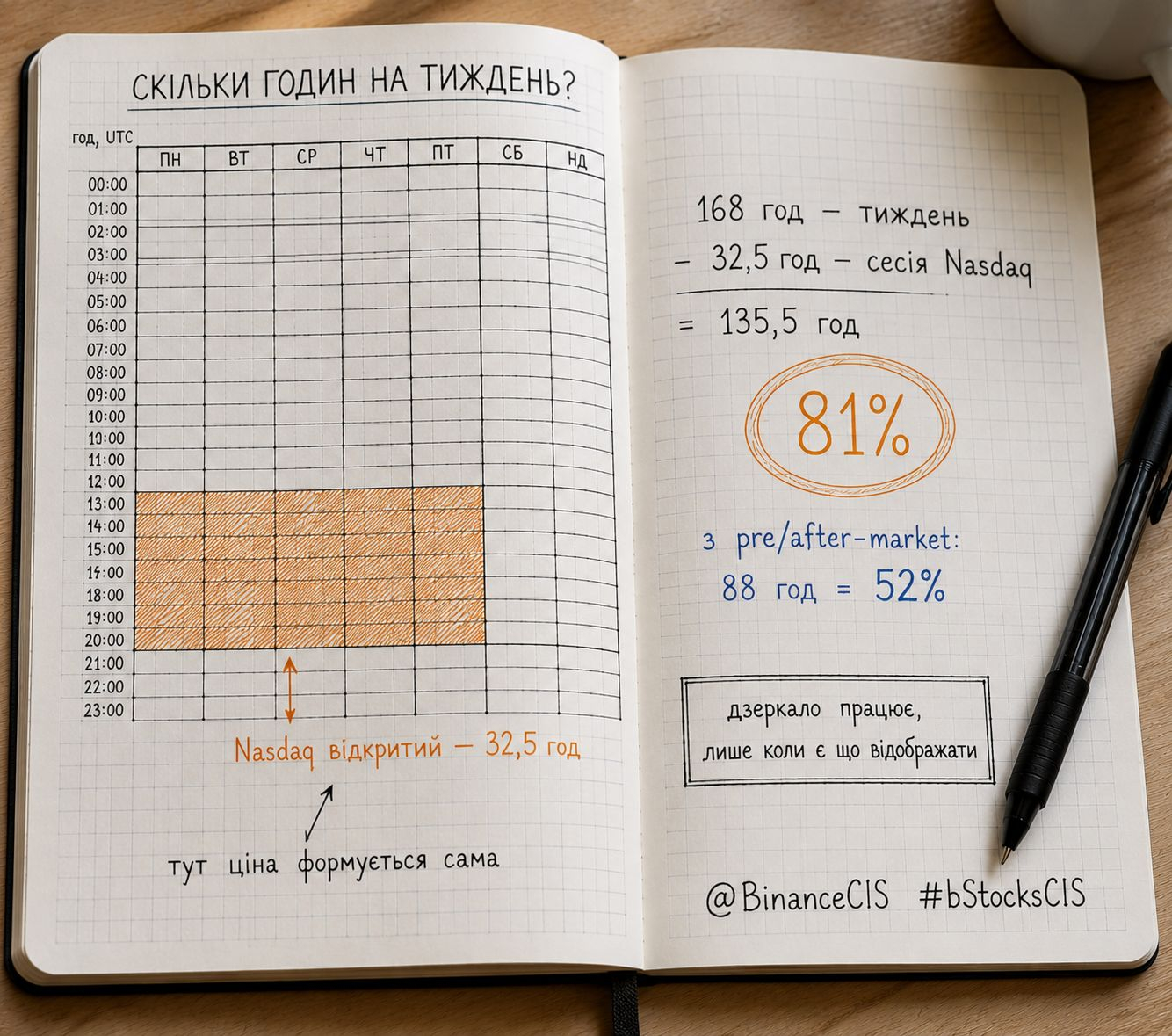
Regular session — 9:30–16:00 ET, 6.5 hours × 5 days = 32.5 hours.
In a week there are 168 hours. So 135.5 hours, ~81% of the time, there’s no real market.
I add extended sessions (4:00–20:00) — 80 hours. But then there are still 88 hours left, 52% of the week.
We’re used to reading bStock as a mirror: there’s a stock = the token repeats it. But a mirror only works when there’s something to reflect. The rest of the time, price is formed by demand and supply inside the bStocks market on Binance.
So “24/7” isn’t just convenience. Most of the week you’re trading not the stock, but expectations about the stock.
Practical takeaway: in the “anchorless” hours, I don’t look at the chart, I look at the spread and the nearest order book levels. Because no one is going to align the price via arbitrage — the underlying market is closed.
Calculation limitations: calendar hours, excluding Nasdaq holidays and uneven liquidity. 81% is the upper bound.
If in 4 out of 5 hours the price lives on its own — is it still a derived instrument, or already a separate market with its own logic? 🤔
@BinanceCIS #bStocksCIS
I calculated on paper:
Regular session — 9:30–16:00 ET, 6.5 hours × 5 days = 32.5 hours.
In a week there are 168 hours. So 135.5 hours, ~81% of the time, there’s no real market.
I add extended sessions (4:00–20:00) — 80 hours. But then there are still 88 hours left, 52% of the week.
We’re used to reading bStock as a mirror: there’s a stock = the token repeats it. But a mirror only works when there’s something to reflect. The rest of the time, price is formed by demand and supply inside the bStocks market on Binance.
So “24/7” isn’t just convenience. Most of the week you’re trading not the stock, but expectations about the stock.
Practical takeaway: in the “anchorless” hours, I don’t look at the chart, I look at the spread and the nearest order book levels. Because no one is going to align the price via arbitrage — the underlying market is closed.
Calculation limitations: calendar hours, excluding Nasdaq holidays and uneven liquidity. 81% is the upper bound.
If in 4 out of 5 hours the price lives on its own — is it still a derived instrument, or already a separate market with its own logic? 🤔
@BinanceCIS #bStocksCIS