



#DAPPOS is finally getting ready for TGE. Recently, the $DOS tokenomics were released. I spent a few hours studying it carefully. Honestly, this is absolutely one of the few hard-core projects among the many recently bloated AI projects.🧐
Before we talk about this project, let me tell everyone first: in the past couple of years, global business history has been undergoing a major shift—namely, the explosive rise of "super individuals" and "one-person companies" (OPC). I believe more and more of you have been hearing these two terms recently.
Let’s talk about the one-person company trend first—it’s spreading worldwide:
A few years ago, if someone told you, "A single person can build a billion-dollar company," you’d definitely think he was just bragging. But now what? This has already become the toughest reality in Silicon Valley’s business circles.
• Dario Amodei, the CEO of Anthropic, directly said: the first unicorn that runs 100% on AI—those kinds of companies where one person can build a $100 million company—will most likely be born in the next few years.
• Look overseas too—those super-individuals like Pieter Levels and Marc Lou. No employees, just one person, yet their annual revenue reaches millions of dollars in ARR.
• With the boost of AI Agents, the speed at which a Solo Founder develops and launches a product today is 3 to 5 times faster than two years ago! Projects that previously required 10 engineers + 5 operators can now be run end-to-end by one person plus a few sets of Agents.
• From Europe’s digital nomad visas to Southeast Asia and the domestic “AI startup wave,” super-individuals are exploding exponentially.
But right now, the AI core pain points are also plenty. Look at OpenAI’s Codex—it’s basically prepared for people who can code and have IT foundations. ByteDance and Tencent are competing by “power/compute” for applications, but what about those who have ideas and resources yet don’t understand technology at all? They’re still stuck on troublesome issues like environment configuration, API interfaces, and cross-border payments.
This is the pain point of today: the massive OPC incremental market urgently needs a product that can turn a “business idea” into an “automated deployment tool” with one click—and is exactly such a project!
Let’s get back to the #DAPPOS project.
Based on all the known real-world deployment cases (e.g., Figures 1 and 2), I truly think this project is pretty impressive in terms of technical implementation capability and its understanding of OPC. I’d like to call it a Web3 version of Codex + Workbuddy.


It has a flagship AI product called xBubble, and what impresses me most is its Bubble Engine SOP system.
You don’t need to understand server environment setup, domain name resolution, API KEY, or any other tedious stuff at all. Just use xBubble Credit to offset everything in a unified way.
OpenAI’s Codex is powerful, but it assumes you have IT foundations. Tencent’s Workbuddy is smart, but it’s basically locked into a centralized ecosystem.
xBubble solves an even bigger incremental market: people who have ideas, resources, and customers, but don’t know how to code, don’t know how to manage servers, and don’t understand APIs.
How exactly do they do it? With three core modules:
• Bubble Engine: customize your own SOP—either AI outsourcing or in-house developers can skip a lot of work.
• Bubble Pilot: automatically match your needs to the most suitable solution.
• Bubble Code: the same system runs both the software and the business end-to-end.
Whether you want to create promotional videos, industry reports, or build automated marketplaces, virtual humans, arbitrage analysis, even market prediction—built-in mature SOPs let you generate them in bulk with one click, delivering industrial-grade output.
Even someone who knows nothing about AI can still produce professional content. It’s like completely shattering the barrier of “one-person companies.” I think it’s the most fully developed one in the current Web3 AI space.
More importantly, it leverages Web3’s natural advantages:
1️⃣ Anti-censorship and data isolation: the underlying infrastructure is provided by a third party. Address login is fully anonymous, and data and business assets are permanently deposited in the entrepreneur’s own hands. You don’t have to worry about the headaches of traditional big-tech firms getting you shut down without warning or data compliance reviews.
2️⃣ Seamless stablecoin settlement: fully integrated with stablecoin networks. Without the high onboarding barriers and long auditing processes of cross-border banks, it perfectly fits the light-asset operations of the OPC era.
Since the project went live in April, it has received a strong market response. xBubble has already helped more than 10,000 OPC ecosystems successfully launch, and it has delivered a real, measurable subscription revenue of $6.8 million.
For a super-individual with no technical barrier but with resources and ideas, a tool like this—an attack that crushes them on a dimensional scale—is basically a must-have.
Let’s talk about the project’s investment background and token allocation structure—this part is also extremely impressive, providing solid support for moving up to top-tier firms later:
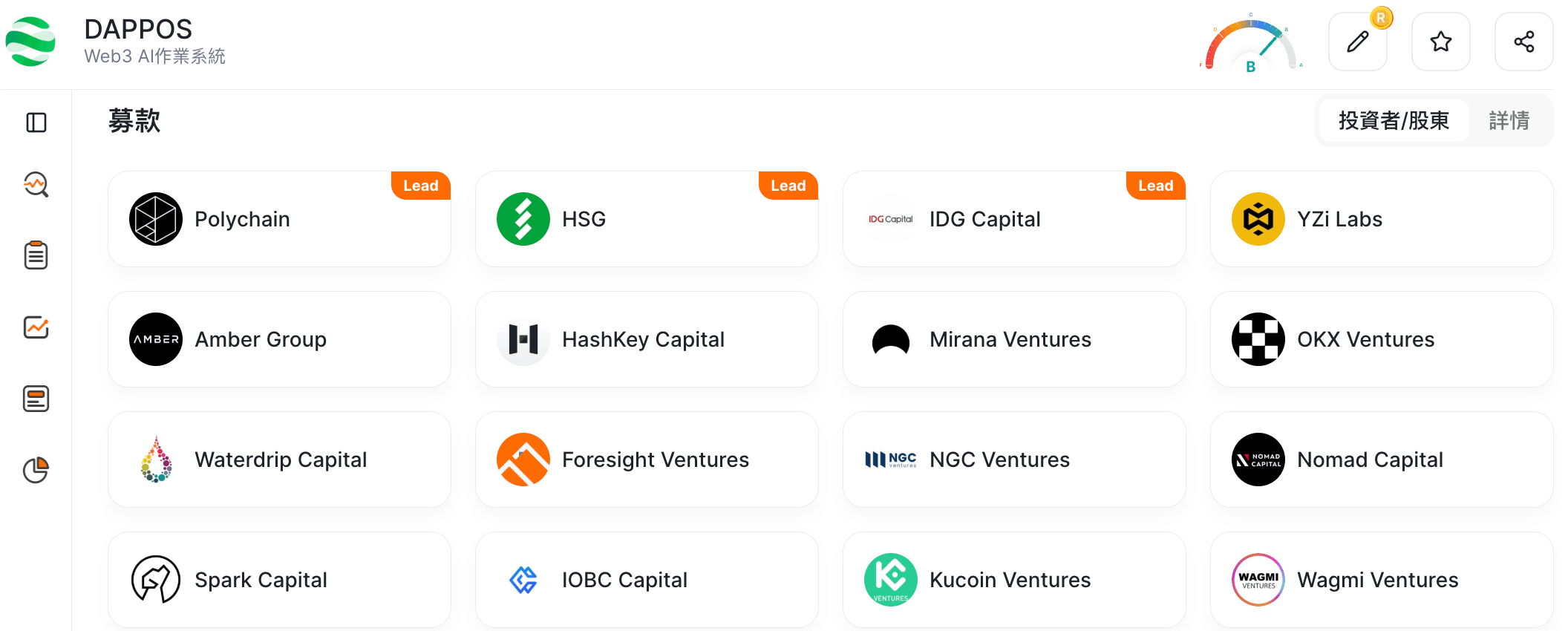
• Top institutions betting across the board: in the seed and A rounds, it received heavy support from T1 institutions such as Polychain, Sequoia China, IDG Capital, OKX Ventures, HashKey, Amber Group, and more. After three rounds of financing, the valuation directly surged to $300 million (see Figure 3).
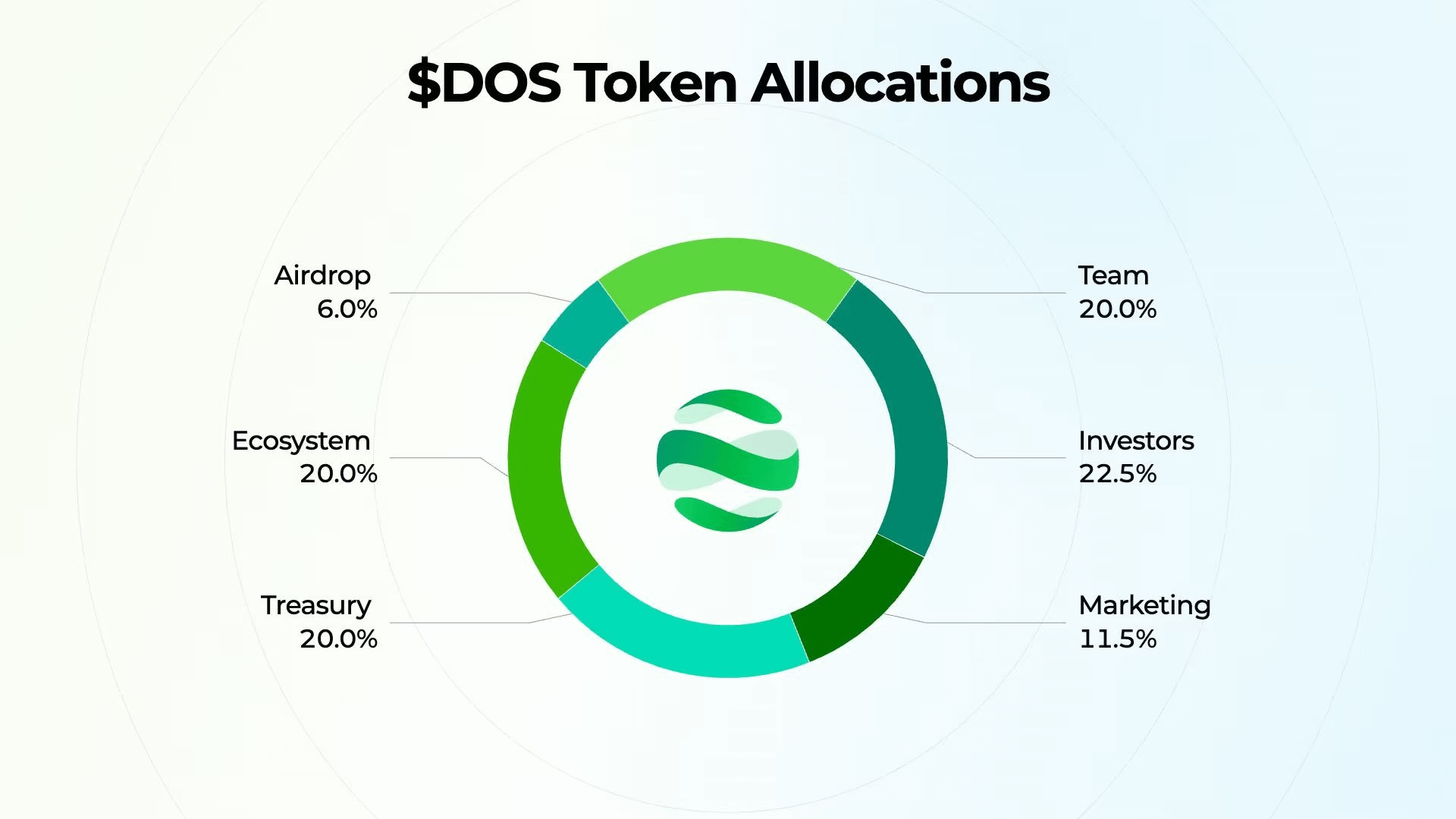
• High token-control, very hard vesting: total token supply is 1 billion, with only 20% initially circulating. The top allocation is for the team and investors (42.5%): all of it is set with a 12-month cliff—no tokens released for an entire year—then linear unlocks over the next 48 months. That means the main players’ tokens won’t be fully released until 60 months, with very low sell pressure early on and highly concentrated holdings (see Figure 4).
In summary, after seeing too many projects on RootData that take funding, launch their token, and then just die, my criteria for judging high-quality projects is very simple: to make it to the end, the underlying core must have “real revenue.”
DAPPOS has generated $6.8 million in real cash flow in just a few months after launch, which shows it’s not surviving on telling grand narratives and “air.” It has strong blood-making capabilities on its own. In this era, there aren’t many projects that can support themselves through technical deployment, while continuously enabling the ecosystem.
Tracking them from the Pre-Seed stage until now, I’ve seen how they turned enabling xBubble and DOS into a complete closed-loop system—so it really makes me look forward to it. This TGE is a big test for the next phase; we hope the team can deliver an astonishing result.
After all, there really aren’t many projects left in the market that actually have something interesting and real performance. DYOR 🙏