


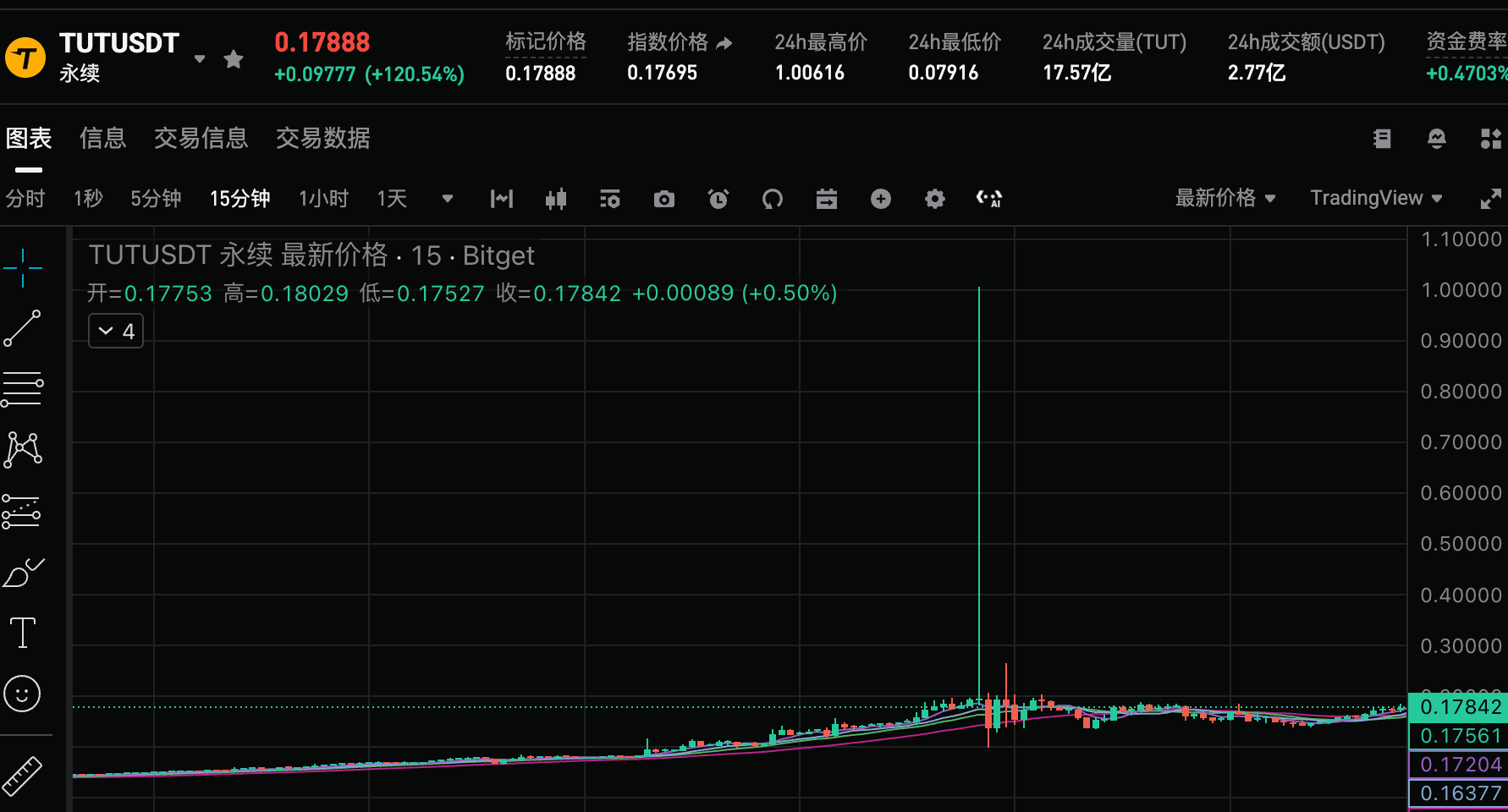
Weekend #TUT driven by one person, blowing up the crypto contract market! Spot trading volume over 24 hours reached $570 million, while contract trading was even higher at $2.5 billion—on Sunday alone, it also liquidated a massive $36 million within just 1 hour.
What exactly is driving these forces? And how should retail investors protect themselves from the arbitrage traps?
1. On-chain data exposes the truth: the main players’ high level of control and the transfer of chips
According to on-chain monitoring, TUT has almost no retail interaction on-chain; it is entirely controlled firsthand by market makers and controlling funds:
Massive chip migration: within a short time, 160 million TUT (20% of total supply) was concentrated and transferred across exchanges from Binance to Bitget.
Trading/control characteristics: low circulating supply, high degree of control, extremely high contract leverage. The main players adjust liquidity across exchanges and, together with the contracts, create the typical liquidation scenario of “pumping high—baiting longs/shorts—then inserting needles to liquidate.”
2. Analysis of the causes of the price difference between Binance and Bitget
During periods of extremely violent volatility on TUT, the three exchanges frequently generate price spreads of several percentage points or even more:
Binance — Price benchmark and liquidity core
As the world’s largest liquidity pool, it offers the deepest order book on both buy and sell sides and typically acts as a pricing center. Even if a large order dumps or pumps the market, the price remains relatively stable and is less likely to be driven through the depth.
Bitget — High contract turnover and a main-players liquidity pool
Contract trading volume is extremely high. As the main players concentrate 20% of the chips into the pool, within a short period they break the supply-demand balance on the BG order book, making short-term premiums or discounts between spot and contracts very easy to trigger. The contract price is pushed directly to 1.00616, causing a large number of BG users to be liquidated.
3. The four fatal traps of cross-exchange “arbitrage trading”
If you see a premium appearing on Gate or BG and want to withdraw from Binance to “arbitrage” ? Be extremely careful: getting trapped.
Deposit/withdrawal “closing of the gate” (a withdrawal wall): once a large price spread appears, exchanges or project teams often suspend deposits/withdrawals using reasons like “network congestion” or “wallet maintenance.”
Delay and price convergence: on-chain transfers take time. During the few minutes of transmission, the buy orders on the high-price exchange have already been consumed by high-frequency trading bots, resulting in “no successful arbitrage—yet you end up buying at the high.”
Thin depth and slippage: although a small exchange’s highest buy price may look tempting, the buy order volume is very small. Large sell-offs will cause severe slippage and wipe out all arbitrage space.
Total trading fees: after deducting trading fees, on-chain withdrawal fees, and potential losses from converting currencies, retail traders find it hard to outperform high-frequency API bots.