#bip110forksignalingexpectedthisweekend
What for days appeared to be a possible Bitcoin split has already happened.
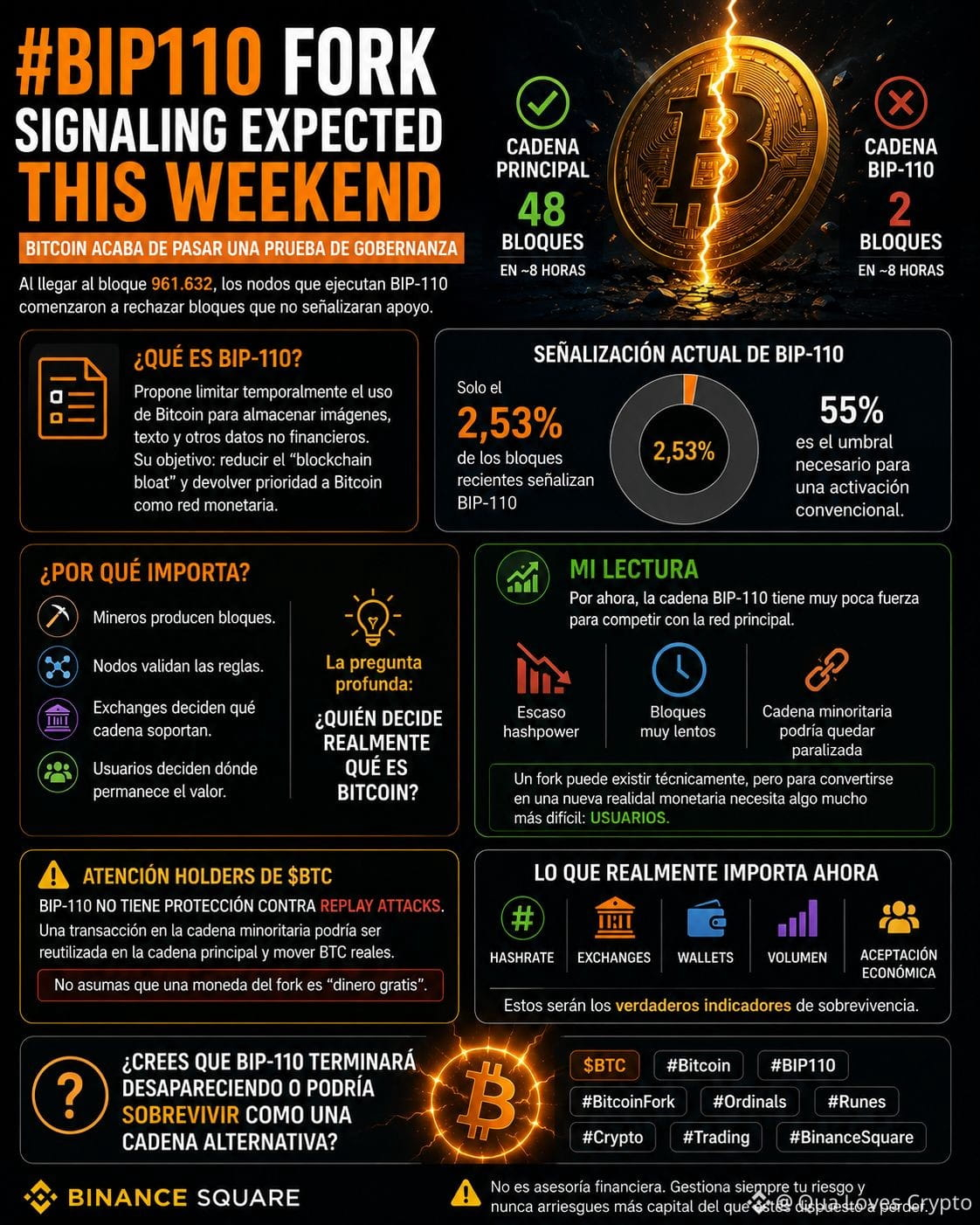
Upon reaching block 961,632, the nodes running BIP-110 began rejecting blocks that did not signal support. So far, the result is quite clear-cut: the minority chain produced just two blocks in about eight hours, while the main chain advanced 48.
And why does that matter?
BIP-110 aims to temporarily limit the use of Bitcoin for storing images, text, and other non-financial data, seeking to reduce so-called blockchain bloat and restore priority to Bitcoin as a monetary network. Its critics argue that block space should be allocated through the fee market, without censoring what type of transaction pays for the right to use it.
But there’s one piece of information that stands out: only about 2.53% of recent blocks signaled BIP-110, compared to the 55% needed for a conventional activation.
And that’s where the real experiment is. This isn’t only about Ordinals versus Bitcoiners. It’s a much deeper question: who actually decides what is Bitcoin?
Miners produce blocks. Nodes enforce the rules. Exchanges decide which chain to support. And users decide where the value stays.
For now, the BIP-110 chain seems to have very little strength to compete with the main network. Its limited hashpower means blocks arrive extremely slowly, and the minority chain could end up virtually paralyzed.
But there’s something even more important for $BTC holders: the lack of protection against replay attacks. A transaction made on the minority chain could, under certain conditions, be reused on the main chain and move real BTC. That’s why I wouldn’t treat a potential fork coin as a “free airdrop” to sell immediately.
The real indicator now isn’t the hashtag.
It’s observing hashrate + exchanges + wallets + volume + economic acceptance.