In fact, investors from the East have a natural advantage when trading U.S. stocks.
I’ve studied a lot of U.S.-stock strategies from quantitative firms in Singapore and Hong Kong, distilled their complex monitoring logic into a set of formulas that ordinary people can also understand.
It’s especially suitable for judging the direction of the U.S. stock market opening on Monday.
✅ A Six-Step U.S. Stock Opening Formula: Weekend news + U.S. stock index futures + Asian follow-through + macro signals + European confirmation = the direction of the U.S. market open
✅ How to look at it specifically?
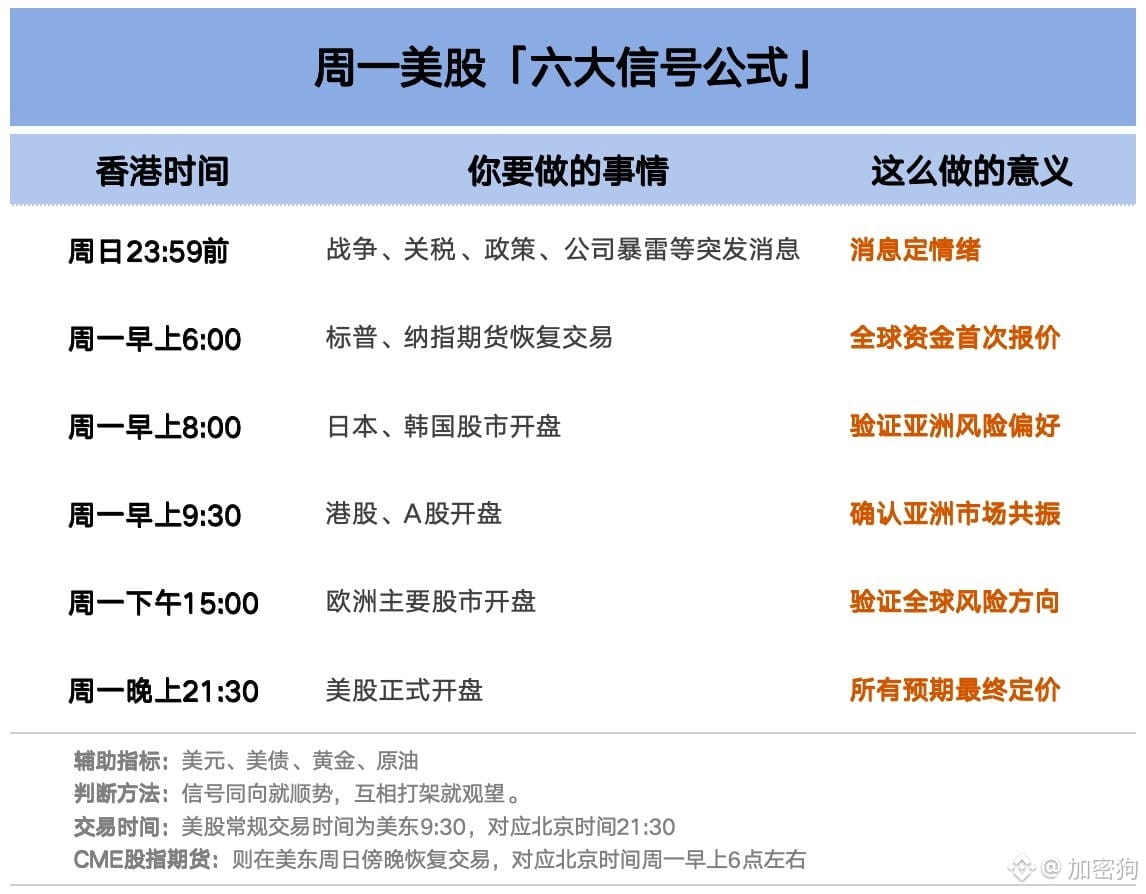
1. By before 23:59 on Sunday: Check whether there are any sudden weekend developments such as war, tariffs, policy changes, or company blowups;
2. Monday at 6:00 AM: S&P 500 and Nasdaq 100 futures resume trading—this is the first quote from global capital;
3. Monday at 8:00 AM: Japan and South Korea’s stock markets open to see whether Asian capital recognizes this direction;
4. Monday at 9:30 AM: Hong Kong and the A-shares market open to further confirm whether the Asian markets are forming a consensus;
5. Monday at 3:00 PM: Major European stock markets open, and at the same time watch whether the U.S. Dollar Index, U.S. Treasury yields, gold, and crude oil show any unusual moves;
6. Monday evening at 21:30: The U.S. stock market officially opens—everything is finalized after the earlier expectations are accepted and priced.
If there are important U.S. economic data on that day, you should also pay special attention to fluctuations around 20:30.
🔸 The first five waves of signals generally move in the same direction, and the opening direction is usually fairly clear;
🔸 If the first five waves of signals are fighting each other, don’t rush to place a bet.
See?
Before the U.S. market opens at 21:30, Eastern investors have already seen the five rounds of votes from global capital in advance.
But we should be clear: this formula can’t guarantee profits, yet whether you trade contracts or spot, it can help us avoid a lot of losses at the open.
I’ve studied a lot of U.S.-stock strategies from quantitative firms in Singapore and Hong Kong, distilled their complex monitoring logic into a set of formulas that ordinary people can also understand.
It’s especially suitable for judging the direction of the U.S. stock market opening on Monday.
✅ A Six-Step U.S. Stock Opening Formula: Weekend news + U.S. stock index futures + Asian follow-through + macro signals + European confirmation = the direction of the U.S. market open
✅ How to look at it specifically?
1. By before 23:59 on Sunday: Check whether there are any sudden weekend developments such as war, tariffs, policy changes, or company blowups;
2. Monday at 6:00 AM: S&P 500 and Nasdaq 100 futures resume trading—this is the first quote from global capital;
3. Monday at 8:00 AM: Japan and South Korea’s stock markets open to see whether Asian capital recognizes this direction;
4. Monday at 9:30 AM: Hong Kong and the A-shares market open to further confirm whether the Asian markets are forming a consensus;
5. Monday at 3:00 PM: Major European stock markets open, and at the same time watch whether the U.S. Dollar Index, U.S. Treasury yields, gold, and crude oil show any unusual moves;
6. Monday evening at 21:30: The U.S. stock market officially opens—everything is finalized after the earlier expectations are accepted and priced.
If there are important U.S. economic data on that day, you should also pay special attention to fluctuations around 20:30.
🔸 The first five waves of signals generally move in the same direction, and the opening direction is usually fairly clear;
🔸 If the first five waves of signals are fighting each other, don’t rush to place a bet.
See?
Before the U.S. market opens at 21:30, Eastern investors have already seen the five rounds of votes from global capital in advance.
But we should be clear: this formula can’t guarantee profits, yet whether you trade contracts or spot, it can help us avoid a lot of losses at the open.