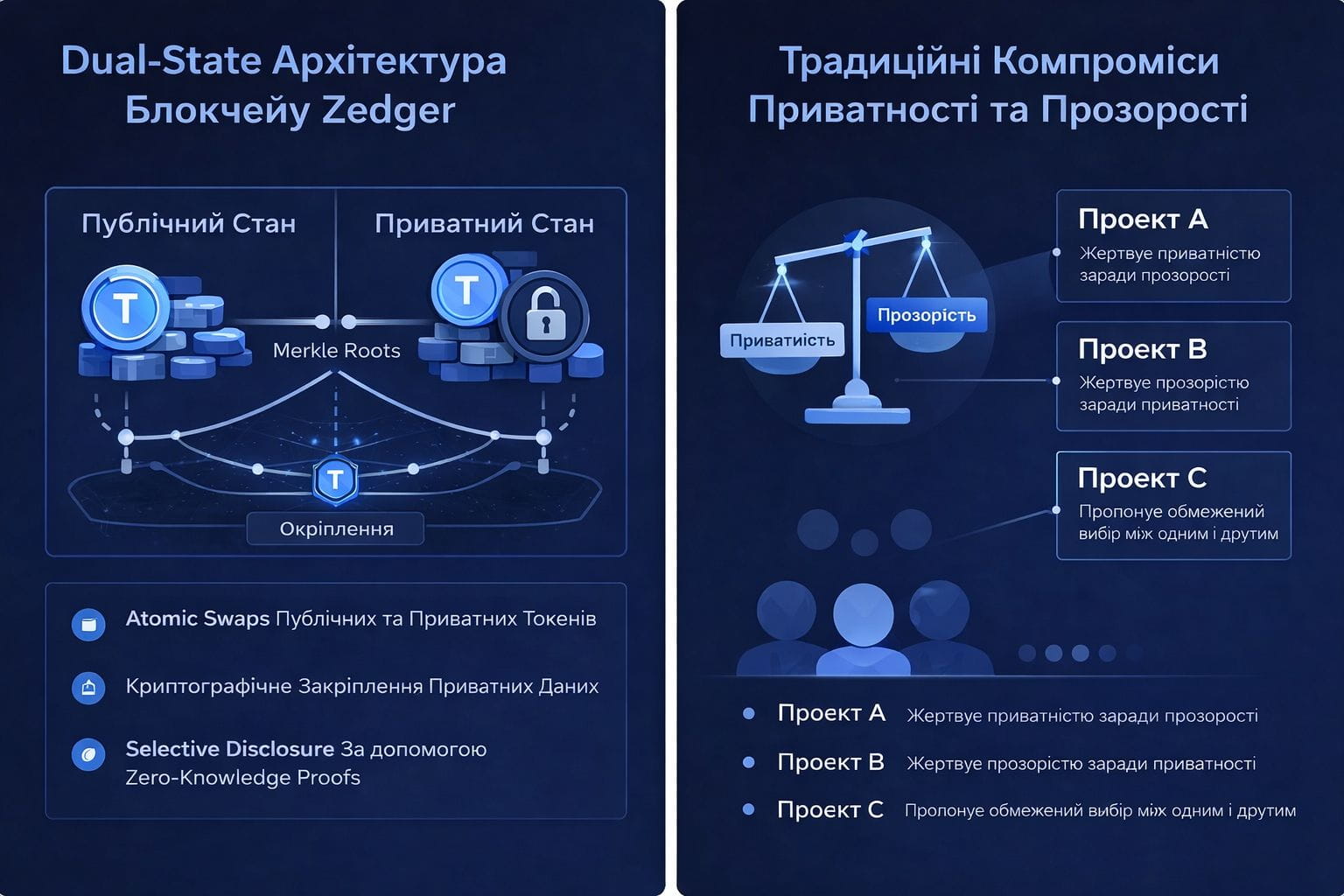
Recently, I have been thinking a lot about the fundamental dilemma of blockchains: how to combine the need for privacy with the need for transparency, and most projects solve this through compromises, where you sacrifice one for the other. @Dusk With the Zedger technology, we found a way to have both states simultaneously without compromises, and this technical achievement deserves more attention than it receives. Zedger is a dual-state system, where a public state exists in parallel, accessible to all network participants, and a private state, accessible only to owners and authorized parties, and both states are cryptographically linked through merkle roots. Technically, it works through state separators: each transaction can update either the public state, or the private state, or both simultaneously, depending on the type of operation and user settings. $DUSK uses a clever anchoring mechanism, where the private state is periodically "anchored" in the public one through cryptographic commitments, allowing validators to verify the integrity of private data without accessing it. What is particularly interesting is the possibility of atomic swaps between the public and private states: you can instantly convert public tokens to private and vice versa, and this happens on-chain without trusted third parties or wrapping mechanisms. #Dusk implemented this through bidirectional bridges within the same blockchain, which is technically more complex than bridges between different chains, but much safer and more efficient. Zedger also solves the problem of selective disclosure: the owner of private assets can generate zero-knowledge proofs that prove certain facts about their holdings (for example, that the balance exceeds a certain amount) without disclosing the exact value, and these proofs can be used for compliance checks or credit scoring. The technical implementation includes optimistic state updates for the private state, allowing transactions to finalize faster, as there is no need to wait for confirmation from all validators for operations that do not affect the public state. Cross-state smart contracts are another innovation: a contract can read data from the public state and modify the private one, or vice versa, which opens up possibilities for complex financial instruments that combine transparency and confidentiality. My technical research on Zedger has shown that this is one of the most complex and elegant state management systems in the blockchain industry, and I am genuinely impressed by how the Dusk team managed to solve problems that seemed theoretically unsolvable. I am convinced that the dual-state architecture will become the standard for enterprise blockchains of the future, as it provides the flexibility that real business demands: the ability to be private when needed, public when useful, and smoothly transition between these modes depending on context and regulatory requirements.