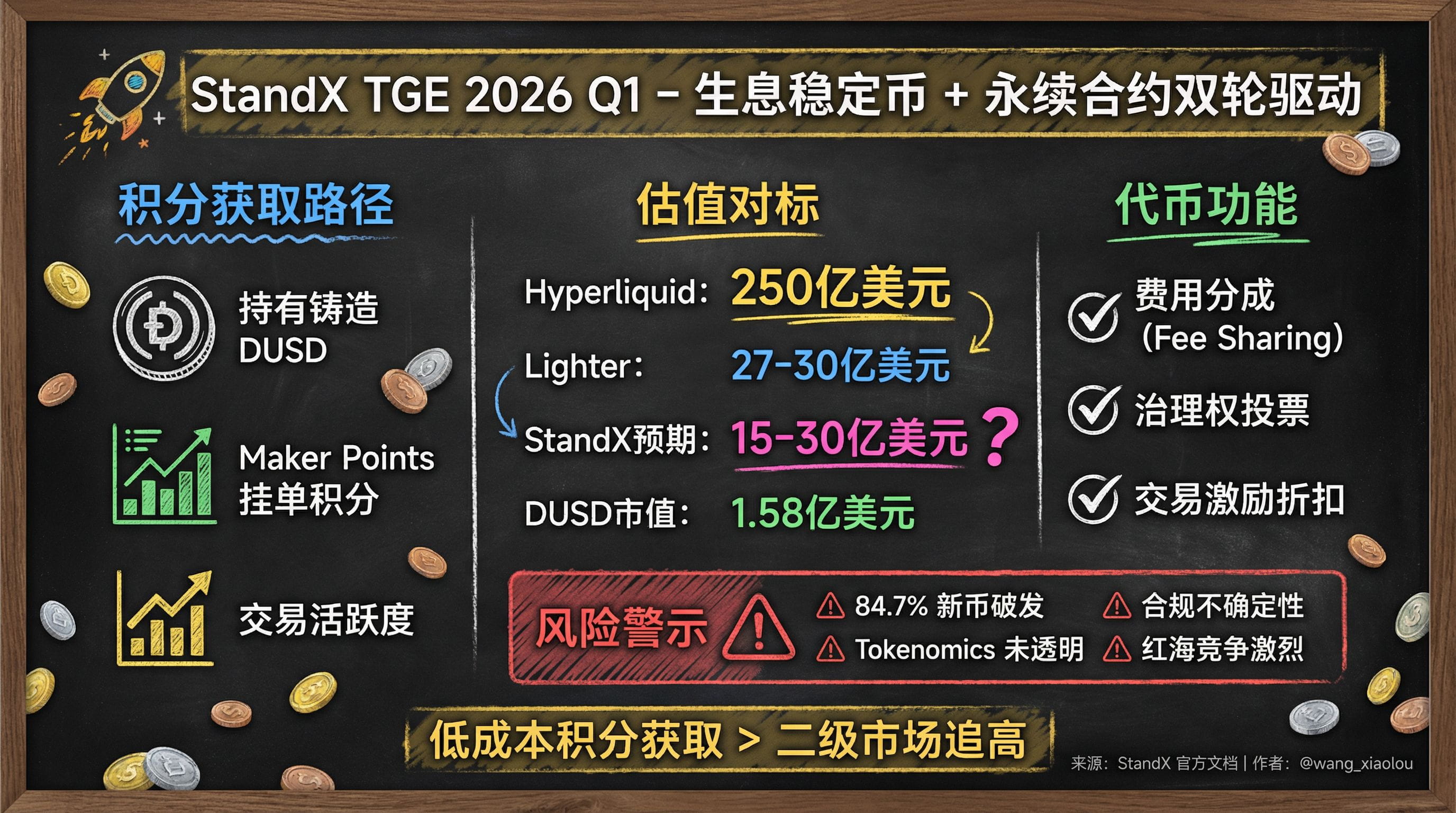
With the explosive growth of decentralized derivatives exchanges (Perp DEX) in 2025, the market focus is gradually shifting from industry leader Hyperliquid to challengers with unique mechanisms. StandX has built a unique moat in capital efficiency with the design of its native yield-bearing stablecoin DUSD. As the timeline hinted at in the official documentation approaches, the TGE (Token Generation Event) of StandX's native governance token has become one of the most anticipated market hotspots in the first quarter of 2026.
The following is a forward-looking analysis of StandX TGE, covering the timeline, valuation logic, token economics expectations, and potential risks.
TGE timeline and roadmap
According to the official StandX documentation (docs.standx.com) and the community-disclosed roadmap, the StandX TGE is expected to take place in the first quarter (Q1) of 2026. This timing is not coincidental, but is intended to align with the maturity of its mainnet ecosystem and the expansion of the DUSD market scale.
The current phase is viewed as a sprint phase of 'point accumulation'. The project team typically conducts snapshots (Snapshot) 1-2 months before the TGE, meaning that from now until early 2026 is a golden window for users to accumulate weight through on-chain interactions.
Point system and airdrop distribution logic
StandX's airdrop expectations mainly revolve around its point system, which is designed to reward users who make substantial contributions to the protocol's liquidity and trading depth. Unlike purely boosting trading volume, StandX introduces a more complex Maker Points (order points) mechanism.
The core points acquisition path includes:
Holding and minting DUSD: as the core collateral of the protocol, holders of DUSD are the backbone of the ecosystem. Minting DUSD from USDT/USDC and holding it long-term usually enjoys the highest point weight.
Maker Points (liquidity provision): this is the key differentiation of StandX from its competitors. The protocol rewards not only transaction volume but also unfilled limit orders to encourage users to provide market depth. The closer the order price is to the market midpoint and the longer the order duration, the more points are earned.
Trading activity: traditional Taker trading volume is still part of the point calculation, but its weight may be lower than Maker behavior.
Potential valuation framework: benchmarking against Hyperliquid and Lighter
To reasonably estimate the FDV (Fully Diluted Valuation) of the StandX token, we need to introduce comparable benchmarks in the market for reference.
Benchmark data: currently, StandX's native stablecoin DUSD has a market capitalization of approximately $158 million. This represents the base of the protocol's TVL (Total Value Locked).
Industry leader: Hyperliquid established dominance in 2025, with its FDV stabilizing around $25 billion, possessing billions of dollars in TVL and daily trading volume.
Direct competitors: Lighter, as a high-performance Perp DEX on Ethereum Layer 2, had an FDV of approximately $2.7 billion to $3 billion after its TGE.
Valuation projection:
Considering that StandX's DUSD market capitalization is still in a growth phase, directly benchmarking against Hyperliquid is unrealistic. A more reasonable valuation range should refer to mid-tier projects like Lighter or Aster.
If StandX can double the market capitalization of DUSD to over $300 million before the TGE and maintain active trading volume, its token FDV is expected to be between $1.5 billion and $3 billion. If the market assigns a higher premium to the narrative of 'interest-generating stablecoins', the valuation ceiling may further open up.
Token function expectations: from governance to revenue
In the regulatory and market environment of 2026, a simple 'governance token' will be difficult to satisfy investors' appetites. The market generally expects StandX tokens to include the following utilities:
Fee Sharing: referencing the transformation trends of Uniswap and Aave, StandX is very likely to distribute some trading fees or the underlying interest income from DUSD to token stakers.
Governance rights: voting rights on protocol parameters (such as DUSD collateral ratio, new trading pair launches).
Trading incentives: staking tokens can earn discounts on trading fees or higher Maker rebates.
Risk warning: the shadow behind opportunities
Before participating in the StandX ecosystem, investors must clearly recognize the current risk factors:
High rate of new coin failures: statistics show that among tokens issued in 2025, 84.7% fell below the issue price or the opening price on the first day after the TGE. The myth of 'guaranteed profits' in the primary market has long been shattered, and blindly buying carries significant risks.
Tokenomics remains opaque: as of now, the token distribution ratios for the team, investors, and community have not been fully disclosed. If insiders hold a disproportionately high amount, there will be immense selling pressure.
Regulatory uncertainty: DUSD, as an algorithmic or partially collateralized interest-generating stablecoin, faces greater compliance pressures under the regulatory frameworks of the U.S. and EU (MiCA regulations) compared to pure DEX.
Intense red ocean competition: the Perp DEX track has entered a stock game, with Hyperliquid occupying most of the liquidity. If StandX cannot continuously attract funds through DUSD, it may face liquidity exhaustion.
User action checklist
For aggressive users looking to gain airdrops or early dividends, the following strategies are available for reference:
Deep involvement in the Maker strategy: during non-volatile periods, placing orders near the market to accumulate Maker Points is currently the most cost-effective way to acquire points.
DUSD cycle: leveraging the interest-generating properties of DUSD, while controlling leverage risks, using it as margin for hedging trades.
Follow official Discord and Twitter: keep an eye on snapshot announcements, as many projects will release surprise tasks weeks before the TGE.
Conclusion
StandX's TGE in Q1 2026 is a DeFi event worth watching, as its 'interest-generating stablecoin + perpetual contract' dual-driven model has strong narrative appeal. However, given the historical data showing poor performance of new coins in 2025, investors should focus on low-cost point acquisition (such as order mining) rather than blindly chasing high prices in the secondary market. Reasonable expectation management and strict risk control are key to participating in this TGE.