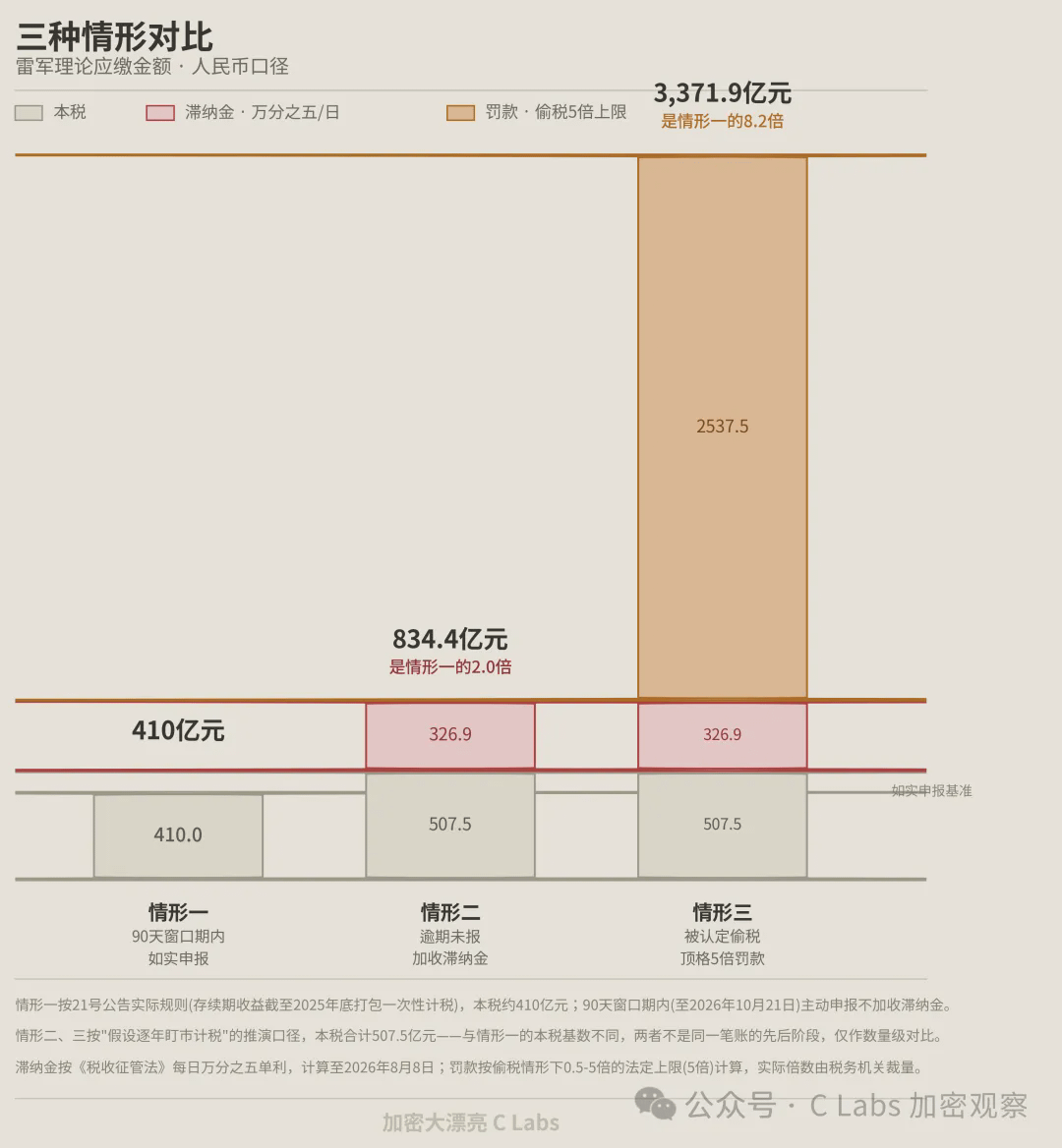

On July 24, 2026, the Ministry of Finance and the State Taxation Administration issued an announcement (Regarding Matters Related to Individual Income Tax for Offshore Trusts), requiring the trust settlor and others to declare and pay the back taxes within 90 days from the date of publication—that is, no later than October 22, 2026.
The tax is divided into two parts: tax for the trust establishment stage. In principle, it will be reclaimed for three years, meaning offshore trusts established from 2023 to 2025 should补缴 20% of the tax. The current impact is still relatively limited.
The more significant impact is on taxes during the trust’s existence period. There is no time limit, and it does not distinguish by year. Instead, all trust income up to the end of 2025 will be bundled and calculated, and an additional 20% tax will be paid.
The offshore trust structure built by Xiaomi Group’s founder, Lei Jun, is fairly typical. Below, we’ll use Lei Jun’s example to see how much tax needs to be made up.
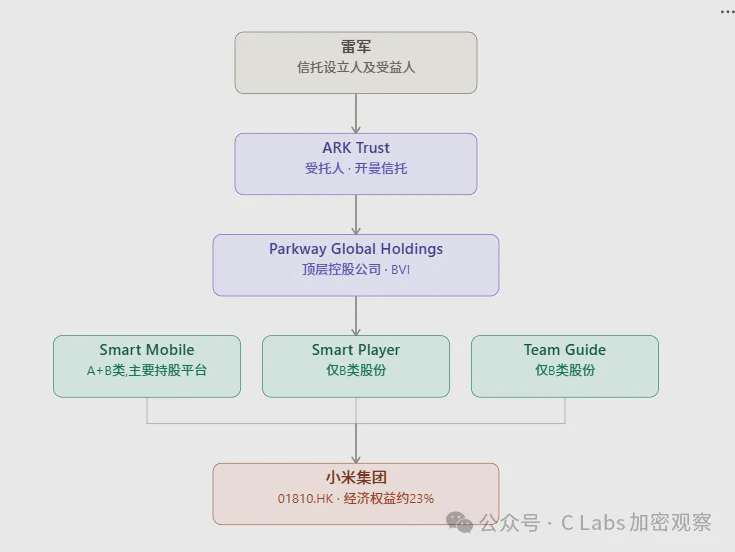
In 2018, Lei Jun set up a family trust. He instructed the trustee, the Ark Trust (AKR Trust) Hong Kong company, to hold and manage the trust assets. Under the family trust, there is a three-tier holding-company structure. At the bottom level, two holding companies in the Cayman Islands—Smart Mobile Holdings Limited and Smart Player Holdings Limited—directly hold shares in the Xiaomi Group established in the Cayman Islands.
As an overseas listed entity, Xiaomi Group controls multiple Xiaomi domestic companies through a VIE structure. Lei Jun holds 31.41% of Xiaomi Group’s shares through the family trust. After the listing, Lei Jun’s controlling interests were gradually diluted, but through mechanisms such as the AB-share system, he could still achieve effective control over Xiaomi Group.
This trust was established in 2018, so tax on the trust establishment stage can be exempted. However, regardless of when the trust is established, the founders still need to pay tax at 20% on the profits generated by their family trust by the end of 2025.
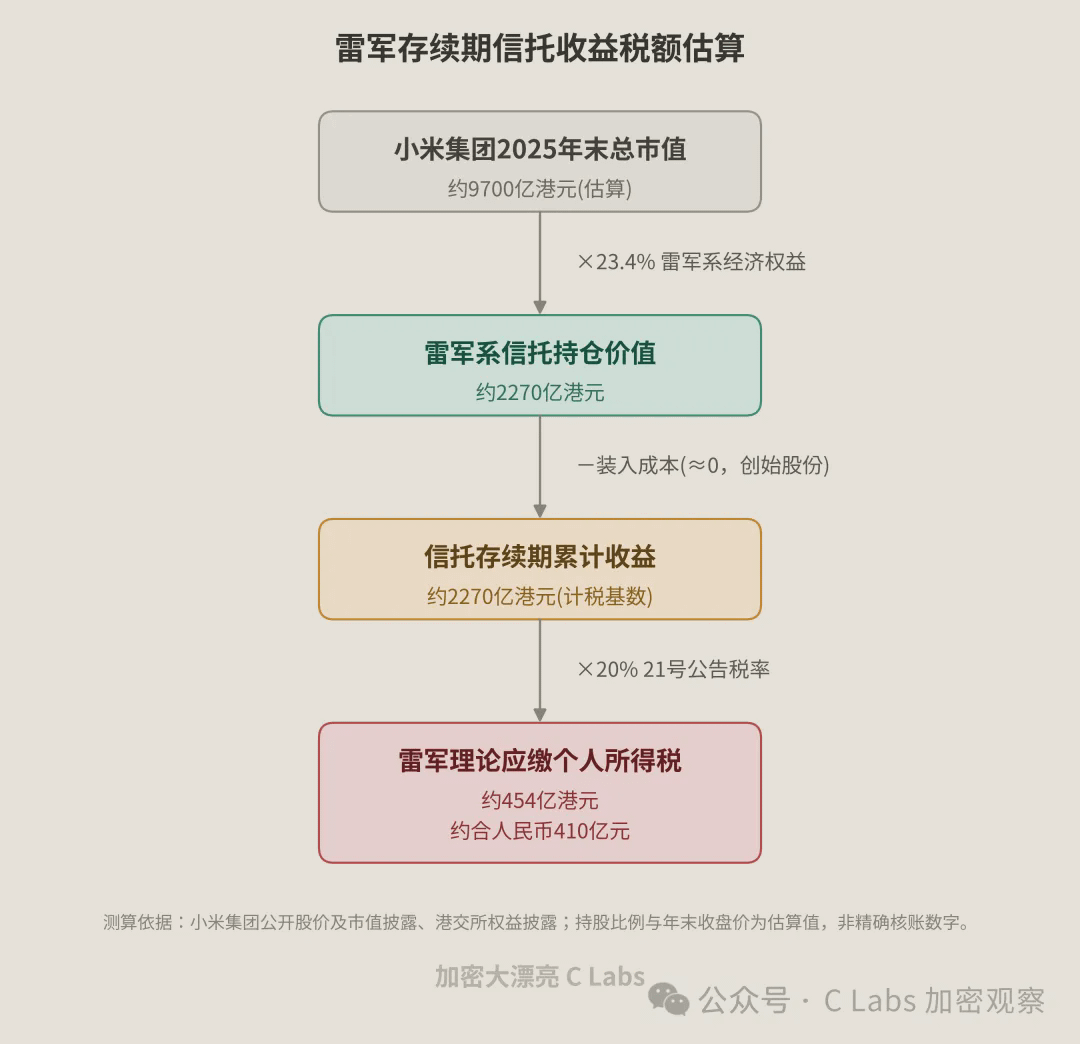
Based on Xiaomi’s market value of RMB 970 billion in Hong Kong dollars at the end of 2025, Lei Jun would need to make up the tax in a one-time payment of RMB 41 billion.
Although Lei Jun’s net worth is in the hundreds of billions of yuan, most of it comes from the market value of these listed companies. Paying RMB 41 billion in back taxes in one go is still very difficult.
Can they pay a little later?
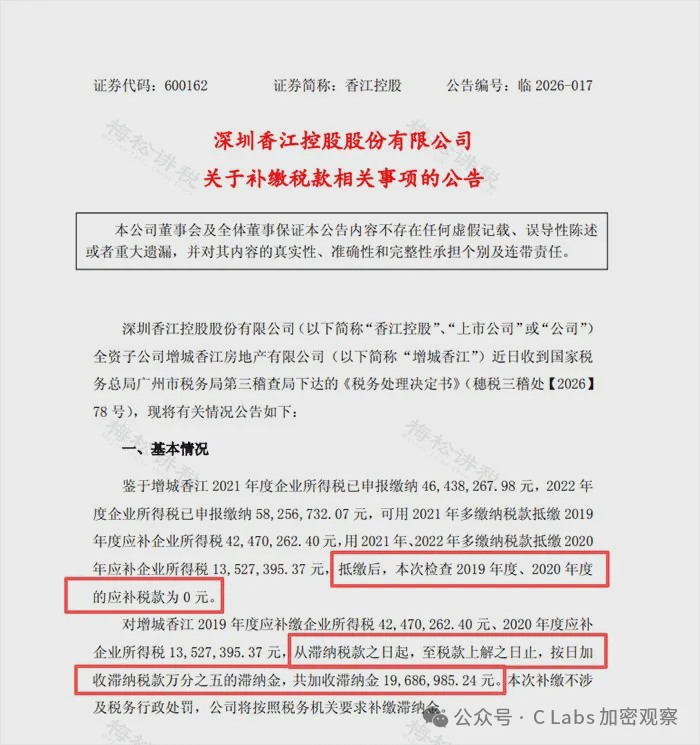
Under current policies, proactive reporting within the 90-day window can exempt late-payment surcharges. If reporting is made after the 90 days, it may mean facing a late-payment surcharge of 0.05% per day.
For example, Xiangjiang Holdings, a listed company, was traced back to 2019. Although there was no unpaid tax, several tax payments were made late, so the tax authorities required it to pay late-payment surcharges at a rate of 0.05% per day.
If Lei Jun did not truthfully report within the 90-day period, and as a result the trust was also pursued for back taxes by the tax authorities year by year, and late-payment surcharges were charged at 0.05% per day—how much would he have to pay?
First, from the tax authority’s perspective, the rules for taxing overseas trusts are: if the trust makes a profit in the year, it is taxed at 20%, and losses do not offset the tax.
Xiaomi’s share price increased in four fiscal years—2020/2023/2024/2025—so taxes need to be paid only for these four years. The total tax amounts to RMB 50.75 billion. Suddenly, it’s about RMB 10 billion more than before…
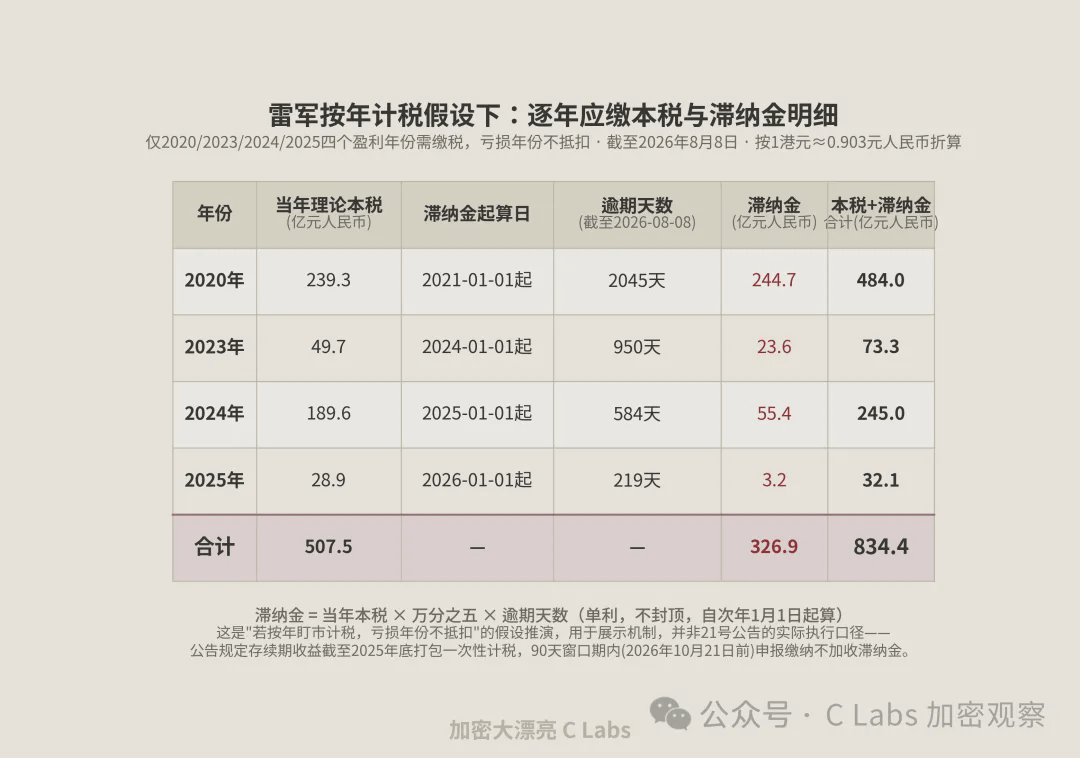
If they have to pay the late-payment surcharge at 0.05% per day again, then the amount to be paid would be as high as RMB 83.44 billion!
That’s double the RMB 41 billion window period within the previous 90 days!
Here, I still suggest that Boss Lei recognize the situation, give up fantasies, and focus on reporting—be forthcoming and seek leniency.

From the tax authority’s point of view, after the 90-day window, they will definitely take action against certain individuals who did not report honestly, to send a warning and set an example.
Because according to Article 63 of the Tax Administration and Collection Law, if the tax authorities determine that someone has "tax evasion," in addition to collecting the unpaid taxes and late-payment surcharges, the tax authority shall impose a fine of not less than 50% and not more than five times the amount of tax that was not paid or was underpaid.
Then they may really not be able to pay…